Trump's 'complete ceasefire' demand exposes the gap between rhetoric and the war on the ground
A 90-second presidential statement is now being treated by markets and capitals as a framework. The actual fighting tells a more honest story.
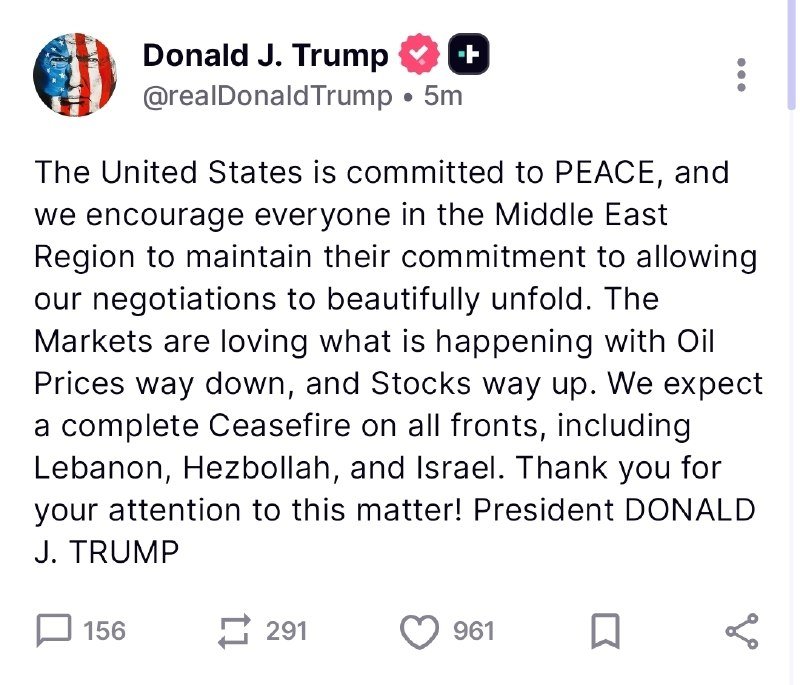
At 18:09 UTC on 18 June 2026, President Donald Trump told reporters that Washington "expects a complete ceasefire on all fronts, including Lebanon, Hezbollah, and Israel" — a formulation carried almost verbatim by multiple wire channels within minutes. The Israeli reporter Amit Segal posted a near-identical line to the same effect at 18:05 UTC, suggesting the remarks originated from a single White House read-out. By 18:09 UTC, The Cradle had transmitted the quote in two discrete posts, and BRICS News had packaged it as a "JUST IN" alert.
The market reaction was immediate. Oil ticked lower on the assumption that a wider Middle East de-escalation was at last being underwritten by Washington, and at least one Telegram channel — the Russian-aligned Intelslava feed, posting at 18:08 UTC — interpreted the same remarks as evidence that "the current so-called MoU is just for market manipulation," citing Trump's own line that "markets are loving what is happening with oil prices." Two readings of the same sentence, ninety seconds apart, on opposite sides of a geopolitical fault line.
The shape of the demand
The line is striking in what it conflates. A "complete ceasefire" across three distinct fronts — the Lebanese-Israeli border, the Hezbollah-Israel confrontation, and the Israel-wide theatre — is not a tactical pause. It is a strategic claim: that the United States is in a position to compel restraint from actors that have spent the last year and a half in sustained combat, including Israeli ground operations inside southern Lebanon and continued rocket and drone exchanges across the border. The same sentence, by naming Hezbollah as a co-equal party to the arrangement rather than an Iranian proxy to be ignored, implicitly recognises a political reality that Western diplomacy has spent decades trying to deny.
The Israeli reporter's framing is telling. Segal's version of the line — "Everyone in the region is expected to continue their commitment to the agreement. Including Lebanon Hezbollah and Israel" — drops the word "ceasefire" entirely and substitutes "commitment to the agreement." That is not a paraphrase. It is a different proposition: the assumption of a pre-existing framework that the White House is now broadening, rather than the announcement of a new one. The two-word gap between "ceasefire" and "agreement" is the gap between press-conference theatre and an actual diplomatic instrument.
What the markets heard
The Intelslava reading is the more cynical of the two, and it is not entirely wrong. Trump has a documented habit of using oil-linked statements to move benchmarks in directions that benefit domestic political positioning; the explicit linkage of "markets loving what is happening with oil prices" to a ceasefire demand is, on its face, an unusual thing for a head of state to say in the middle of a war. The Intelslava framing — that the MoU is a price-management tool rather than a peace framework — is a hypothesis, not a conclusion, but it is a hypothesis the White House did itself the courtesy of not refuting in real time.
The more charitable read is also available. The administration may be using market signals as leverage precisely because the kinetic track has run out of road: a ceasefire that the United States cannot enforce by military means can sometimes be enforced by the prospect of a $90 barrel. Neither reading is fully dispositive. The sources do not let us choose between them.
The counter-narrative from the ground
What the wires do not contain is any corroboration from the parties actually expected to comply. There is no Hezbollah statement, no Lebanese government response, no Israeli cabinet reaction, no Iranian foreign ministry comment in the source set. A "complete ceasefire" announced by a third party, on a Wednesday afternoon in Washington, with no on-the-record response from any of the named participants, is — at the moment of transmission — an aspiration dressed as a fact. The Cradle, which carried the quote twice in two minutes, is structurally sympathetic to the Hezbollah and Iranian reading of the war and would, on prior form, transmit the line precisely as the White House delivered it. The Israeli channel transmitted a softer, more committed-sounding version. Both versions are sourced to the same presidential remarks; neither is sourced to a ceasefire agreement that actually exists as a signed document.
This publication is not arguing the statement is hollow. A US president naming Hezbollah as a party to an arrangement is, on its own, a meaningful normalisation. The point is narrower: that the distance between a White House remark and a binding halt to hostilities is currently being compressed, by multiple outlets, in real time.
What remains uncertain
Three things are not in the source set and would be needed to assess the statement's weight. First, a confirmation from the Israeli government that it accepts the framing — Jerusalem has, in past episodes, publicly rejected US-brokered formulae it deemed to reward Hezbollah. Second, a Hezbollah or Lebanese state response indicating willingness to freeze rocket fire and southern Lebanon operations. Third, an Iranian signal that its regional posture is compatible with the new "all fronts" formulation; without Tehran's acquiescence, Beirut's options are constrained. None of those three signals is present in the wires as of 18:09 UTC on 18 June 2026.
The honest reading is that something may indeed be moving. It is also possible that the markets are being invited to price a ceasefire that exists only as a sentence at a podium. The next 72 hours will tell us which. For now, the gap between the rhetoric and the ground is wide enough to drive a column through.
Desk note: Monexus is treating the Trump remarks as a discrete event and quoting them at the level the wire channels transmitted them, while flagging that no on-the-record confirmation from the parties named in the demand has reached the source set as of publication.
Wire provenance
This editorial synthesis draws on the following public wire/social posts:
- https://t.me/TheCradleMedia
- https://t.me/thecradlemedia
- https://t.me/intelslava
- https://t.me/amitsegal
- https://t.me/bricsnews