Beirut's skyline, Aoun's statement, and the question the wires won't ask
Lebanon's president says Israeli drones over Beirut and strikes in the south and Bekaa are a 'dangerous and condemnable escalation.' The framing gap between Beirut and Jerusalem is now the story.
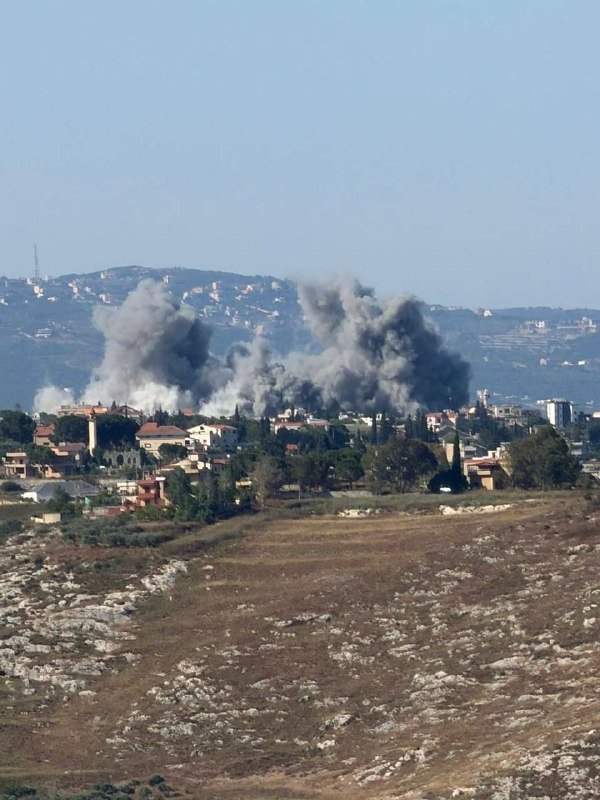
On the morning of 19 June 2026, the office of Lebanese President Joseph Aoun put out a statement that any editor in Beirut could have drafted by reflex. The country, the statement said, is "witnessing … a dangerous and condemnable escalation" — the expansion of Israeli attacks in the south and the Bekaa, conducted in violation of the ceasefire that ended the open war a year and a half ago. By 11:36 UTC, Al-Alam Arabic was carrying the line; by 11:38, the Telegram channel @wfwitness had begun a thread built around the same Aoun statement; by 11:43, the channel was reporting that Israeli drones were over Beirut and its southern suburbs; by 11:51, the same channel was running the headline that the Lebanese presidency had condemned Israeli ceasefire violations. Six hours of news, one message, repeated by the same handful of Beirut-based outlets that always carry it.
The question worth asking is not whether Aoun said it. He said it. The question is why the wires that the Western reader meets in the morning are not yet asking the harder one: what does it cost a country to live inside a ceasefire that is, in practice, a permission slip for low-altitude overflights and a steady cadence of strikes? The Lebanese position, as Aoun articulated it, is that the agreement has been hollowed out from one side. The Israeli position, when it appears in the same day's coverage, is that any given strike is a response to a specific threat, and that the architecture is intact. Both positions can be true at the level of a single incident. They cannot both be true as a description of the year.
A statement, an airspace, a pattern
The single new fact in the thread is procedural. Aoun's office released a written condemnation of ceasefire violations; the statement is being carried in Arabic first, by Al-Alam and the Telegram channel @wfwitness, with a clear geographic frame — the south and the Bekaa. The drone activity over Beirut is reported by @wfwitness as a separate, concurrent fact. The two items are not the same event. The statement is a diplomatic act, attributable and on the record. The drone flight is an operational one, reported by a single channel and not yet corroborated by Reuters, AFP, or the IDF spokesperson's daily briefing. A reader is entitled to hold those apart.
What connects them is timing. A Lebanese presidency will normally issue a public condemnation only when the volume of incidents has risen enough to require a written record. A statement that names both the south and the Bekaa — the two regions that bore the brunt of the 2023–2024 war — is doing more work than the words suggest. It is asserting, on the public record, that the geography of the fighting has not been compressed into a narrow border strip. It is asserting that Israeli fire is reaching the same population centres the war reached. Whether the incidents of 19 June rise to that level is not yet known from the source material available; the presidency says they do, and that is the news of the morning.
The other half of the briefing
The framing the Western reader usually meets is the inverse. The Israeli security establishment's daily account, when it appears, leads with the threat that was disrupted — a launch site, a weapons convoy, a Hezbollah reconstitution attempt — and treats the strike as a discrete, justified act. The Lebanese presidency's daily account leads with the civilians who were inside the geography the strike happened to hit. Both framings are accurate to a particular institutional interest. Neither is, on its own, the full story. The structural problem is that the Western wire ecosystem relays the first framing inside the day and the second framing a day late, after the Lebanese statement has already been picked up by regional outlets and reframed in Arabic. By the time the rebuttal reaches the Anglophone reader, the strike has already been narrated as a fait accompli.
This publication has no view on the specific incidents of 19 June 2026; the source material available at the time of writing does not include the IDF spokesperson's account, nor a UNIFIL statement, nor casualty figures from the Lebanese health ministry. What it can say is that the framing asymmetry is itself a fact, and that the gap between Beirut's morning statement and the version of the day the Anglophone reader encounters is wide enough to be the story.
What "violation" means on each side of the border
The word "violation" is doing a great deal of work. To the Lebanese presidency, a violation is any act inside Lebanese territory that is not explicitly authorised by the ceasefire framework — an overflight, a strike, a vehicle on a road the agreement reserved for the state. To the Israeli security establishment, a violation is an act that crosses the threshold the other way — a rocket, a drone launched from Lebanese territory, a weapons transfer that the state did not prevent. Each side's definition is internally coherent. Each side's definition is, in practice, the negation of the other's. The agreement survives because both sides keep using the word; it erodes because neither side ever concedes that the other side's definition is the one in force on a given morning.
A reader looking for honesty in the day's coverage should look for the paragraph that names that contradiction plainly. Most of the morning's English-language reporting will not contain it. The Arabic-language reporting will contain only the Lebanese half. The structural pattern — an agreement whose terms are publicly affirmed and operationally contested, day after day, in two languages — is the actual story. The statements are the visible surface of it.
What it would take to be wrong about this
The honest read of the morning is also a falsifiable one. If the IDF spokesperson, in the daily briefing that follows this statement, releases operational footage of a specific launch site or a specific weapons cache inside Lebanese territory struck on 19 June, then the Israeli framing of the day's events as a discrete, justified response becomes the more accurate account. If UNIFIL confirms a rocket or drone launch from Lebanese territory into Israel in the preceding 24 hours, the same conclusion follows. The Lebanese framing, on the other hand, holds if the day's reporting shows strikes and overflights without a corresponding triggering incident on the other side of the border, and if the cumulative pattern of the past months shows a steady cadence of low-level operations that the agreement was meant to prevent.
What the source material on the morning of 19 June 2026 does not yet contain is the operational footage, the UNIFIL confirmation, or the cumulative count. It contains a Lebanese statement and a single Telegram channel's report of drone activity over Beirut. It contains, in other words, one half of a two-sided morning. The other half will arrive in the next twelve hours. Until it does, the correct editorial move is to print the half that exists, name the half that does not, and resist the temptation to manufacture symmetry out of silence.
This article has been written against a narrow source base — a Lebanese presidential statement carried by Al-Alam Arabic and a Telegram channel — and does not include the Israeli, UN, or wire-service operational account of the day's events. Where those accounts are added later, the framing above is the one that should be revisited, not the underlying facts.
Wire provenance
This editorial synthesis draws on the following public wire/social posts:
- https://t.me/alalamarabic/0
- https://t.me/wfwitness/0