Beirut's southern suburbs are burning again, and the world is barely watching
A pre-dawn cascade of Israeli raids across Nabatieh and Jezzine districts has made 19 June 2026 another morning of bombardment for a country that has run out of ways to say it is exhausted.
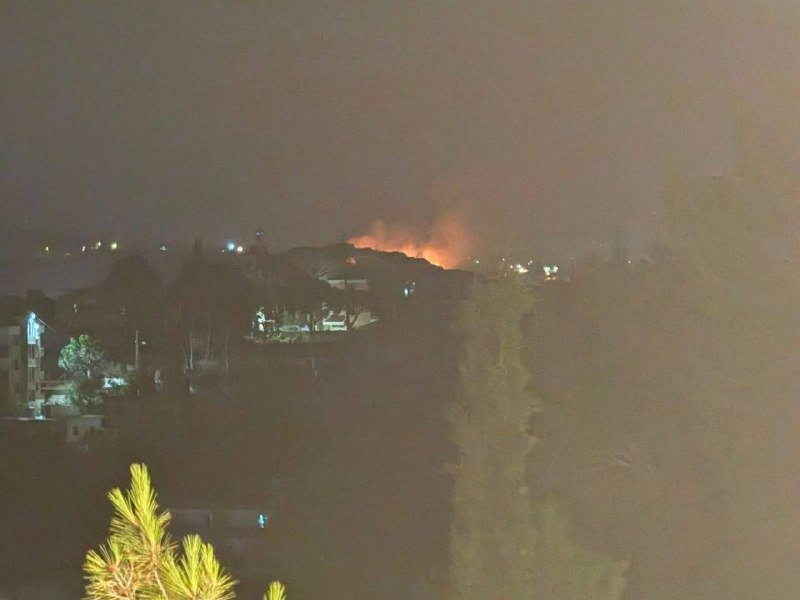
At 04:24 UTC on 19 June 2026, Israeli warplanes hit the city of Nabatieh and the neighbouring towns of Harouf and Al-Duwair in southern Lebanon, according to Al-Alam Arabic's breaking-news wire on Telegram. By 05:24 UTC a series of raids had struck the town of Habboush in Nabatieh district. By 05:28 UTC the strikes had spread to Toul in Nabatieh and to Jabour in Jezzine district. By 05:35 UTC Israeli jets were raiding the Abu Rashid Heights in the Jabour area. In the space of seventy-one minutes, four named localities — one city, three towns, one ridge — were added to a list that, on this evidence, never closes.
This is what the cross-border war between Israel and Hezbollah's residual southern network looks like at ground level on a June morning: not a single dramatic operation that commands the front page, but a cascade of strikes filed under the "Urgent" tag, dispatched by a state-aligned outlet with a four-figure Telegram subscriber base, and largely ignored by the global news cycle except as a scrolling banner. Lebanon is being bombed in increments, in a campaign that Israeli officials have framed publicly as targeted action against militia infrastructure and that Lebanese and regional outlets describe, with equal conviction, as collective punishment of a civilian population that has nowhere left to flee.
A morning compressed into a Telegram feed
The four dispatches that anchor this article all originate from Al-Alam Arabic, the Iranian-state-owned Arabic-language channel that has run a continuous southern-Lebanon breaking ticker for years. Each follows the same template — "Urgent" header, time-stamped through-line, named town — and each attributes the action to Israeli warplanes without quoting an Israeli military spokesperson. The pattern across the four items is geographic: Nabatieh district first, then Jezzine district to the west, then the elevated Jabour terrain that sits between them. The clustering is consistent with the Israeli air force's documented operating pattern of striking road junctions, ridge positions, and suspected launcher sites along the Litani corridor.
What the four items do not contain is just as telling. There is no casualty count from the Lebanese health ministry, no preliminary figure for displaced families, no IsraeI Defence Forces statement confirming the targeting rationale, and no comment from any Western embassy. The signal is the strikes; the noise — the part that would normally turn a strike into a story — is absent.
The framing contest nobody outside the region is having
Israeli security concerns along the northern frontier are legitimate and well-documented: communities in the Galilee have been within rocket range for decades, and any government in Jerusalem bears a real obligation to degrade that threat. That obligation is not in dispute here. What is in dispute is the operating assumption baked into a campaign that can hit Habboush, Toul, Nabatieh city, Al-Duwair, Harouf, and the Abu Rashid Heights in a single pre-dawn window while presenting each strike as discrete and proportionate.
The Lebanese government's repeated position — that civilian infrastructure, agricultural land, and residential blocks in the south are bearing the cost of a fight between Israel and an armed non-state actor — has the inconvenient feature of being empirically visible every time a southern town appears on a newswire. Regional outlets including Al Jazeera English and Middle East Eye have carried the Lebanese framing in their broader coverage of the file, but on a Thursday morning in mid-June those voices are competing for attention with the European football calendar, the U.S. presidential primary run-up, and the slow grind of the Ukraine war. They are losing.
What a campaign of increments looks like
There is a structural problem with how the international press prices risk in Lebanon. A single large strike — a Beirut suburb flattened, a port detonation, a hospital hit — produces a news cycle. A persistent low-level bombardment produces a chart that creeps. The southern towns hit before dawn on 19 June are not unfamiliar names: Nabatieh has been struck repeatedly since operations escalated in late 2023, Jezzine district saw Israeli ground manoeuvres earlier in the conflict, and the Jabour area has been a recurring target in Israeli after-action statements. The pattern is cumulative rather than dramatic, which is precisely why it does not break through.
This is, in plain terms, what a hegemonic asymmetry looks like when it is normalised. The side with the air force files operations; the side on the receiving end files body counts; the international press, starved of a single hook event, runs the strike as a ticker item and moves on. The structural dynamic is not new — it describes the long tail of every modern air campaign fought by a capable air force against a non-state adversary embedded in a civilian landscape — but naming it plainly is the only way to explain why a four-strike morning on the Litani produces, in editorial terms, a shrug.
Stakes, and what remains genuinely uncertain
If the trajectory visible in the 19 June dispatches continues — and there is no source in the thread suggesting a de-escalation posture from either side — the southern districts will absorb another cycle of displacement, another wave of damage to already-strained health infrastructure, and another incremental erosion of the Lebanese state's authority in its own borderlands. The Israeli calculus, in this framing, is that degrading launcher and command capability faster than Hezbollah can reconstitute it is worth the diplomatic cost. The Lebanese calculus, framed by Beirut and by outlets sympathetic to the Lebanese position, is that the cost is being paid by civilians whose names do not appear in any of the four Telegram dispatches that prompted this article.
What the available sourcing genuinely cannot resolve — and what should be flagged rather than smoothed over — is the precise targeting rationale behind each of the four strikes, the casualty outcome on the ground, and the identity of any Hezbollah infrastructure actually struck versus the residential and agricultural sites that may have absorbed the ordnance. Those answers will arrive, if they arrive at all, from wire correspondents on the ground in Tyre and Nabatieh over the coming 24 hours. For now, the morning's record is four Telegram messages, four named towns, and one ridge — and the weight of an unanswered question about why a campaign this sustained against a country this battered still registers as background noise.
— Monexus framed this as a structural story about media attention and the architecture of low-intensity air campaigns, rather than as a single event. Where wire reporting leads with the strike count, this piece reads the silence around the count.
Wire provenance
This editorial synthesis draws on the following public wire/social posts:
- https://t.me/alalamarabic
- https://t.me/alalamarabic
- https://t.me/alalamarabic
- https://t.me/alalamarabic