White phosphorus strike on Nabatieh and a roadside bomb in Ali al-Taher mark a new tempo on the Israel-Lebanon frontier
On 19 June 2026, a white phosphorus strike on Nabatieh and a roadside bomb in Ali al-Taher landed within hours of each other. Read separately, they are a story each. Read together, they are a tempo, and the tempo is what carries.
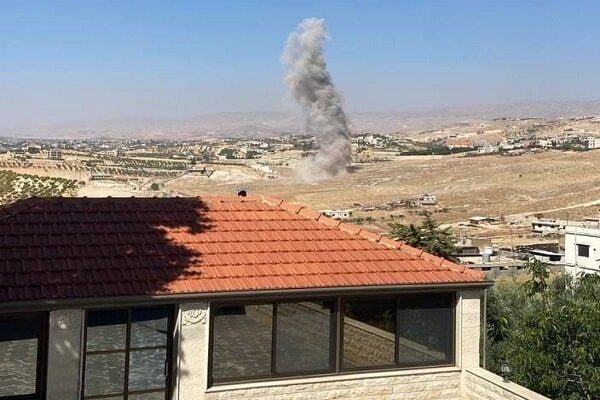
At 19:46 local time on 19 June 2026, residents in the southern Lebanese city of Nabatieh heard a series of sharp concussions. The projectiles carried white phosphorus, witnesses told reporters in the hours that followed, and they fell on residential blocks where displaced families had returned to retrieve belongings. Two days later the toll was still being counted, but the disc-shaped burns on photographs out of the city pointed to a weapon whose tactical purpose is to mark and burn over an area rather than to strike a discrete target. Within twenty-four hours of that strike, a roadside device detonated near the southern village of Ali al-Taher against an Israeli infantry unit; Israeli media described the exchange as a Hezbollah attack and noted injuries among the soldiers involved. The two incidents were not formally linked. Operationally, they read as one tempo.
Treating them as a single news story, rather than two parallel ones, is the editorial choice that frames the rest of this piece. The mainstream wires on 19 June leant on the roadside bomb; it is the kind of event the international press handles well, with named units, casualty updates, and a clean Hezbollah attribution within hours. The munitions choice in Nabatieh will outlast that bomb. White phosphorus, when deployed over a populated area, burns at roughly eight hundred degrees Celsius and continues to reignite on contact with oxygen, which is why its use in built-up terrain generates a different category of liability than a high-explosive round. The legal and reputational question raised by the Nabatieh strike is the slower, larger story.
The strike on the city
Nabatieh is a built-up provincial capital, not a forward outpost. The strike landed on residential blocks where civilians had begun re-entering after earlier Israeli evacuation orders. Mohammad Sallum, a shopkeeper interviewed by Middle East Eye on 21 June as he moved through damaged property, summed up the calculation that thousands of his neighbours have made: "Nabatieh is a disaster-stricken city but that's bearable compared to their [Israeli forces] presence on our land." That sentence is the operative one. It captures the dynamic that makes incendiary munitions attractive to the side that drops them: the population is already weighing an occupation-grade risk against a damage-grade risk, and damage is the cost they are absorbing in the hope of being left alone. White phosphorus sharpens that compromise. It is the wrong tool if the strategic goal is to clear a battlefield. It is the right tool if the strategic goal is to make a city uninhabitable on a delay.
The roadside bomb in Ali al-Taher
On the Israeli side of the same frontier, a device detonated against an infantry unit in the Ali al-Taher area south of the Litani. Israeli media carried the incident within hours, and Israeli commanders cited by Walla acknowledged what one described as a Hezbollah-built targeting system that is now actively hunting them. The phrasing matters. "The Zionist Army's fear of hunting its commanders at the hands of Hezbollah" ran in Fars' English wire on 21 June, summarising Hebrew-language reporting from Walla; the underlying claim was that Hezbollah had rebuilt an intelligence and surveillance layer after the worst of the 2024 strikes and was using it to direct fire at individual officers. Whatever the precise tactical effect, the device's signature suits that threat picture: a short-duration anti-personnel blast, set off close, designed to inflict casualties that the unit's protective kit cannot fully blunt.
The two events read as a paired tempo because they are testing each other's claims. Nabatieh tests the Israeli claim that mass-evacuation compliance has cleared the airspace over the south. It does not. Ali al-Taher tests the Hezbollah claim that it can locate and hit small Israeli targets in built terrain. The paired incidents are, in the language of military press officers, a signal exchange. Each side is showing the other what the new fire looks like.
The strategic tempo underneath
Outside the immediate combat reporting, 21 June carried its own diplomatic signals. In Washington, US Vice President JD Vance opened a fresh round of US-Iran technical talks by saying that "Iran has been a driver of regional instability" but that he sees "a future where everybody can work together to promote peace and prosperity," per a Middle East Eye post on the day. The same channel carried word that a four-way track covering the Strait of Hormuz, Lebanon, and the Iranian nuclear file was scheduled to run into the night on the American side. Tehran's framing was sharper. Tasnim carried a statement from IRGC commander-in-chief on the "holy defense" track, Major General Rezaei, holding the United States responsible for what the channel styled "the aggression of the Zionist regime in Lebanon" and invoking what Rezaei termed the "Islamabad MoU" as the legal basis. Mohsen Rezaei, advisor to Iran's supreme leader, made the same point in a separate Tasnim post. PressTV also carried the line, attributing responsibility under that same MoU.
What that talking-stack does to a Lebanese neighbour reading the news is let him triangulate: the United States says it wants quiet; Iran says Washington owns the field; the soldiers in Ali al-Taher and the residents of Nabatieh absorb the practical version. The diplomatic choreography and the Nabatieh-Ali al-Taher exchange are not separate stories. They are the same story at two resolutions.
What Beirut sees
Lebanon's southern borderlands carry an additional weight that the wire language often flattens. Mona Khalil, a Lebanese conservationist who built a movement to protect sea turtle nesting grounds on the southern coast, died on 19 June from injuries sustained in an Israeli airstrike on her beachside home two weeks earlier, NPR's news desk reported on 21 June. Khalil's death is not a counter-weight to the strategic frame; it is part of it. When the civilian record names an individual whose work was to keep a coastline alive, the difference between an air strike, a phosphorus round, and a roadside device becomes the difference between the kind of country that survives the war and the kind of country that does not. The Canary's 21 June feature on "the Orwellian nightmare facing Lebanon's journalists" runs in the same bracket: the parallel collapse of the physical and informational infrastructure of the south.
The Fars wire also brought a regional echo worth flagging. On the same day, Fars reported that Ahmad al-Jolani had responded negatively to a recent Trump entreaty, citing, in its framing, fear of Hezbollah. Whether that account is sourced to an Israeli reading, a Saudi reading, or a Damascus reading is not yet sortable from the public record, but it points to a Tehran-aligned observer reading Hezbollah's tactical position as more formidable than its interlocutors would like, and adjusting.
What to watch next
The editorial question on this beat is not whether Nabatieh was hit by white phosphorus, but whether any of the actors involved is willing to make or contest that claim on the documentary record. Three checkpoints follow.
First, the casualty ledger from 19 June needs to be settled. The white-phosphorus claim is a legal and reputational one only if burns and contamination sites can be documented by an independent medical authority rather than by an interested party. Second, the Israeli Walla reporting cited on 21 June will harden into either confirmed kills of named officers or reputational noise. A confirmed officer loss out of Ali al-Taher would be the more consequential outcome; its absence would not mean the device failed, only that the surveillance apparatus Hezbollah is rebuilding is less tight than its spokesman wants it to be. Third, the Tehran-Washington track on the broader file will produce a public read-out, or not, before the end of the month; the opening Vance statement sets the polite tone that Iranian official media are simultaneously refusing, and the difference between those two registers is where the next round of the war will be fought in prose if not in steel.
The 19 June tempo is the operative one. Two cities on the same frontier absorbed two different kinds of fire on the same day. The diplomatic corridors describe the air around that fire. The newsroom question is whether the air is the story or the fire is.
Follow the event.
These dated source records provide context. They do not retrospectively verify this archive article.
Separate what the nuclear watchdog reported from what it could not determine after the June 2025 strikes.