When the framing is the casualty: how Israeli strikes on south Lebanon are being reported, and how they aren't
On 21 June 2026, south Lebanon arrived in English-language feeds almost entirely through Iranian, Israeli, and Hezbollah-aligned channels, leaving Lebanese civil society and international monitors silent in the same window.
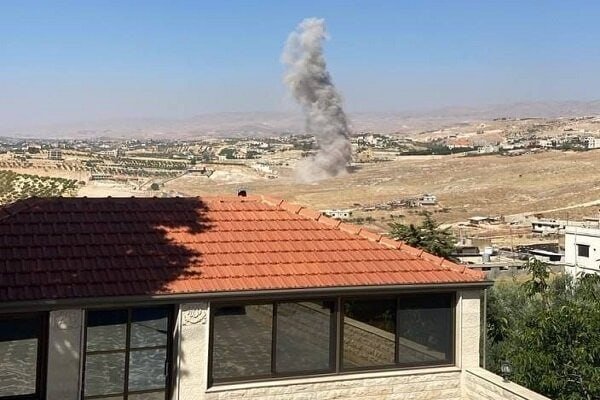
On the evening of 21 June 2026, the open-source traffic out of south Lebanon did not look like the southern front of a war winding down. A displaced shopkeeper named Mohammad Sallum told Middle East Eye that Nabatieh, his city, had become "a disaster-stricken city" and that Israeli forces were still on Lebanese ground. Two weeks earlier, an Israeli airstrike hit the beachside home of Mona Khalil, a Lebanese conservationist credited with building a movement to protect sea turtle nesting grounds; she died on Friday, NPR reported. The same evening, the commander of Iran's Islamic Revolution Guards Corps Quds Force, Esmail Qaani, issued what Iranian state media called a warning to Israeli troops in the south: leave or be forced out. Hezbollah released footage dated 12 June showing its fighters striking an IDF Merkava Mk. 4M tank on the eastern outskirts of Yahmar al-Shaqif with an Ababil fiber-optic FPV drone.
That is what the record shows from one twenty-four-hour window. It is also where the framing problem begins. Three of those four anchoring events reached English-language readers through channels whose editorial language is shaped by, or aligned with, the Iranian state or its regional allies. The fourth arrived via NPR. The first circulated in Hebrew through Walla, an Israeli outlet, which quoted Israeli officers warning that Hezbollah had rebuilt a system of "monitoring and gathering" capable of hunting down individual commanders. None of these reports is, on its face, untrue. Each is, however, a selected slice of a much larger information environment, and the selection is doing work.
The vocabulary of the source stack
Read the Iranian-adjacent posts together and a pattern emerges within seconds. Tasnim and Press TV describe an "occupying" force in a land the "Zionist regime" must be made to quit. Press TV frames Qaani's statement as a defensive warning; Al Alam Arabic, the Iranian state Arabic service, amplified it. A Mehr News summary relays a domestic Israeli survey finding that roughly 73 percent of Israeli respondents consider Prime Minister Netanyahu's claims about Iran to be false, a number that itself becomes a weapon in a regional information war.
The Israeli-language channel is leaner but equally pointed. Walla, an Israeli outlet with a mainstream commercial audience, quoted army commanders arguing that "Hezbollah is in danger," meaning the long-feared degradation of the group's capabilities had not happened the way Israel's planners had publicly promised. The X account Sprinter Press posted a clip of an Israeli commentator declaring that "all of Lebanon should become our playground," then disputing that anyone distinguishes between Lebanon and Hezbollah.
The Lebanese voice in the day's traffic is one shopkeeper, one conservationist's family, and the absent residents of towns whose names do not trend. There is no Lebanese state press agency briefing in the thread, no UN Interim Force in Lebanon (UNIFIL) bulletin, no International Committee of the Red Cross update. The window is full of Iranian, Israeli, and Hezbollah-aligned voices, and conspicuously thin on the humanitarian reporting institutions that a serious inventory of a southern front would expect to include.
What the framing choices actually do
When an outlet's headline vocabulary runs from "Zionist occupiers" to "IDF commanders," and the sources are clustered on one side of a single border, the selection is itself an editorial act. A reader who only sees what Iranian state media published that evening would walk away believing that Israel's presence in the south is occupation pure and simple, that Hezbollah remains militarily formidable in fixed engagements, and that Israeli public opinion has decisively turned against its own government's claims about Iran. None of those impressions is false in the literal sense. Each is, however, incomplete in ways that matter to the reader's mental model.
The Israeli stack, smaller but present, does roughly the inverse: it depicts a force that has battered Hezbollah but finds itself unable to translate that campaign into the disappearance of an underground threat, with commentators drifting toward maximalist language about Lebanese territory that, if taken literally, would amount to a policy of indefinite occupation. The shopkeeper's "bearable compared to their presence on our land" sits awkwardly in either framing: civilian testimony does not rotate neatly around ideological poles, because civilians, unlike spokespeople, talk about homes, shops, and beaches.
This is the awkward second-order casualty of reporting under saturation. When open-source traffic becomes the primary filter for an evening story, the loudest channels fill the column-inches their way, and the silent ones, Lebanese civil society, international monitors, the actual structures of ceasefire diplomacy, recede. The American official quoted via Al Alam saying Washington had worked on "mechanisms to reduce the pace of the conflict and implement a ceasefire in southern Lebanon" is, on the same evening, the diplomatic subplot; the more kinetic voices around it did not let that subplot dominate.
The absent corroborating layer
A serious reconstruction would triangulate the day's claims against Lebanese state institutions, UNIFIL ground reports, the Lebanese Armed Forces communications directorate, and major Western wire services with correspondents in Tyre and Sidon. None of those voices is visible in the evening's open-source traffic. Mona Khalil's death is verifiable because NPR's naming created an institutionally accountable record. Nabatieh's status as a "disaster-stricken city" is a displaced-resident quote published by Middle East Eye, which gives it journalistic reach; whether it represents the wider governorate is, on this evidence, not yet testable.
The kinetic claims are also unverified by independent means within the window. The Hezbollah footage of a Merkava strike is a militant release; the IDF has not, in the visible traffic, confirmed or denied the specific engagement at Yahmar al-Shaqif. Walla's "commanders hunted" story is a leak-driven Israeli read of intelligence picture, not a confirmed kill-chain event. Qaani's warning is a political statement, not an order of battle. Each is reportable; none can be presented as the ground truth of who controls what on Monday morning.
What a reader should take from one evening
The point is not that any single claim is fabricated, but that the framing landscape on 22 June 2026 is shaping what an English-language reader thinks they know about south Lebanon before breakfast. Where you read your evening update determines what "occupation," "destruction," and "ceasefire" mean in your head. Where you do not read, that ambiguity grows. The honest journalistic move is to name the source stack, name what it is, and refuse to launder it into a unified narrative that the day does not actually support.
Follow the event.
These dated source records provide context. They do not retrospectively verify this archive article.
Separate what the nuclear watchdog reported from what it could not determine after the June 2025 strikes.