Trump's Axios interview reads less like diplomacy and more like a real-estate prospectus for the Western Hemisphere
In a 19 June 2026 sit-down with Axios, the President described killing the Iranian supreme leader, floated regime change in Tehran, and pitched Caracas on oil and Havana on real estate — all in the same hour.
It is not every afternoon that a sitting American President explains his Iran policy by telling an interviewer "I killed the Ayatollah," dismisses the heir apparent as a different person, then pivots to describing Cuba as a property play and Venezuela as a pre-paid oil contract. That is, however, the texture of the 19 June 2026 Axios sit-down with Marc Caputo, captured in real time by the Telegram channel Clash Report and circulated as verbatim quotations before the network had finished its own edit. Read end to end, the interview is less a foreign-policy document than a sales pitch — and the sales pitch is the policy.
The striking thing is not that the President speaks in transactional terms. That register has been audible since the first term. What is new is the open fusion of three formerly separate files: a still-active war against Iran, a blockade-and-board posture around Venezuelan crude, and a half-joking promise to redevelop Cuba once the Castros are no longer in the way. Each section, on its own, has a precedent. Read together, they describe a doctrine in which the Western Hemisphere is treated as a closed estate to be managed, with offshore hydrocarbons as the rent and ideological rivals as the tenants to be cleared.
The Iran file: regime change, casual register
On Iran, the President went further than the official line. Asked by Caputo "how is this regime change? You have Khamenei Jr. in Iran," he replied: "Khamenei Jr. is different from the father. They're different people." A moment earlier, in the same exchange, he had boasted of killing the Ayatollah — "I killed the Ayatollah, and I sadly hurt the other Ayatollah. I did not meet him. I did not speak to him, but people were speaking of him. But he's got a certain braveness" — a reference to Mojtaba Khamenei that treats the decapitation of the Iranian command structure as a personal score settled on camera.
The substance is consistent with what has been reported about the posture of the administration since 2025: maximum pressure compounded by direct action, with deniable operations layered on top. The register is not. Public discussion of a leadership succession in Tehran, delivered as a thumbnail sketch to a domestic reporter, removes a layer of ambiguity that previous administrations have insisted on. It also raises a question the wire services have not yet answered: does the executive branch still recognise the successor as a counterpart, or is the working assumption that the Islamic Republic is to be governed, in the President's words, by being "taken out" — a phrase he used in the same hour, in a different exchange, when asked about "hardliners." The administration's public answer so far is that policy has not changed. The President's answer, on camera, was that he has "lost respect for some people" and is "not looking to kill people." Readers can pick the line they prefer.
The Venezuela file: oil, paid up front
The Venezuela portion is the part most likely to age well, because it tracks actual cargo flows. "We've paid for that war with Venezuela many, many, many times," the President told Caputo. "We're taking out millions of barrels of oil and we're making them more money than they've ever made before. All the big…" The sentence trails off in the published excerpt, but the direction is unmistakable: Caracas is being kept solvent by the United States as the customer of first resort, and the President is proud of it.
This is not a novelty. The architecture of sanctions relief conditioned on supply discipline has been the operating manual since late 2025, and the barrels that have flowed to Gulf Coast refiners under the licence regime are the mechanism by which the Venezuelan state continues to function. The novelty is the language. By calling the arrangement "paying for that war," the President is signalling to Caracas that the deal is not a concession but a transaction — the US is a buyer, and a buyer who intends to keep the price honest. The implicit threat is that the licence regime can be tightened as easily as it was loosened, which is the same threat Washington's regional partners have heard for forty years. What has changed is that the threat is now being made into a sales pitch.
The Cuba file: real estate, no oil
If Venezuela is the oil concession, Cuba is the property listing. "Venezuela has oil. Cuba doesn't," the President said. "Cuba has nice property and a nice shoreline." The line was delivered with the cadence of a pitch, and it is reasonable to read it that way. The Cuban economy is in its seventh decade of crisis, the diaspora's commercial claims against the island run into the tens of billions of dollars, and the political opening that sanctions relief would create is the precondition for any of that capital to be deployed.
The structural point is the one that should worry Miami, Madrid and Mexico City in equal measure. A doctrine in which the United States treats Caracas as a fuel supplier and Havana as a redevelopment site is a doctrine in which the Caribbean basin is being reorganised around American capital flows. The prior framework — support for a democratic opposition, calibrated sanctions, a hemispheric human-rights line — has been replaced, in the space of one interview, by a framework in which ideology is incidental and the ledger is what matters.
The G7 file: "I'm the boss" — comedy or cover?
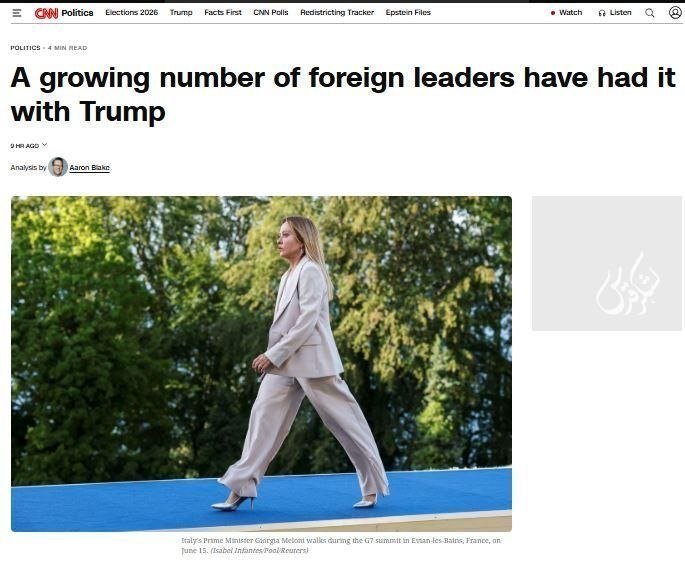
Caputo's final question returned to the G7, where the President's reported walk-in line was "I'm the boss." His answer, on the record, was: "All of them. But I was just being funny… That was done a…" The sentence, like the Venezuela answer, ends mid-thought. The joke structure — seven leaders, one boss — has the virtue of being short enough to fit a cable chyron and the drawback of being repeated in capitals that have to decide, in writing, whether to treat it as a joke. Few will. The political cost of treating it as a joke, in the unlikely event the United States is offended, is higher than the cost of treating it as a statement of fact.
The interviews' combined effect is therefore a public confirmation of something that has been implicit in US policy for at least a year: the period in which Washington asks permission from allies is over, and the period in which Washington reads allies the terms is open. The polling the President cited in the same hour — "I have great poll numbers. I would beat any candidate they have by 25 points" — is the political floor underneath that posture. He believes the domestic cover is thick, and on the evidence of the interview he is prepared to spend it.
Stakes and the counter-read
The most plausible counter-read is the charitable one: the President is selling, not governing, and the actual policy will be conducted through the Treasury, the Pentagon and the relevant embassies, in language that does not end in mid-sentence. There is something to this. No administration survives on chyron alone, and the working-level track on Iran, Venezuela and Cuba will continue regardless of who says what to whom. The difficulty with the charitable read is that the President's statements, on the subjects he chooses to speak about, are themselves the policy. The Treasury does not contradict him. The Pentagon does not contradict him. The interview is therefore best read as the policy, in the form the President prefers it to be received.
The stakes are concrete. On Iran, the bet is that a decapitated, demoralised clerical establishment can be coerced into a follow-on settlement without a ground invasion. On Venezuela, the bet is that a customer of last resort can also be the disciplinarian of first resort, and that the Caracas regime will accept the role. On Cuba, the bet is that the diaspora's appetite for property will outlast the regime's appetite for survival. None of these bets is implausible. None of them is cheap. And the interview, taken as a whole, is the clearest sign yet that the administration intends to be measured against outcomes, not against the language in which it describes them.
What remains uncertain
The sources available for this piece are the Clash Report transcripts of the Axios interview, published on 19 June 2026, and the Axios publication itself. Several questions are not yet answerable from this material: the exact text of the Venezuela and G7 answers as Axios eventually published them; the formal US position, if any, on the status of Mojtaba Khamenei; and the reaction, if any, of the Cuban and Venezuelan governments to the language used about their countries. The interview, in other words, has set the frame; the next 72 hours will determine whether the frame holds.
Desk note: Monexus is treating the Axios interview as the primary document and Clash Report as the verbatim capture of the exchange, in line with our practice of privileging direct quotation over downstream summary.
Wire provenance
This editorial synthesis draws on the following public wire/social posts:
- https://t.me/s/ClashReport
- https://t.me/s/ClashReport
- https://t.me/s/ClashReport
- https://t.me/s/ClashReport
- https://t.me/s/ClashReport
- https://t.me/s/ClashReport
- https://t.me/s/ClashReport
- https://t.me/s/ClashReport