Trump's Iran boasts on Air Force One are a confession, not a press conference
Trump's Air Force One claims about Iran's destroyed military are not a briefing. They are a confession, and the Geneva walkout is the receipt.
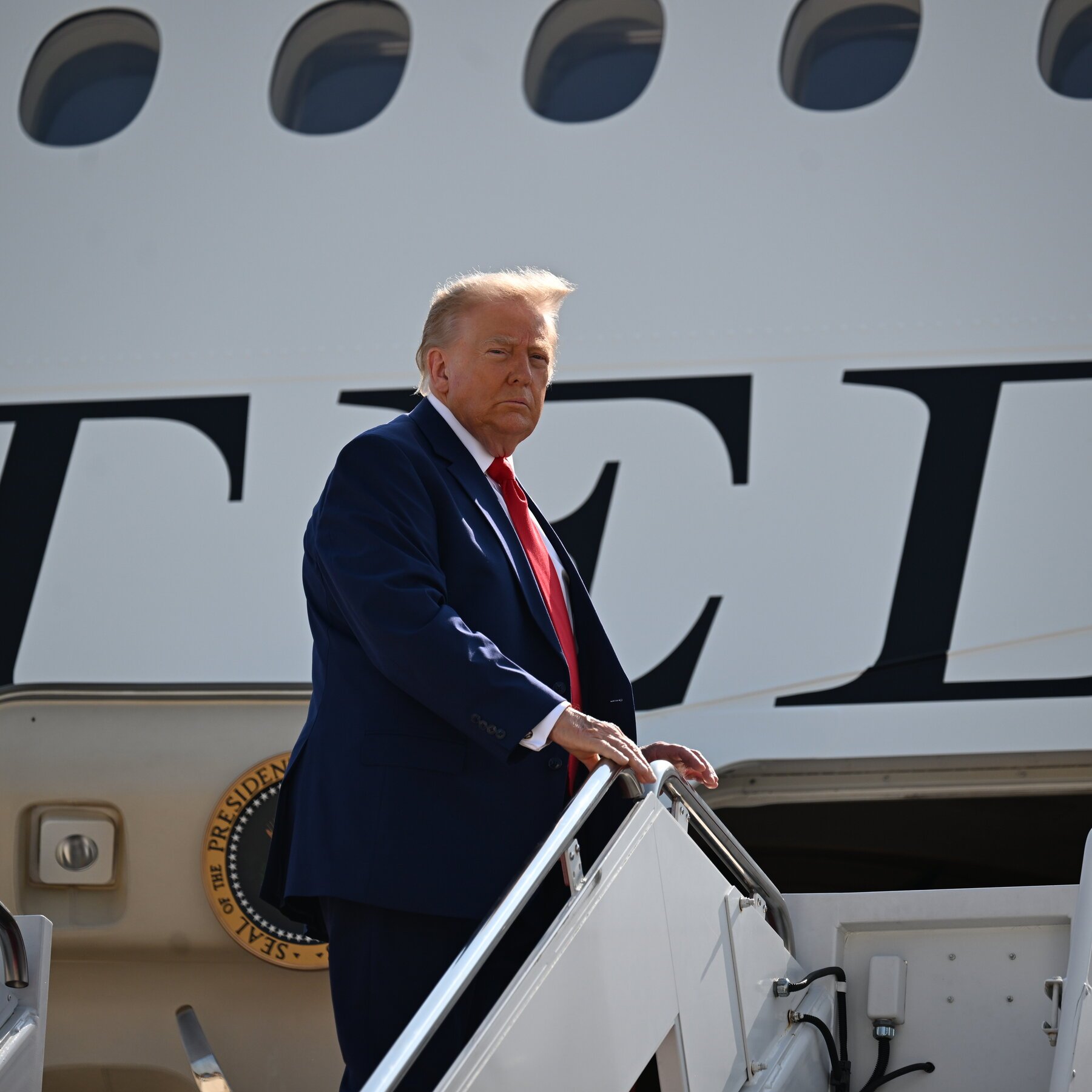
On the evening of 19 June 2026, somewhere over the Atlantic, Donald Trump told reporters aboard Air Force One that the United States had "won" a war against Iran, that Iran's military was "DONE," its navy "GONE," its air force "GONE," and its missile capability reduced to rubble. The boasts were not new; they had appeared on his Truth Social account earlier in the day, where he quote-tweeted a New York Times headline reading "What Changed After Almost 4 Months of War? Analysts Say Not Much" and answered it with the caps-locked refrain. The Air Force One version added the flourish: cameras, microphone, presidential seal in the background, the performative theatre of a commander-in-chief who cannot quite let the war go.
The thesis is straightforward. Trump is not briefing the press. He is confessing. The boast register and the diplomatic track are running on the same channel, and the contradiction is the story: the harder he sells the victory, the harder the negotiations in Geneva become, and the harder it is for any future administration, including his own, to define what "winning" actually means against a state that is still governing, still meeting in Geneva, and still broadcasting its own official.
What Trump actually said
Clash Report and Open Source Intel captured the full Truth Social text in real time, and it deserves to be read at face value rather than paraphrased into respectability. Trump's core claims: Iran's military is destroyed, its navy gone, its air force gone, its missile launch capability eliminated, its government "will NEVER have a Nuclear Weapon," and "THE MIDDLE EAST WILL BE A SAFE AND PEACEFUL REGION." Senator Lindsey Graham endorsed the line within minutes, citing Operations Midnight Hammer and Epic Fury as the proof points, and calling any contrary framing an "insult to our men and women in uniform."
Strip the political theatre away and the operational claim is narrow and testable: that a roughly four-month air campaign has degraded Iran's conventional order of battle to the point where Tehran cannot reconstitute its missile and air force inventory within a meaningful horizon. That is a real military judgment, the kind of thing a Pentagon briefing slide would either confirm or contradict. It is also, deliberately, a presidential assertion that forecloses the very questions an honest war audit would ask.
The Geneva contradiction
Within hours of Trump's Truth Social posts, the Iranians walked out of the quadrilateral talks in Geneva. Tasnim, the Iranian state news agency, told its readers that the Iranian delegation "did not agree to return to negotiations within the framework of the Quartet" because of "Trump's threatening and offensive statements." A separate Tasnim report said the talks had run for about an hour before suspension. The South China Morning Post framed it bluntly: "Iranians walk out of Swiss talks venue after Trump threatens to 'hit Iran very hard again.'"
The sequence is the point. A US president publicly declares that the Iranian armed forces have been functionally annihilated, then warns that he will hit them "very hard again," then expects a rival negotiating team to sit across the table and pretend that the leverage is symmetrical. Tehran's walkout is not a surprise. It is the only move available to a regime whose entire domestic legitimacy now rests on the assertion that it has not been defeated. For Iran to return to the table while Trump is on cable news claiming total victory would be to accept, on camera, the very "DONE" framing the president is selling.
The braggadocio and the threat are the same message
The wire captures the second-order voice as well. Esmail Qaani, commander of the Quds Force, addressed the "Soldiers of the Zionist regime" in Hebrew, promising "extraordinary surprises within less than four days." Germany, via Defence Minister Boris Pistorius, pointed the finger back at Washington: "Donald Trump is the one who caused the problem of closing the Strait of Hormuz, not us, but we have an interest in removing it." OSINTdefender logged at least six KC-135 Stratotankers and a P-8A Poseidon working the Strait of Hormuz, evidence that the air bridge is still hot.
In other words, the braggadocio and the threat are doing identical work. They are aimed at three audiences simultaneously: a domestic American audience that wants a victory tape; an Israeli audience that needs to hear the campaign is not winding down; and an Iranian audience that Qaani is now openly taunting in its adversaries' language. There is no separate diplomatic register left. The negotiation and the boasting are running on the same channel because the administration is trying to use the boast as leverage, and the leverage is the reason the table keeps emptying.
The China problem on the same flight
The skeleton headline flagged this and the wire confirms it: on the same Air Force One gaggle, Trump paired the Iran boasts with a separate line on China that, taken together, exposes the two-front constraint the United States has built for itself. A commander-in-chief who is still claiming unfinished business in the Persian Gulf cannot, in the same news cycle, posture as the unchallengeable Pacific power. The boast on Iran is therefore not just a miscalculation with Tehran; it is a structural admission that the United States has chosen to spend the first half of 2026 in a major air campaign against a regional power while Beijing watches, sanctions-battered Russia re-arms, and European allies quietly hedge their exposure to the Strait.
What a press conference looks like when the president is selling himself
The deepest tell is the format itself. A press conference answers questions; a confession answers nothing. Trump quoted the Times headline not to engage with it but to perform his rebuttal to it, on a platform he controls, in language calibrated for the rally rather than the briefing room. The "REALLY?" is the giveaway. It is the punctuation of grievance, not analysis. When the commander-in-chief cannot tell the public what the next phase of a war is, only what the last phase achieved, the absence is the information. Four months in, the answer to "what changed?" is "trust me," delivered at 30,000 feet.
The Geneva talks will resume or they will not. The KC-135s will keep refuelling the orbit over Hormuz, or they will not. The Quds Force will keep talking in Hebrew, or it will not. The variable that the wire has not captured, and that the boast register is designed to obscure, is whether the US administration itself has decided what "done" means, or whether it is outsourcing that definition to a Truth Social post and a New York Times headline it does not control.
Sources
- https://t.me/ClashReport, Clash Report, "Trump: The headline in the Corrupt and Failing New York Times...", 2026-06-19
- https://t.me/osintlive, Open Source Intel, "U.S. President Donald Trump: The headline in the Corrupt and Failing New York Times...", 2026-06-19
- https://t.me/intelslava, Intel Slava, "President Trump via Truth Social: The headline in the Corrupt and Failing New York Times...", 2026-06-19
- https://t.me/tasnimnews_en, Tasnim News (English), "The latest news from the negotiations in Geneva...", 2026-06-19
- https://t.me/SCMPNews, South China Morning Post, "Iranians walk out of Swiss talks venue after Trump threatens to 'hit Iran very hard again'", 2026-06-19
- https://t.me/englishabuali, Al-Alam Arabic (English mirror), "Esmail Qaani, commander of the Quds Force...", 2026-06-19
- https://t.me/alalamarabic, Al-Alam Arabic, "Pistorius: Donald Trump is the one who caused the problem of closing the Strait of Hormuz...", 2026-06-19
- https://t.me/osintlive, Open Source Intel, "U.S. military activity over the Strait of Hormuz continues...", 2026-06-19
Desk note: Monexus has paired the boast register with the China line because they were made on the same day by the same speaker, and together they expose the two-front constraint. The wire record on 19 June is thin and largely single-source via Middle East Eye's live blog and Telegram OSINT channels; this article will be updated as wire and Iranian-government responses appear.
Follow the event.
These dated source records provide context. They do not retrospectively verify this archive article.
Separate what the nuclear watchdog reported from what it could not determine after the June 2025 strikes.