Trump's "they do as I say" framing exposes the gap between American leverage and Israeli agency
An Axios interview carried by Iranian, Arabic and English-language wires on 19 June 2026 frames Israel as a client to be reined in. The framing flatters Washington and flatters Tehran — and misreads the actual balance of leverage.
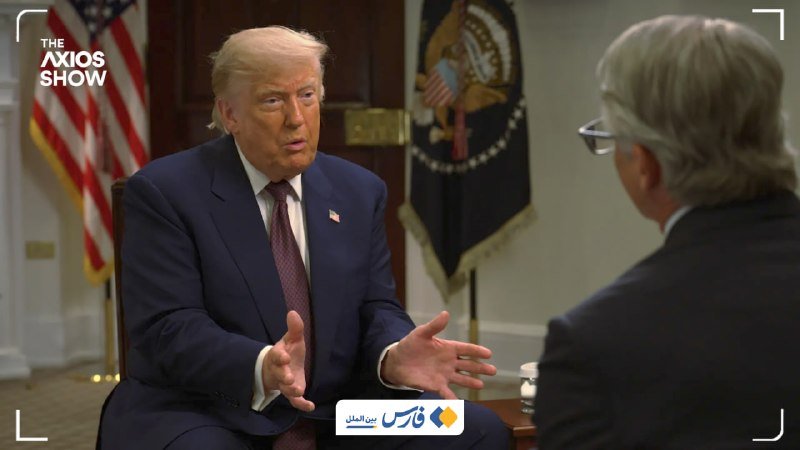
At roughly 10:16 UTC on 19 June 2026, the same Axios interview began circulating across three continents almost simultaneously. The Iranian outlets Mehr News and Tasnim ran it on their official channels; the Arabic channel Al-Alam posted it as "urgent"; the open-source monitors Open Source Intel and Clash Report clipped the English subtitles. The lines were identical, and they were, in their own way, extraordinary. Asked whether he could keep Israel from attacking Lebanon, the US president answered: "Yeah. They have a lot of respect for me, and they do as I say." Asked about his relationship with the Israeli prime minister: "It's good, but we have to keep him a little bit… sane." On whether Israel would have survived without US backing: "If it wasn't for my intervention, Israel would have been crushed."
The interview is a single document, but it is doing two opposite things at once. For an American audience, it projects control: the donor state as the indispensable guarantor, the regional partner as a sometimes unruly charge. For audiences in Tehran and across the Arabic-speaking region, the same lines project something flatter and more degrading — the image of a sovereign country taking orders from a foreign patron. Both readings flatter their intended reader. Neither is a description of how Middle East coercion actually works in 2026.
What the quote does, and what it does not say
Strip the boast out of the phrasing and the operational content is thin. The US president is asserting, in advance, credit for restraint he has not yet delivered. There is no ceasefire framework on the table in the circulated clips; there is no described concession from Jerusalem in exchange for American forbearance. What the interview offers is a promise — that if Lebanon is struck, it will be because the patron failed to stop it, not because the patron authorised it. That is a useful posture for a White House that wants both Israeli military latitude and Arab-world credibility on the same day. It is also a posture that ages badly if the strike happens anyway.
The "keep him sane" line is the more revealing of the two. It concedes, in a single half-sentence, that the relationship involves a partner whose decisions the patron sometimes finds unmanageable. That is closer to the truth than the "they do as I say" formulation that surrounds it. American leverage over Israel is real and large — arms flow, diplomatic cover at the UN, intelligence sharing, and the implicit veto over a strike on Iran's nuclear infrastructure. It is not, however, a remote control. Israeli cabinets have overruled sitting US administrations on settlement expansion, on Iran operations, and on the pace of wars in Gaza and Lebanon. The historical record runs against the interview's central claim.
Why the Iranian and Arabic wires amplified it
The speed of the pickup matters. Mehr News carried the clip at 10:17 UTC; Tasnim's Jahan channel followed within minutes; Al-Alam posted two "urgent" alerts, at 10:16 and 10:18 UTC; Clash Report and Open Source Intel added the English-subtitled version by 10:35 and 10:44 UTC. The clips were framed differently in each outlet, but the underlying clip was the same.
This is not a coincidence of distribution. The "they do as I say" formulation is, in Tehran, a propaganda asset. It validates the foundational claim of the Islamic Republic's regional messaging: that Israel is not a sovereign peer but a forward operating arm of the United States, and that resistance to Israeli action is, by extension, resistance to American policy. The same line is uncomfortable in Jerusalem, because it makes the prime minister look like a regional manager rather than a head of government, and it is uncomfortable in Washington for the opposite reason — because the boast will be tested the next time Israeli and American interests diverge on Lebanon.
The Iranian state media is not, on this evidence, reporting a story; it is deploying a story. That is the appropriate framing, but it does not mean the quote is fabricated. It was given, on camera, to a Western outlet. The exploitation is downstream; the words are the source's own.
What this tells us about the actual balance of leverage
Three structural points sit underneath the interview and will outlast it.
The first is that American arms and diplomatic cover remain the single largest external input into Israeli decision-making. That is not in dispute, and no serious Israeli analyst disputes it. The second is that Israeli domestic politics — a coalition that includes nationalist and ultra-Orthodox parties with their own vetoes on any concession in Lebanon — sets hard limits on what any American president can extract in real time. The third is that Iran's regional position has been weakened over the past two years by the successive degradation of Hezbollah's external command structure, and that Tehran therefore has more incentive than usual to amplify any image of American restraint as a strategic victory.
The interview sits at the intersection of those three. Read it as policy, it is empty. Read it as bargaining — the administration telling its Arab and Gulf interlocutors that Israel will not move on Lebanon without a green light from Washington, and telling Jerusalem that the green light will not be automatic — it is a more familiar instrument. Read it as a piece of evidence in the information war between Washington and Tehran, it is exactly what the Iranian wires wanted it to be.
What remains uncertain
The Axios clips circulating on 19 June do not include any Israeli response, any description of a specific deal, or any operational test of the "they do as I say" claim. The interview's leverage content will only become legible when an Israeli decision on Lebanon is either taken or deferred, and when the credit or blame is then assigned. Until then, the quote is a posture, not a fact — and the people most invested in treating it as a fact are sitting in Tehran, not Tel Aviv.
This publication treats the Axios clip as a single document amplified by competing editorial frames. The pickup pattern across Iranian, Arabic, and open-source channels is itself the story; the underlying claim of Israeli subordination remains an open empirical question until tested against a real decision.
Wire provenance
This editorial synthesis draws on the following public wire/social posts:
- https://t.me/osintlive
- https://t.me/ClashReport
- https://t.me/mehrnews
- https://t.me/alalamarabic
- https://t.me/JahanTasnim