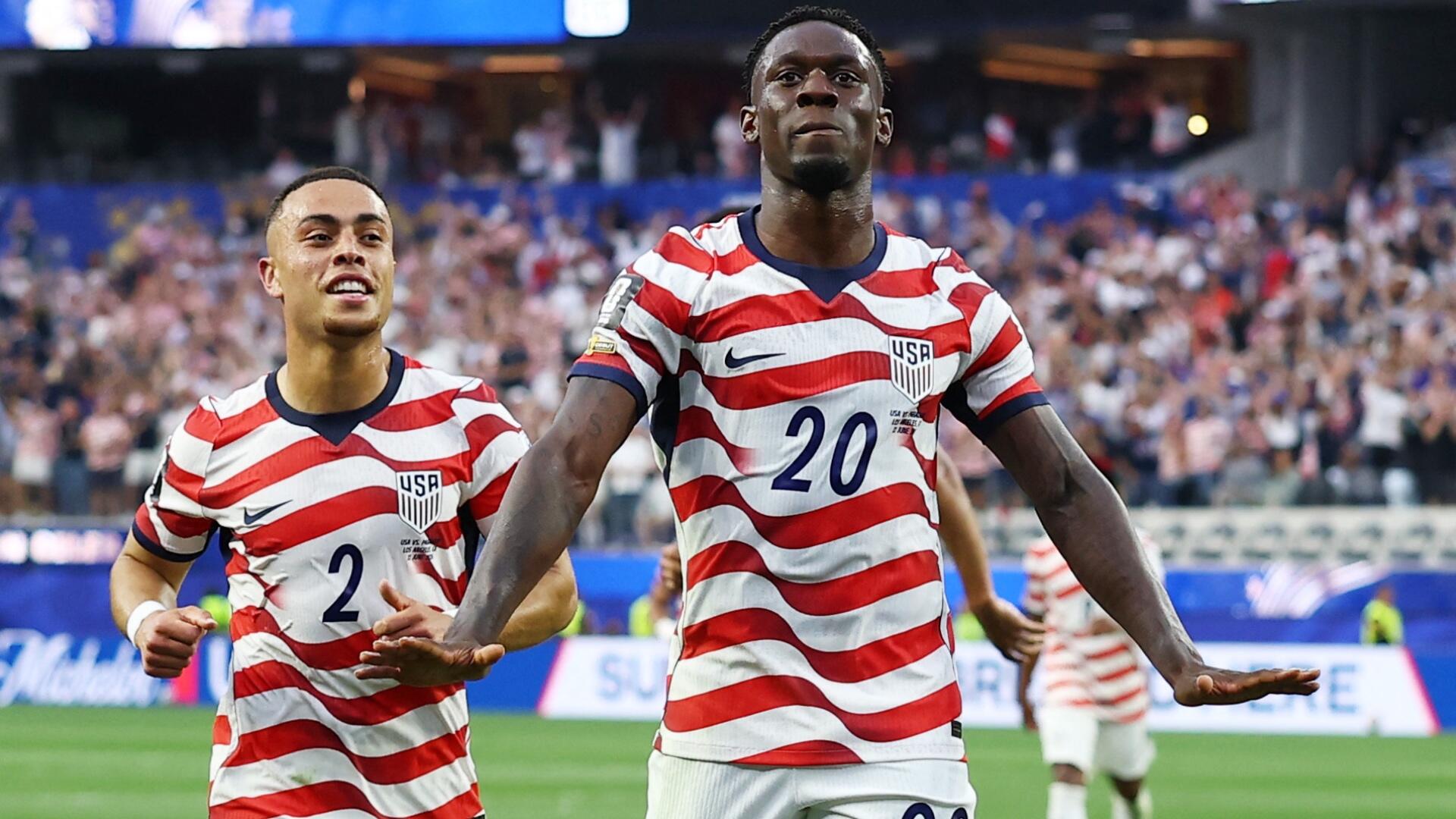
Folarin Balogun and a thinner US frontline: what USA–Australia tells us about the Pulisic-less plan
Christian Pulisic's calf turns a routine group-stage tune-up into a read on depth, and on whether Folarin Balogun's role is opportunistic or structural.
Folarin Balogun walked off the field in Denver on Wednesday night as the most scrutinised forward in the United States men's national team setup. Twenty-four hours later, he is the centre of a betting market and a tactical argument that, on its face, concerns a June friendly against Australia in Commerce City, Colorado. Underneath, it is about how thin the USMNT's attacking layer really is, and whether a 24-year-old Arsenal-developed striker who chose the Stars and Stripes over England and Nigeria can be the answer to a question Christian Pulisic's calf has just made more urgent.
The match, scheduled for 19 June 2026, lands in the awkward space between the World Cup's June opening and the noise around it. With Pulisic's status uncertain because of a calf complaint, Balogun is not simply a name in a prop sheet; he is a referendum on depth. The dominant framing — Pulisic absent, Balogun elevated — is straightforward. The more interesting question is what it reveals about a roster that has spent two cycles planning around one creator.
What the lineup actually says
The headline version of the story is mechanical: Pulisic is hurt, Balogun plays. The deeper version concerns the structure around them. The USMNT has, for the better part of two years, organised its attacking shape around a single ball-progressing No. 10 who doubles as the team's leading chance-creator and emotional centre. When that player is unavailable — even for a friendly in late spring — the question is not who replaces him but whether the system that depended on him has a second setting.
That is the context in which SportsLine expert Brandt Sutton's player-prop sheet for USA–Australia on 18 June 2026 should be read. Sutton's picks, published by CBS Sports on 18 June 2026 at 14:12 UTC and updated by 18:02 UTC the next day, frame Balogun as the betting line's centre of gravity in Pulisic's absence. The market's instinct — that the minutes and shot volume shift to Balogun when the No. 10 is missing — is the same instinct a coaching staff carries into a World Cup summer.
Balogun is not a like-for-like stand-in. His profile is different: a penalty-box finisher who plays off the last defender rather than a chance-creator who operates between the lines. The USMNT's wider attacking shape, with Pulisic on the wing and a traditional nine underneath, has allowed him to be a goal rather than a supply line. Without Pulisic pulling defenders out of the central channel, the geometry changes. That is the tactical question the Australia friendly is meant to answer, quietly, before the tournament proper begins.
The market is not just pricing a player — it is pricing depth
Player-prop markets in international soccer are blunt instruments. They do not distinguish between a striker who starts because the manager trusts him and one who starts because there is no one else. Sutton's sheet treats Balogun as the natural beneficiary of Pulisic's calf, which is reasonable, but it also assumes the USMNT's structure survives the removal of its most important piece. That assumption is the article.
The counter-read is simpler and less flattering: the United States has, for the duration of Pulisic's tenure, been a one-No. 10 team that has done well enough to avoid asking what happens when that No. 10 is not there. A friendly against Australia — a Socceroos side that will be fighting for its own World Cup minutes — is exactly the kind of match that exposes the gap. If Balogun scores, it tells us a finisher can finish; it does not tell us whether the system can manufacture the chances without the creator.
What this means for the World Cup group stage
The structural stakes are modest but real. The United States will host the opening matches of the 2026 tournament, and the first game sets a tone that no amount of pre-tournament planning can fully control. A Pulisic injury in the run-up would, in this framing, do more than remove a player; it would remove the only USMNT attacker whose individual brilliance is treated, by friend and foe alike, as a difference-maker. The question of who carries the chance-creation load in his absence is not new. It has been deferred.
That deferral is, itself, a piece of evidence about how the program has built. The USMNT has invested in athletic full-backs, in a deep midfield, and in a generation of dual-national forwards of which Balogun is the most prominent example. It has not, on this evidence, invested in a second creator of Pulisic's calibre. The friendly against Australia will not resolve that gap. It will, however, give the market — and the coaching staff — a first real look at what Balogun looks like when he is not finishing chances Pulisic has manufactured.
Stakes and uncertainty
The honest version of this story is short on resolution. Pulisic's calf injury is described in published reporting as a soft-tissue issue; whether it costs him minutes in the World Cup opener is not yet known as of the CBS Sports update at 14:12 UTC on 18 June 2026. Balogun's role is, similarly, contingent: if Pulisic is fit, the prop sheet's logic collapses and Balogun returns to being a secondary line rather than the centre of the betting conversation.
What is not contingent is the underlying structural question. The United States enters a home World Cup with a roster built around one elite creator. That is a normal way to build a team, and it is also a fragile one. A friendly in Colorado will not decide the tournament, but it will tell us something about whether the program has, finally, built a second setting — or whether the entire attacking shape still runs through a calf that may or may not be ready in late June.
This article leans on US-focused wire and outlet coverage that frames the Pulisic question as the central USMNT storyline heading into the friendly. The market data cited reflects SportsLine expert modelling rather than independent sample-size analysis, and player-prop sheets of this kind carry known limitations as tactical evidence.
Sources
- CBS Sports — Folarin Balogun odds, picks, player props, predictions: Best bets for USA vs. Australia in 2026 World Cup — 18 June 2026
- CBS Sports — Folarin Balogun odds, picks, player props, predictions: Best bets for USA vs. Australia in 2026 World Cup (Pulisic questionable) — 18 June 2026
- Sportshub / CBS Sports Images — Folarin Balogun training photo — 18 June 2026