Trump's 'much more' message: Zelensky reads a signal to Moscow in the margins of a phone call
A short call between Washington and Kyiv is being read in Kyiv as a guarantee of escalating arms, with the message — and the audience — sitting in Moscow.
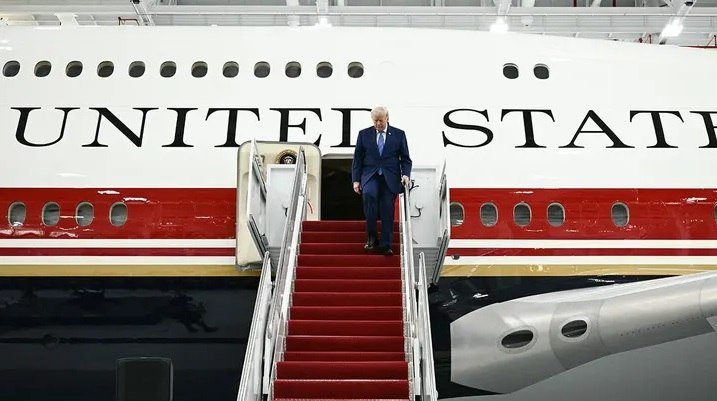
A short telephone call between President Volodymyr Zelensky and Donald Trump on 19 June 2026 has produced a single line that is now doing most of the diplomatic work: the American president's assurance, relayed in Kyiv, that the United States intends to give Ukraine "much more" help than it has so far. The wording, surfaced by Zelensky at a press availability in Kyiv and translated into English by the open-source monitor War Translated, is being read by the Ukrainian side as a signal — not only to Kyiv, but to the Kremlin.
What makes the remark more than boilerplate is the audience Zelensky attributes to it. The Ukrainian president cast Trump's phrase as a deliberate cue to Vladimir Putin, intended to make clear that Western military assistance will continue to expand and that, in Zelensky's reading, Moscow should treat the war as a losing proposition. It is a small piece of political theatre, but it sits inside a much larger question: whether Washington's posture has shifted from managed stalemate to active escalation of the arms pipeline, and how Moscow is being invited to interpret that shift.
The call, as Kyiv describes it
According to TSN, a major Ukrainian broadcaster, Zelensky used the post-call briefing on 19 June 2026 to lay out what he said had changed for Ukraine as a result of the conversation. The headline of the broadcaster's report, picked up on Telegram, framed the exchange as one with concrete operational consequences — what would change, in TSN's phrasing, rather than what was merely discussed. The Ukrainian president did not, on the materials now in circulation, publish a written readout; the message travelled through his on-camera remarks and through Ukrainian press, with War Translated's same-day English rendering amplifying the line about "much more" help.
This is the third time in recent weeks that Zelensky has emerged from a call with Trump and used the post-call moments to address Russia directly, rather than the American voter. The pattern matters. It is a recognition that the politically durable part of these exchanges is not what is said about the relationship between the two presidents, but what each side says the other leader meant for Moscow's benefit.
What "much more" might mean in practice
The Ukrainian readout is a political reading, not a delivery schedule. The phrase does not name a weapons system, a dollar figure, or a delivery window. In the absence of a publicly available package, the claim that help will grow has to be triangulated against the trajectory of the last several U.S. aid tranches and the political bandwidth available to deliver more.
Two readings are live. The first is that the call produced a substantive commitment — additional air-defence interceptors, deeper fires packages, or expanded use of Western-donated long-range systems — that is being telegraphed by Zelensky to lock the White House into a public posture it will not easily walk back. The second is that the line is calibrated reassurance: an assurance to Kyiv that the political ceiling on aid is rising, even if the operational change is incremental. Both readings point in the same direction — upward — but at different speeds, and the difference will register first in the air-defence and deep-strike categories where Ukrainian consumption is heaviest.
There is also a third possibility, less flattering to either government, and worth stating plainly. Calls between Washington and Kyiv have, at several points in this war, produced a more ambitious-sounding Zelensky summary than the White House readout confirms on the following day. Until the U.S. side corroborates the "much more" framing in its own language and points to specific systems, the Ukrainian claim is best read as a confident interpretation rather than a binding schedule.
The audience that matters is in Moscow
Zelensky's framing of Trump's words as a message to Putin is the most telling part of the exchange. The Ukrainian government has spent much of the war trying to convert bilateral reassurance into a deterrent posture aimed at the Kremlin — that is, into signals that the cost calculus in Moscow has changed, not into signals that reassure Ukrainian voters. The "much more" line, on Zelensky's account, is the latest in that vein.
The logic is straightforward, if speculative. If Putin is weighing whether to press or pause — on the front, on the air campaign, on civilian infrastructure — then a credible reading that Western aid is going to expand, not contract, raises the expected cost of holding the line. A counter-reading, from Moscow, would be that Zelensky is once again overreading a Trump phone call, and that the practical additions to the aid pipeline will be modest, late, and contingent on U.S. domestic politics. Russian state media, on past form, will lean on the second interpretation; Ukrainian outlets are already working with the first.
That divergence is itself the point of Zelensky's public framing. The Ukrainian side is trying to harden the higher number into the working assumption, knowing that the message travels to Moscow through Western wire coverage of the press conference as much as through any direct channel.
Stakes and what remains unresolved
The immediate stakes are operational: a more generous air-defence and deep-strike pipeline changes the cost equation on the front and on Ukrainian cities within weeks. The medium-term stakes are political. If the U.S. posture is genuinely moving toward escalation of arms delivery, Moscow faces a narrowing window in which to negotiate from a position of relative strength. If it is not, and the gap between Kyiv's public reading and Washington's private tolerance is wide, then the next round of political bargaining — domestic Ukrainian funding for wartime production, European participation in the pipeline, Russian calculations about a 2027 horizon — will be conducted on assumptions that one side privately knows to be softer than the public line.
What remains unresolved, on the materials now in circulation, is straightforward. The U.S. side has not, in the wire currently visible, matched Zelensky's "much more" framing with its own language or specific systems. The exact operational contents of the call are not in the public record. And the central counter-claim — that a Trump call is being read more expansively in Kyiv than it warrants — is not yet rebutted or confirmed by the White House. Until that happens, the "much more" line is a directional claim with a specific audience and a specific intent. It is, for now, a piece of the war's information architecture as much as it is a piece of its logistics.
Desk note: Monexus reports the call from the Ukrainian side, the only side with an on-camera readout in the public record on 19 June 2026. The Russian side has not, in the available wire, offered a matching characterisation. Readers should treat the "much more" framing as a Ukrainian interpretation of an American statement, not as a U.S. policy document.
Wire provenance
This editorial synthesis draws on the following public wire/social posts:
- https://t.me/TSN_ua
- https://t.me/wartranslated
- https://t.me/osintlive
Follow the event.
These dated source records provide context. They do not retrospectively verify this archive article.
A dated voting record is evidence of one decision. Use the original UN record before turning it into an alignment label.
Visual explainer · historical vote of 2022-03-02 →