Tehran's Hormuz card: a blockade threat, a leverage play, and the cost everyone else pays
On 20 June 2026, the IRGC Navy ordered traffic out of the Strait of Hormuz and blamed Israeli operations in Lebanon. The US Navy is watching. The question is whether Tehran is closing a chokepoint or pricing one.
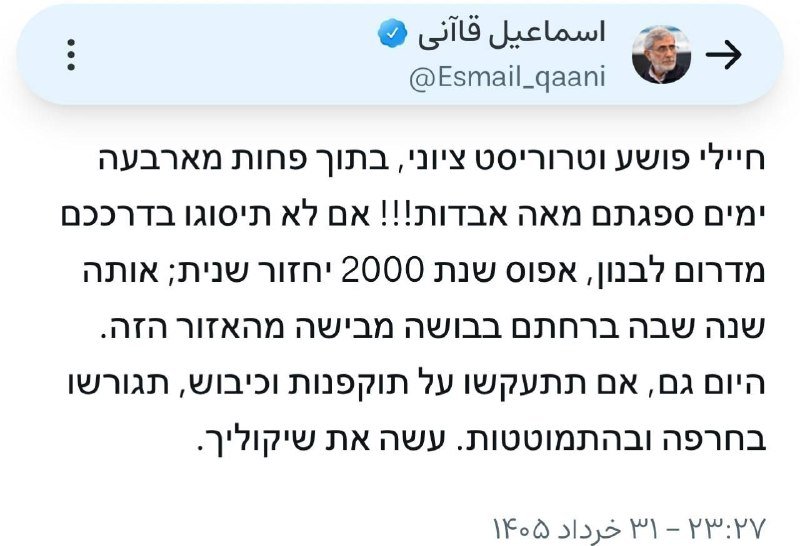
At 19:42 UTC on 20 June 2026, an open-source channel monitoring the Islamic Revolutionary Guard Corps Navy rebroadcast an Iranian military radio order: the Strait of Hormuz is closed to navigation, all vessels are told to stay away for their own safety, and the cause named is Israeli operations in Lebanon. The notice landed hours after Iranian state media, citing the country's joint military command, said the same thing, and it was followed at 21:15 UTC by a Reuters wire reporting that US forces were actively monitoring the waterway to keep it open. The market reaction was immediate and ugly; the strategic interpretation is harder. Iran has not closed the Strait of Hormuz. It has done something more interesting: it has reminded the world that it can.
Strip the rhetoric away and the move is a textbook leverage play by a sanctioned state whose conventional tools are depleted. Tehran's nuclear file is in a fragile negotiating window, its regional allies are under sustained Israeli pressure in Lebanon, and its economy is structured around the implicit threat of disrupting the roughly twenty million barrels a day that transits Hormuz on a normal day. A blockade, even a partial one, reprices insurance, freight and crude in minutes. The threat itself — restated, repeated, visualised by fast boats on the waterline — does most of the work. The US Navy's presence, rather than negating the threat, confirms that it has weight.
The Western wire line reads this as escalation, and there is a case for that reading. Israeli operations in Lebanon have been the proximate trigger named in every Iranian statement and in the breaking alert circulated by Axios earlier on 20 June. The framing inside the US administration, per the Reuters dispatch, is that freedom of navigation must be preserved; that posture implies a willingness to escort tankers through contested water, which is the kind of mission that turns a signalling contest into a shooting one. Israeli security concerns in the north are a first-order fact, and the Iranian decision to weaponise a civilian sea lane in response to them puts the onus on Tehran. Iranian state media's narrative — that the closure is retaliation for Israeli action and that ships ignoring the order do so at their own risk — sits inside a long pattern of asymmetric signalling against a conventionally superior adversary.
The counter-reading is that nothing here is what it looks like. Tehran has announced Hormuz closures before; tankers, including Iranian ones, kept moving; insurance markets spiked, then settled. The structure of the Iranian oil export economy makes an actual sustained closure suicidal: Iran itself exports through Hormuz, and the regime's hard-currency position deteriorates the moment it physically stops the flow. The more coherent read is that the closure is a negotiating instrument priced for the nuclear talks rather than a strategic decision. If the Iranian frame is correct — that Israel is the trigger and the United States is the broker — then the bargaining unit is simple: dial down the Lebanon operations and the waterway reopens. The risk is that the bargaining unit gets confused with a fait accompli, and that insurance underwriters and oil traders price the worst case long before diplomats reach a deal.
The structural pattern is the part that should worry capitals from Tokyo to Brussels. The chokepoint economy is back as a category of geopolitics. For two decades after the first Gulf war, the implicit assumption under US maritime supremacy was that no regional power could credibly hold a strait hostage without being broken. That assumption has frayed. Iran's IRGC Navy, Houthi pressure on the Red Sea, and the slow-motion re-arming of non-state actors along the maritime shoulders of the Gulf have all eroded the monopoly the US Fifth Fleet used to enjoy on the impression of control. None of these actors can hold a waterway against a determined American response; all of them can raise the cost of transit to the point where the global economy pays a permanent risk premium. The premium, once priced in, is a strategic asset independent of whether any given closure lasts a day or a month.
The honest limit of the available reporting is that several of the most consequential claims on the table are sourced from Iranian state media, from channels that relay IRGC Navy radio, or from social posts that have not been independently verified. Reuters' confirmation that US forces are monitoring the strait is solid; the framing in Iranian advisories is the framing of an interested party. What the open record does not yet say is how many commercial vessels are actually diverting, whether the IRGC Navy is physically interdicting traffic or only broadcasting the threat, or what the negotiating temperature inside the nuclear file looks like twelve hours after the closure notice. The next forty-eight hours will tell. If insurance war-risk premia spike and stay spiked, the leverage has been priced in. If the strait quietly returns to normal traffic behind a wall of statements, the threat did its work in the oil futures market and will be deployed again the next time Tehran needs a bargaining chip.
Wire provenance
This editorial synthesis draws on the following public wire/social posts:
- http://reut.rs/3SUkrSY
- https://t.me/sprinterpress
- https://t.me/osintlive
- https://x.com/sprinterpress/status/2026-06-20-2111
- https://x.com/unusual_whales/status/2026-06-20-1506