Italy Draws a Line: How a G7 Photo Spat Became a Stress Test of Transatlantic Etiquette
A White House boast about a G7 photo has produced an unusually public rupture with Rome, the cancellation of a senior Italian visit, and a rare Italian refusal to defer.
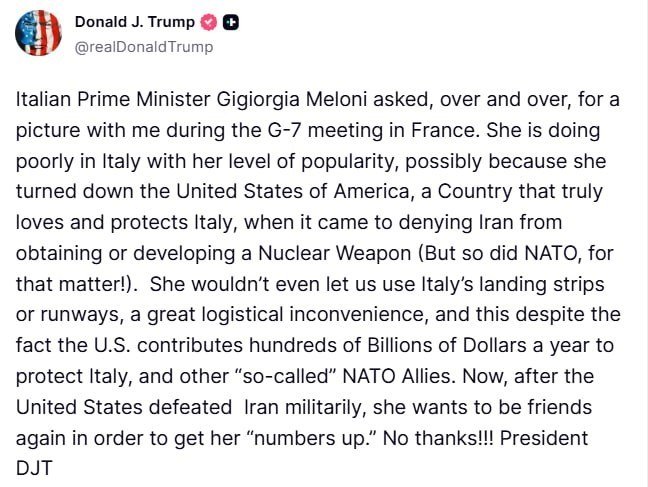
The rupture is small in the catalogue of transatlantic disputes, but unusually public. On 19 June 2026, President Donald Trump told reporters that Italian Prime Minister Giorgia Meloni had "begged" him for a photograph together at the recent G7 summit, according to a post on X by the prediction market Polymarket that relayed his comments at 13:13 UTC. Within hours, Meloni publicly rejected the framing, telling Italian media she was "astonished" by the claim, in remarks captured by Polymarket at 16:13 UTC. By the following morning in Europe, Italy's foreign minister had cancelled a planned visit to Washington, a development flagged on Polymarket at 20:19 UTC on 19 June and confirmed in coverage carried by The Indian Express on 20 June at 05:52 UTC.
What the wire reads as a curious footnote is, in fact, a stress test of how the post-2024 transatlantic relationship handles embarrassment. The American president does not normally have to insist on his own popularity with allied leaders; allied leaders do not normally have to deny having courted him. The reversal of those defaults is the story.
A dispute over optics, not substance
The substantive question — whether Meloni did, in fact, seek out a bilateral moment with Trump on the margins of the G7 — is, at the moment, unverifiable from public sources. The Indian Express report, timestamped 05:52 UTC on 20 June, carries Meloni's public rebuttal: "Italy will never beg." Polymarket's earlier posts at 13:13 UTC and 16:13 UTC on 19 June set the two competing framings side by side. The Indian Express's coverage does not provide video or photographic evidence settling the encounter one way or the other; nor do the Polymarket posts. Both sides have, for now, the same evidentiary base — a public boast and a public denial.
That matters because the dispute is not really about a single handshake. It is about who gets to narrate the moment. A White House that routinely re-publishes flattering imagery with allied leaders is now testing whether an ally will absorb the spin, and discovering that one of Europe's more media-confident prime ministers is willing to push back in English, on the record, in real time.
The Italian position, taken seriously
Meloni's coalition government has spent the better part of two years positioning Rome as a reliable interlocutor in Washington without surrendering Italian framing on Ukraine, EU fiscal rules, or migration. That posture depends on being treated as a peer, not as a supplicant. A public characterisation of an Italian head of government as having "begged" for access to the American president is, in that context, not a barb to be laughed off; it is a description of the relationship that Italy has actively refused to accept.
The cancellation of the foreign minister's visit, reported by Polymarket at 20:19 UTC on 19 June and carried in The Indian Express's 05:52 UTC item on 20 June, is the diplomatic instrument. It is calibrated — visible enough to register, reversible enough to leave a door open. There is no indication in the available reporting that Rome has recalled its ambassador, downgraded its representation, or shifted policy on any live file with the United States. The signal is reputational, not structural.
What the framing leaves out
The dominant English-language framing treats this as personality friction: two outsized figures, one insult, one walkout. That framing flatters neither government. A more honest read is that the United States, under its current administration, has shown a recurring pattern of testing allied leaders with public characterisations — and that allied leaders, when they push back, tend to be the ones with stable domestic positions and clear ideological identities. Meloni, polling steadily at the top of Italian approval rankings through 2025, is unusually well placed to absorb a fight with Washington without paying an immediate domestic cost. That is not bravado; it is political arithmetic.
The alternative reading — that the White House line was an offhand comment now being over-interpreted in a hyperactive news cycle — is also plausible. Without the underlying video, the case remains circumstantial. Monexus finds, on the public record available at publication, that the more parsimonious explanation is the simpler one: a US side that has grown casual about the dignity of allied counterparts, meeting an Italian side that has decided, on this occasion, not to absorb it quietly.
Stakes and what to watch next
The near-term stakes are narrow. No trade file, no defence commitment, no Ukraine coordination is reported as disrupted. The medium-term stakes are wider. If the pattern holds — public boasts from Washington, public denials from Rome, calibrated cancellations in between — the cost of doing business with the United States rises for allies who value being treated as principals. That cost is paid in time, in translation, in the quiet diplomatic work of pre-negotiating every public statement. It is the kind of cost that does not show up in communiqués, but accumulates.
What to watch in the coming days: whether the Italian foreign minister's visit is rescheduled on Italian terms, whether the White House issues any walk-back, and whether the next G7 sideline produces another photograph that both sides claim authorship of. The answer to each will signal whether 19 June 2026 was an isolated embarrassment or the opening move of a longer game.
This piece treats the Italian government's framing — carried by The Indian Express on 20 June 2026 at 05:52 UTC — as a primary source for Rome's position, and the Polymarket wire at 13:13 UTC, 16:13 UTC, and 20:19 UTC on 19 June as the source for the timeline of the US side's statements and the visit cancellation. The underlying video of the G7 encounter has not been published in the material available to Monexus at time of writing.
Wire provenance
This editorial synthesis draws on the following public wire/social posts:
- https://x.com/Polymarket/status/1
- https://x.com/Polymarket/status/2
- https://x.com/Polymarket/status/3