A 'ceasefire' that hasn't stopped the helicopters
Less than 24 hours after Israel–Hezbollah ceasefire announcements, Israeli helicopters are again over southern Lebanon and Lebanese state media report at least 11 dead. The 'ceasefire' label is doing a lot of work the facts won't support.
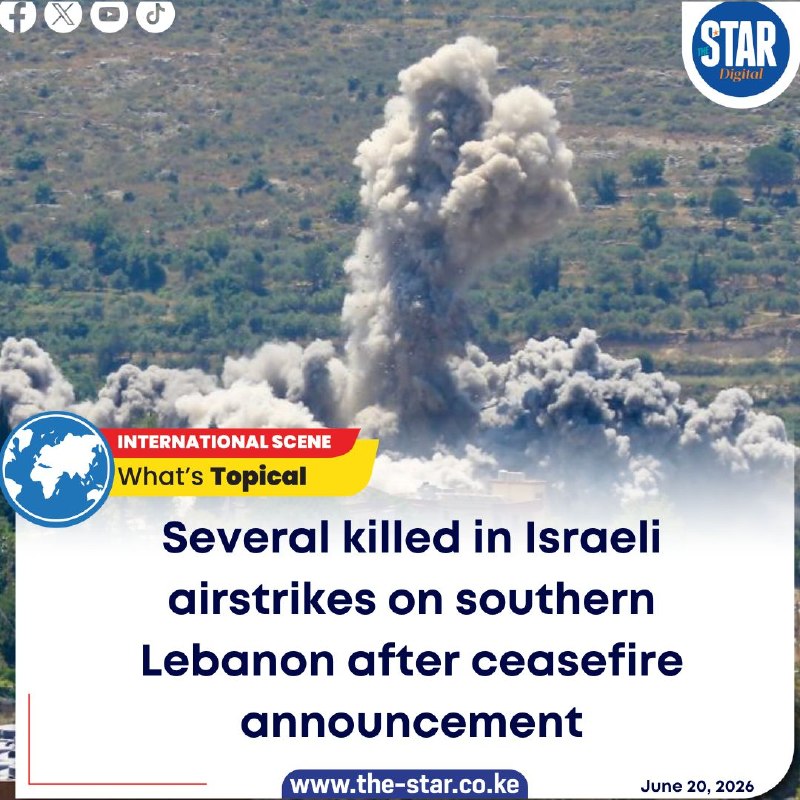
Less than a day after a ceasefire between Israel and Hezbollah was announced, the airspace over southern Lebanon is full of Israeli helicopters and the casualty clock is running again. By 10:00 UTC on 20 June 2026, the Lebanese state news agency was reporting at least eleven people killed in renewed Israeli airstrikes on the south of the country. By 10:04 UTC, Arabic-language field channels were tracking Israeli helicopters low over the Ali al-Taher heights and the town of Nabatieh El-Faouqah — terrain the Israeli military has now been holding, by Iranian state media's own count, for three consecutive days.
The word "ceasefire" is doing a lot of work the facts will not support. Either the agreement that was supposed to take hold overnight was never real, or it was real and is now being openly violated before the ink has dried. The framing matters: if a "ceasefire" can co-exist with air strikes that kill civilians and helicopter operations over contested ridges, the term has been emptied of operational meaning. It becomes a press-release device, not a constraint on behaviour.
The hours after the announcement
The sequence on the ground does not look like a ceasefire. It looks like an air campaign that did not pause for the diplomacy. The Star Kenya wire, relaying Lebanese state media, put the toll at eleven killed in renewed strikes on southern Lebanon within 24 hours of the announced deal. The geography is consistent with the days-old Israeli push to hold the Kfartbenit axis and the Ali al-Taher heights — a stretch of high ground on the eastern edge of the south Lebanon sector that, once secured, dominates the approach routes into the Litani basin. Field observers on Telegram, including channels relaying from the local monitor @rnintel, reported Israeli helicopters circling low over Nabatieh El-Faouqah and the Ali al-Taher ridge on the morning of 20 June, behaviour more consistent with continued offensive shaping than with a de-escalation posture.
The Iranian framing, and what it is worth
Iran's Fars News International has spent three straight bulletins asking why Israel is "insisting on occupying Ali al-Taher despite heavy casualties." The framing is not neutral. Tehran has an interest in portraying the Israeli position as a losing, casualty-soaked occupation, and Fars's casualty language is an Iranian-state estimate rather than an independently verified figure. But the structural point is harder to dismiss: holding a contested ridgeline against an entrenched local adversary is a casualty-intensive undertaking, and Israeli operations in the south have been visibly attritional in recent months. The piece of the Iranian framing worth keeping is the admission — implicit in the repeated coverage of a single ridge — that the area has become a sustained Israeli holding operation rather than a passing raid. The piece to discount is any specific body-count claim that has not been cross-checked against Israeli or wire-service reporting.
What "ceasefire" actually means here
Three readings are live, and the available reporting does not yet let this publication pick one cleanly. The first is that the announced ceasefire was a political communiqué issued before the military was ready to honour it, and the operations over Ali al-Taher are an open continuation of the previous campaign. The second is that the deal defines "ceasefire" narrowly — no rockets, no cross-border tunnels, no organised Hezbollah fire — while leaving the IDF free to continue what it classifies as defensive shaping of the border zone. The third is that the deal exists, and is being violated, and the violations are themselves a stress test of how much external pressure can be brought to bear on Israel to honour its terms. Each reading produces a different policy prescription. The first suggests the announcement was largely theatre. The second suggests the language of the agreement is the problem and needs to be re-negotiated in public text. The third suggests that mediators — Washington, Paris, Beirut, and to a lesser extent Tehran — need to be visibly holding the clock, not just announcing the stop.
The stakes for the south, and for the word itself
A ceasefire that does not stop helicopters is a problem for the people of Nabatieh and the villages along the Ali al-Taher ridge in the most immediate sense. It is also a problem for the diplomatic vocabulary that mediators in Washington, Paris, and Beirut will try to use the next time the guns fall briefly quiet. If the word "ceasefire" can be deployed in headlines while a parallel air campaign continues under a different label, every subsequent announcement is read in advance as provisional. That dynamic is corrosive in a region where ceasefires are already treated as breathing space rather than as binding. The narrower but more immediate stakes: how many more days the Ali al-Taher axis stays in Israeli hands, what happens to the villages between Nabatieh El-Faouqah and Kfartbenit in the meantime, and whether the next 24 hours produce a verified halt in the air activity — or another field dispatch at 10:04 UTC describing helicopters where the ceasefire was supposed to be.
Desk note: Monexus is leading on the Lebanese state-media toll (at least eleven) and on the open-source field reports of continued helicopter operations over Ali al-Taher, while flagging Iranian-state framings as Iranian-state framings. We are not yet in a position to confirm a specific Israeli military position on whether operations are consistent with the announced deal; Israeli source confirmation is the next beat this piece is missing.
Wire provenance
This editorial synthesis draws on the following public wire/social posts:
- https://t.me/TheStarKenya/
- https://t.me/FarsNewsInt/
- https://t.me/rnintel/