Strikes, envoys, and a fragile ceasefire: Lebanon sits at the centre of an Israel–Hezbollah–US triangle
Israeli airstrikes killed at least five civilians and a Lebanese soldier in the south on 20 June 2026, even as Washington's lead negotiators flew to Switzerland to consolidate a ceasefire Tehran's allies say they will defend.
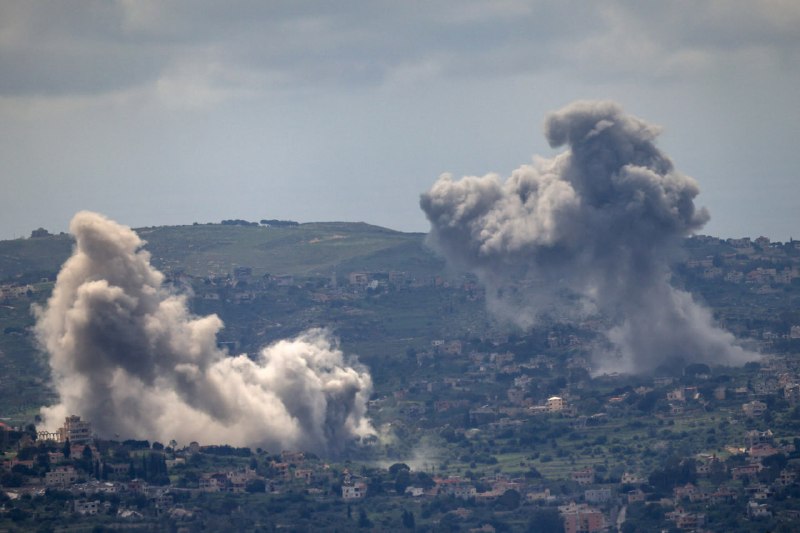
At 10:41 UTC on 20 June 2026, monitoring channels reported that Israeli airstrikes across southern Lebanon had killed at least five civilians and one Lebanese soldier, the latest round in an air campaign that has run in parallel with — not after — a US-brokered ceasefire process. Three hours earlier, the same corridor produced the diplomatic counter-image: US special envoy Steve Witkoff travelling to Switzerland to join Jared Kushner in what channels described as "ongoing negotiations following a ceasefire in Lebanon." The two scenes, airstrikes and shuttle diplomacy, are no longer contradictory features of this war. They are its operating system.
What is unfolding in Lebanon is not a single conflict but three overlapping ones: an Israeli campaign against Hezbollah infrastructure, an Iranian effort to preserve a residual deterrent through its Lebanese proxy, and an American bid to convert battlefield exhaustion into a paper architecture durable enough to hold until the next crisis. The 20 June airstrikes and the Witkoff-Kushner mission are the two visible edges of the same arrangement.
A southern front that did not stop when diplomacy started
The strikes reported at 10:41 UTC on 20 June fell on southern Lebanon — the Shia-majority border districts that have been the principal arena of the Israel–Hezbollah war since it opened in October 2023. The reported toll, at least five civilians and one Lebanese soldier, is consistent with the pattern of IDF operations in the area throughout 2026: targeted strikes against what the military describes as Hezbollah infrastructure, frequently with civilian casualties that the UN and Lebanese authorities document and that Israeli spokespeople generally characterise as incidental to legitimate targeting.
The fact that the strikes occurred at all, on the same day that a senior US envoy was flying to Switzerland to consolidate a ceasefire, is the most telling detail. Ceasefires in this corridor have rarely produced a clean halt in fire. The November 2024 arrangement that ended the main phase of the cross-border war was, from its first day, violated by both sides: Israel continued air activity against what it called Hezbollah reconstitution efforts, and Hezbollah kept a low-intensity rocket and drone presence. Each party has accused the other of breaking the terms. The Lebanese state, formally the sovereign, has functioned more as a witness than an enforcer.
The lesson the airstrikes underline is that the Israeli military campaign has not been suspended pending diplomacy. It has been calibrated to it. The strikes degrade Hezbollah's capacity to project force northward into Israel, while giving the Israeli negotiating team the argument that a bad deal is worse than continued pressure. For Beirut, the cost is being paid in civilian lives, destroyed villages, and a reconstruction bill that the World Bank has previously estimated in the billions of dollars.
Tehran's leverage, and its limits
If Israel is fighting to set the terms, Iran is fighting to keep a seat at the table. The 10:33 UTC report from PressTV — an outlet that operates as a foreign-policy instrument of the Islamic Republic and should be read as such — quoted a Hezbollah-alligned Lebanese legislator accusing the Lebanese government of "inaction" and stating that Hezbollah "will respond to any Israeli aggression," with Iran "committed to backing Lebanon." The framing is partisan; the underlying signal is structural.
Hezbollah's military position has been substantially degraded since 2024. Israel's campaign killed long-time secretary-general Hassan Nasrallah in September 2024 and severely damaged the group's senior cadre, its communications network, and much of its precision-missile project. Successors have been appointed; the political-military organisation has reconstituted enough to maintain a deterrent posture, but not enough to impose one. The legislative rhetoric carried in Iranian state-aligned media therefore serves two functions. Domestically, it tells a Lebanese Shia audience that the resistance is intact. Diplomatically, it tells Washington and Tel Aviv that any settlement that strips Hezbollah of its remaining deterrent capacity will be treated as a casus belli by Tehran.
The structural problem for Iran is that its principal leverage runs through a proxy whose autonomy has narrowed. Beirut's government, whatever its internal Shia-Christian-Sunni tensions, has been pressed by Saudi Arabia, Egypt, and the United States to constrain Hezbollah's rearmament. The Lebanese Armed Forces, equipped and partly funded by the US, France, and the Gulf, operate in the south alongside UNIFIL and have an interest in reclaiming sovereignty over a region that has not been under full state control for two decades. Iran's commitment to "back" Lebanon is real in rhetorical terms and limited in operational ones — a function of Israeli air superiority, Lebanese institutional pressure, and Iranian caution about being dragged into a direct war with Israel that its current economic condition cannot sustain.
The American middle: Kushner, Witkoff, and the architecture of an exhausted peace
The American role is the third leg of the triangle, and the one the 20 June reporting puts in sharpest relief. Witkoff's reported flight to Switzerland on 20 June to join Kushner marks a continuity rather than a new phase. Both men are central to the Trump administration's Middle East portfolio: Witkoff as special envoy, Kushner as the informal architect of the Abraham Accords framework now being extended, in effect, into Lebanon. Switzerland as a venue is significant — the Swiss have long hosted low-profile Iran–US back-channel work, and the location allows the Americans to project the appearance of European-hosted neutrality while running an agenda that is unmistakably Washington's.
What the Americans are buying with this diplomacy is time, not peace. A formal ceasefire in Lebanon, even one as leaky as the November 2024 arrangement, produces a financial effect: it unlocks reconstruction aid, calms maritime insurance markets, and gives Gulf donors a reason to reopen chequebooks to Beirut. It also produces a political effect: it allows the Israeli government to claim the war aims have been achieved without having to declare victory and govern an occupation. For the Trump administration, a deal on the model of the Abraham Accords — normalisation layered on top of a security settlement — would represent a deliverable in a region where deliverables have been scarce.
The counter-reading is that this is exactly the structure that produces the next round of violence. A ceasefire that neither disarms Hezbollah nor fully neutralises its Iranian patron leaves the underlying contest unresolved. The airstrikes of 20 June, hours before the negotiators convened, are the visible proof that the contest is still live.
What the wire reported, and what it did not
The English-language wire on 20 June was thin. Monitoring channels carried the strike report and the Witkoff travel note; Iranian state media carried the Hezbollah-aligned legislator's warning. The absence of detail is itself the story. There was no Israeli military spokesperson statement in the materials reviewed, no casualty breakdown by village, no indication of which specific targets had been hit, no Lebanese government readout, and no confirmation from the US State Department of the Witkoff–Kushner mission. Numbers — five civilians, one soldier — are initial and likely to be revised.
That epistemic thinness should discipline the analysis. The 20 June reporting establishes that strikes and shuttle diplomacy are running in parallel. It does not establish whether the strikes are coordinated with the American negotiating track, whether they reflect a tactical dispute inside the Israeli security cabinet about the wisdom of the Witkoff–Kushner initiative, or whether they are the routine continuation of a low-intensity air campaign that has been underway for months. The most plausible reading, given the pattern of 2024–2026, is that they are all three at once: coordinated in the sense that the IDF has a green light from the political level, contested in the sense that not every minister is comfortable with the diplomatic track, and routine in the sense that southern Lebanon has been under bombardment for so long that any given day is statistically similar to the last.
Stakes: a corridor that does not stay where it is
The stakes of the 20 June pattern are not confined to Lebanon. A successful ceasefire-and-reconstruction framework would, over a one-to-three-year horizon, give the Israeli northern front a stability it has not had since 2023, give the Lebanese state a chance to re-establish itself in the south, and give the United States a Middle East deliverable that the Abraham Accords architecture could absorb. Iran would retain a damaged but extant proxy and the political argument that it had prevented the dismantling of the "resistance."
The alternative trajectory is uglier. Continued strikes of the 20 June pattern, with civilian casualties and Lebanese state impotence, degrade the ceasefire's credibility. Hezbollah's calculus on whether to break it openly becomes more favourable. Iran's rhetorical commitment to "back" Lebanon is tested against operational reality. The Americans are left negotiating over a tattered document while the ground situation drifts. The worst-case version of that drift is a wider war — Israel striking Iranian assets directly, Iran responding against Israeli or Gulf targets, and the Lebanese ceasefire becoming a footnote to a regional conflagration.
The pattern of 20 June — airstrikes at 10:41 UTC, an Iranian-aligned warning at 10:33 UTC, an American shuttle mission launched at 10:27 UTC — captures the present equilibrium precisely. The war is not over. The diplomacy is not dead. The civilians of southern Lebanon are paying the carrying cost of the gap between the two.
How Monexus framed this: the wire on 20 June carried strikes, an envoy's flight, and a Hezbollah-aligned warning, but no Israeli or US readouts. The piece treats the three reports as the edges of one operating system rather than as three separate stories, and reads Iran's role through the structural limits on a damaged proxy rather than through its own rhetoric.
Wire provenance
This editorial synthesis draws on the following public wire/social posts:
- https://t.me/s/osintdefender
- https://t.me/s/osintdefender
- https://t.me/s/presstv
- https://en.wikipedia.org/wiki/Israel%E2%80%93Hezbollah_conflict_(2023%E2%80%93present)
- https://en.wikipedia.org/wiki/November_2024_Lebanon_ceasefire
- https://en.wikipedia.org/wiki/Steve_Witkoff
- https://en.wikipedia.org/wiki/Jared_Kushner
- https://en.wikipedia.org/wiki/Hezbollah
Follow the event.
These dated source records provide context. They do not retrospectively verify this archive article.
Separate what the nuclear watchdog reported from what it could not determine after the June 2025 strikes.
- https://t.me/s/osintdefender
- https://t.me/s/osintdefender
- https://t.me/s/presstv
- https://en.wikipedia.org/wiki/Israel%E2%80%93Hezbollah_conflict_(2023%E2%80%93present
- https://en.wikipedia.org/wiki/November_2024_Lebanon_ceasefire
- https://en.wikipedia.org/wiki/Steve_Witkoff
- https://en.wikipedia.org/wiki/Jared_Kushner
- https://en.wikipedia.org/wiki/Hezbollah