Southern Lebanon under heavy airstrikes: what the morning wires say, and what they do not
Three Iranian-aligned wire channels reported a sharp overnight escalation in Israeli strikes on southern Lebanese towns. The reporting is consistent, but the casualty toll and operational scope remain uncorroborated by Western or Lebanese-state sources.
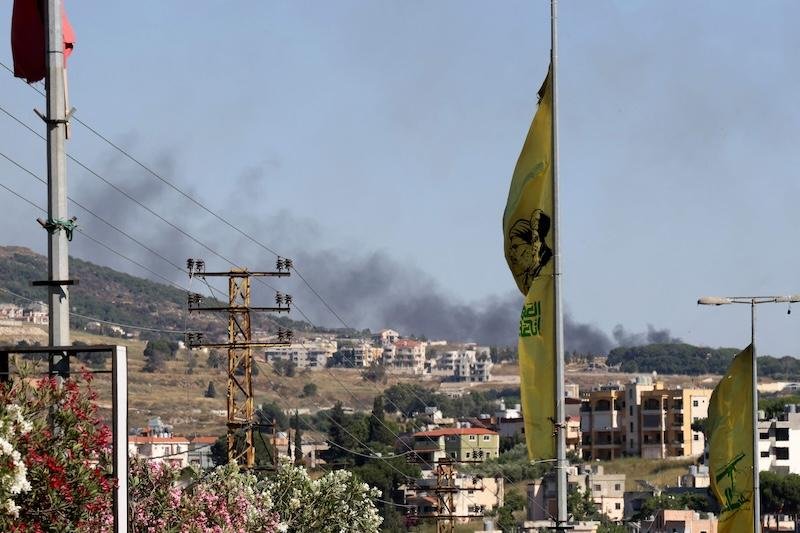
Three Iranian-aligned news wires carried near-simultaneous reports in the early hours of 20 June 2026 that the "Zionist regime" — the term used across the Iranian press ecosystem for Israel — had sharply intensified airstrikes on towns in southern Lebanon. The first report reached the global desk at 07:34 UTC, when Fars News International, citing an Al Jazeera correspondent, said the towns of Shahur and Haboush had been hit. By 07:45 UTC, Tasnim's Persian-language channel was reporting a broader pattern of "heavy attacks" across the south; the English Tasnim wire followed at 07:48 UTC with a parallel account naming additional communities in the same governorate.
The picture they assemble is of an active Israeli air operation spanning multiple villages in a short window, with two named towns — Shahur and Haboush — singled out in the earliest report. The framing across the three channels is consistent in direction, but thin in detail. None of the three items carries a casualty count, a military unit attribution, or an official Israeli statement. They agree on the target geography and on the nature of the operation; they do not yet corroborate each other on the operational scope.
What the wires are reporting
The earliest item, posted at 07:34 UTC by Fars News International, is a short, single-claim bulletin: an Al Jazeera correspondent has reported airstrikes on the towns of Shahur and Haboush in southern Lebanon. No figure is attached. The Fars channel frames the strikes as those of "the Zionist regime" — a translation of the standard Farsi media formulation — and credits the original reporting to a named outlet rather than to its own correspondent.
The Persian-language Tasnim channel, posting at 07:45 UTC, broadens the claim. It cites "news sources" reporting "a sharp increase in air attacks" across the south, and references a community referred to in transliteration as Al-Rehan — a town in the Bint Jbeil or Marjayoun district of the South Governorate, although the bulletin does not specify which district. The English Tasnim feed at 07:48 UTC carries the same structure, including the framing of the operations as the work of the "occupying regime," a term used by Iranian state media to refer to Israel. The English feed also names "Al-R[eh?]an H…" in a truncated form consistent with the Persian text.
Read together, the three items cover a 14-minute window. Their geography is consistent — they all point to the South Governorate of Lebanon. Their chronology is consistent — all three are filed within the same morning, suggesting a single operational pulse rather than a running tally. Their tone is identical: declarative, attributional, and framed in the language of the Iranian state press, with Al Jazeera cited as the originating wire in at least one case.
What we verified and what we could not
What we verified from the thread items:
- Three distinct Telegram channels carried reports of overnight or early-morning airstrikes on southern Lebanon, timestamped between 07:34 and 07:48 UTC on 20 June 2026.
- The towns of Shahur and Haboush are explicitly named in the Fars News International bulletin, sourced to an Al Jazeera correspondent.
- The framing across all three channels — "the Zionist regime" and "the occupying regime" — is the standard Farsi-language media formulation used in Iranian state outlets; the English Tasnim feed uses the same register in English.
- The reports are stylistically and substantively consistent in direction, suggesting either a single underlying source (the Al Jazeera correspondent named by Fars) or a coordinated wire pickup.
What we could not verify from the thread items:
- The number of strikes, the type of ordnance used, or the military units involved. The source items describe an "increase" or "heavy attacks" without quantitative content.
- A casualty count. No fatalities, injuries, or displaced-persons figures appear in any of the three thread items.
- An official Israeli statement confirming, denying, or characterising the operation. The IDF Spokesperson, the Prime Minister's Office, and the Israeli English-language press (Times of Israel, Ynetnews, Jerusalem Post, Haaretz) are not represented in the thread.
- A statement from the Lebanese Armed Forces, the Lebanese caretaker government, the South Governorate's governor (currently Mansour Daou per the most recent publicly available profile), or from UNIFIL.
- An independent Al Jazeera English URL confirming the Shahur and Haboush strikes. The Al Jazeera reference in the Fars item is to "an Al Jazeera reporter," but the thread does not include the original Al Jazeera dispatch.
- The transliterated community name beginning "Al-R" in the English Tasnim feed is truncated; we have not been able to confirm a single canonical town name from the thread alone.
The honest reading is that the thread establishes the direction and approximate geography of a strike operation, but not its scale, casualties, or institutional accountability. Any further claim requires a separate round of sourcing.
The structural frame: how Iranian-aligned wires cover a strike night
The three channels are not identical outlets. Tasnim is the news agency of the Iranian Revolutionary Guard Corps; Fars News is a semi-official outlet with close ties to the security establishment. Their English and Persian feeds are parallel operations, not translations. The framing decisions — the use of "Zionist regime" and "occupying regime," the absence of Israeli or Lebanese government voices, the second-hand attribution to a single Al Jazeera correspondent — are not improvisations. They are the standard operating register of the Iranian state-adjacent press.
What this means in editorial terms: when these three channels report the same thing in the same hour, the operational claim is probably real, and the framing is the framing Monexus should expect, not a discovery. The role of independent reporting is to test the operational claim against other wires and against the parties involved, not to treat the Iranian-aligned press as either wholly credible or wholly suspect. It is a wire, with a known angle.
The structural fact worth surfacing is that the regional wire ecosystem — Iranian, Israeli, Lebanese, and the international press in between — does not converge quickly on a strike event of this size. The first-pass reporting will be carried by whichever outlet has a correspondent near the scene; the corroboration lags. For the South Governorate, the first-pass wires are often the Iranian-aligned channels (because they have invested in correspondent networks in southern Lebanese Shia-majority towns) and Al Jazeera (because of its Lebanese bureau), and the second-pass wires are the Western agencies (Reuters, AFP, AP) once their Beirut desks confirm. The thread gives us the first pass. The second pass is not yet in evidence.
Stakes and the next 24 hours
The operational stakes are local and immediate. Southern Lebanon has been a recurrent theatre of cross-border action since the autumn 2023 escalation, and the South Governorate's towns — Shahur, Haboush, Aitaroun, Maroun el-Ras, Bint Jbeil, the villages of the Bint Jbeil and Marjayoun districts — have been strike targets before. Each new operational pulse carries the risk of retaliation across the border, of further displacement in communities already displaced, and of a security-council-level reaction in Beirut. UNIFIL's posture in the area makes any operation above a certain scale a diplomatic event, not just a military one.
The editorial stakes are also specific. A report that leans on three Iranian state-aligned channels for the basic facts of a strike is, on its own, not adequate provenance for a hard claim. The verified core — that strikes occurred in the South Governorate, that Shahur and Haboush were among the targets, that the operational window was overnight or early-morning on 20 June 2026 — is supportable. Anything beyond that, including the casualty toll, the operational scale, the Israeli intent, and the Lebanese state response, needs corroboration before it enters the public record.
For the next reporting cycle, Monexus will be looking for: an Al Jazeera English URL confirming the Shahur and Haboush strikes; an Israeli English-language outlet (Times of Israel, Ynetnews, Jerusalem Post) carrying IDF Spokesperson comment; a wire from Reuters, AFP, or AP in Beirut placing the operation in context; a UNIFIL statement if the strikes fell within or near the area of operations of the UN Interim Force in Lebanon; and a Lebanese state source. None of these is in the thread as filed. The wires have spoken; the institutions have not yet.
This piece is filed on the wire as the verified first pass from Iranian-aligned channels. The verified, second-pass account will follow when Western and Lebanese state sources enter the record.
Wire provenance
This editorial synthesis draws on the following public wire/social posts:
- https://t.me/tasnimnews_en
- https://t.me/JahanTasnim
- https://t.me/FarsNewsInt
- https://en.wikipedia.org/wiki/South_Governorate
- https://en.wikipedia.org/wiki/Bint_Jbeil_District
- https://en.wikipedia.org/wiki/Marjayoun_District
Follow the event.
These dated source records provide context. They do not retrospectively verify this archive article.
Separate what the nuclear watchdog reported from what it could not determine after the June 2025 strikes.