Three signals, one question: what is the second Trump administration actually running on?
A same-day convergence of moves — Geneva talks, a court rebuff at the consumer watchdog, and a 21% market line on a Trump–Kim summit — exposes how improvised the second-term agenda really is.
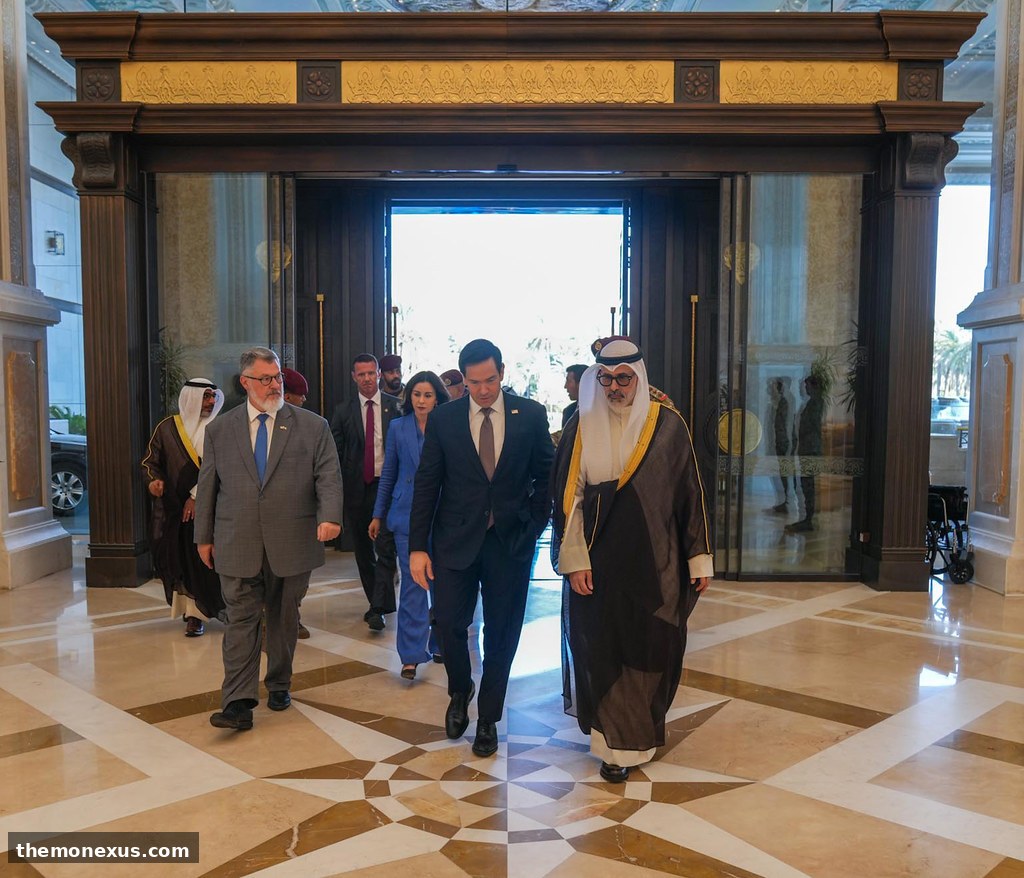
At 05:30 UTC on 20 June 2026, Reuters reported that a Trump administration envoy and an Iranian minister were travelling to Switzerland for talks — the second publicly tracked channel between Washington and Tehran this month. Ninety minutes earlier, the same wire carried a separate dispatch: a US appeals court had blocked the administration from enacting fresh plans to slash staffing at the Consumer Financial Protection Bureau. And on a prediction market tracked the previous afternoon, traders were giving a 21% chance that Donald Trump meets Kim Jong Un before the year is out.
Read in isolation, these are three small stories. Read together on the same news day, they describe a White House running on improvisation rather than doctrine — and the pattern is more revealing than any one of the items on its own.
Diplomacy by travel itinerary
The Geneva-tracked contact with Tehran matters less for its content than for what it reveals about process. Reuters' confirmation that an envoy and a minister are heading to Switzerland for talks is, on the record, the entirety of what is known. There is no announced framework, no text on the table, no agreed deliverable. Compare that to the structured back-channels that have historically preceded US-Iran negotiations — months of Omani mediation, prisoner packages sequenced against sanctions relief, IAEA access tied to specific verification steps.
None of those scaffolding items appear in the reporting. The signal here is the absence: the administration appears willing to fly ministers across the Atlantic on the strength of a headline commitment, with no visible architecture underneath. Iranian state-aligned outlets have their own reading of what such trips are worth — press tours, photo opportunities, leverage in domestic politics in Tehran — and they are not wrong to suspect that the diplomatic optics are doing most of the work. The structural question is whether Washington is negotiating, or merely performing negotiation, and the sources do not yet let a reader tell the difference.
A court that will not be deferred to
The CFPB story is, on its surface, a routine administrative-law tussle. The administration wants to thin out the agency created after the 2008 crisis; an appeals court, on 20 June 2026, said no — at least to the specific new staffing cuts proposed. That procedural detail is what makes the item genuinely informative.
In the first Trump term, agency restructuring was largely a fait accompli: the slow gutting of career civil-service protections, the appointment of leadership openly hostile to the agency's mission, the steady bleed of enforcement resources. Courts pushed back intermittently, but rarely in a way that reset the trajectory. The fact that an appeals court is willing to block a new staffing-reduction plan suggests that the second-term project of hollowing out the consumer-finance watchdog is hitting more friction than the analogous first-term effort did. The institutional muscle memory of the federal courts — staffed, by now, with a mix of first- and second-term appointees — appears to be reasserting itself, at least on this file.
That carries political weight the wire framing does not fully capture. The CFPB is not a glamour agency; it does not move voters. But it is the place where predatory lending, illegal debt-collection, and mortgage-servicing abuses actually get reined in. Whether the court order holds, gets stayed, or quietly erodes in subsequent rounds will determine whether ordinary American households feel the second-term policy mix as anything other than a redistribution of risk from finance onto consumers.
The Kim line on Polymarket
The third signal is the smallest and possibly the most honest. A prediction market tracked on 19 June 2026 priced a Trump–Kim meeting this year at 21% — meaningful enough that traders are taking it seriously, low enough that the bet is closer to a tail-risk position than to a base-case. That is a useful read on where the second-term foreign-policy portfolio actually stands.
The North Korea file has been dormant for most of the past two years, and the market is in effect saying: dormant, not dead. Trump officials have an incentive to keep the option open because a summit, if it happens, is by definition a television event — and television events are the currency this administration trades in. The countervailing reality is that there is no visible diplomatic scaffolding for a 2026 meeting either: no working-group channel, no announced preconditions, no release of any negotiation framework that the public can assess. The 21% number is the market's honest acknowledgement that in this White House, presidential time and attention can be redirected at the speed of a cable-news segment.
What ties the three together
Strip the three items of their respective political packaging and a single pattern emerges. Each move is announced at speed; each is small enough that no single item demands a doctrine; each can be reversed or expanded on a tweet; and none rests on a publicly visible architecture that survives the next news cycle. That is not necessarily a failure mode — it may simply be how this White House intends to govern. But it carries identifiable costs.
For Iran, a Geneva trip without a framework either produces a headline that ages badly or a real negotiation that the public only learns about after the fact. For American consumers, a court order without follow-through means the CFPB story becomes a slow attrition rather than a clean ruling. For North Korea, a 21% market line means the second-term agenda is partially priced as a lottery ticket.
The structural frame, stated plainly: an administration that treats policy as a sequence of episodic moves rather than as a coordinated programme ends up dependent on whatever institution is willing to hold the line at any given moment — courts this week, perhaps a Senate next week, perhaps a foreign ministry the week after. The three signals above are not a theory of government. They are, however, the closest thing to a documented one that the public has.
What remains genuinely uncertain
The sources do not specify what the Geneva talks will cover, whether the court order will be stayed on appeal, or what would actually need to be true for the Polymarket line to drift sharply upward. The Reuters dispatches are limited to confirmed travel and to the procedural posture of the CFPB litigation. The market data point is a snapshot, not a forecast. A reader who wants to know which of these items is decisive will have to wait, at minimum, until the next filing cycle and the next round of travel announcements.
Desk note: this publication treats the three same-day signals as a single pattern rather than three separate stories — a framing the wires themselves do not offer. The Reuters reporting is the factual floor; the prediction-market line is included as market-sentiment data, not as editorial endorsement.
Wire provenance
This editorial synthesis draws on the following public wire/social posts:
- http://reut.rs/4vrVKvK
- http://reut.rs/3SapLlb