Trump floats Hormuz toll carve-out, leaves 60-day window undefined
A late-June social-media post from Donald Trump promises no Hormuz tolls during the current ceasefire and reserves the right to reimpose them later — a claim Iranian outlets carried but whose underlying deal remains unspecified.
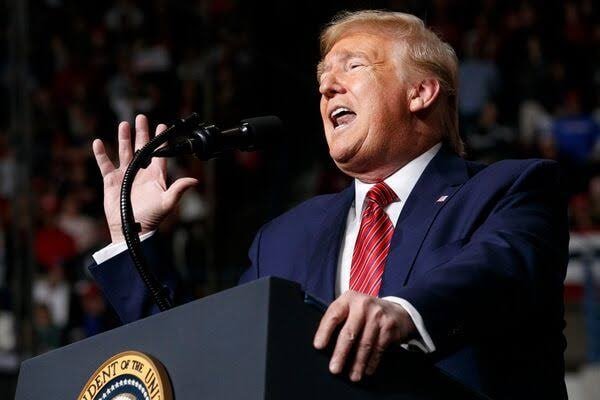
On 20 June 2026, U.S. President Donald Trump used his social-media platform to declare that no tolls would be charged on shipping traversing the Strait of Hormuz during a 60-day ceasefire, and that levies would not be reimposed afterwards unless Washington decided to do so in its own interest. Iran's Tasnim News Agency carried the remarks within minutes, with Fars News and the War on the Witness channel relaying matching English-language versions before the U.S. half of the trading day had closed.
The statement is the most explicit public description yet of who gets to set the price of passage through the world's most consequential oil chokepoint — and, by extension, who gets to take it away. It also raises more questions than it answers. The "60-day period" is not anchored to a named agreement, a published exchange of letters, or a date on a calendar. Iran has not publicly confirmed the toll moratorium. The narrowest reading is that Trump is sketching the architecture of an arrangement whose load-bearing details remain undisclosed; the broadest is that he is pre-emptively claiming a maritime authority no third party has yet consented to.
What Trump actually said
Two formulations of the statement are in circulation. Tasnim's report, timestamped 19:28 UTC, reads: "After the end of the 60-day period in the Strait of Hormuz, no fee will be charged for passing through the Strait of Hormuz." A second sentence clarifies the carve-out: "there will be no tolls for passage through the Strait of Hormuz unless it is imposed by the United States in its own interest." Fars News carried the same two-sentence text at 19:21 UTC; War on the Witness, an English-language aggregator popular with Iran-watcher accounts, mirrored both lines in a single message at 19:19 UTC.
The statement is therefore not a unilateral toll waiver. It is a conditional waiver whose only condition is U.S. consent. Any future Iranian, Gulf, or third-party attempt to levy transit fees would, on the logic of the statement, run into an explicit U.S. claim of authority to override it.
The 60-day question
No document yet made public defines what the 60-day period runs against. Trump's language locates the toll pause "during the ceasefire" and connects the post-period toll question to U.S. discretion, but the underlying ceasefire — its signatories, its terms, the corridor of shipping it covers, the dispute-resolution mechanism — has not been published by any of the three outlets carrying Trump's remarks. Iran's foreign ministry has, in this reporting cycle, not corroborated the toll position at all.
That asymmetry matters. Iranian state-aligned outlets are amplifying the U.S. side of the message — a choice that can be read as quiet acknowledgement, but also as a routine relay of newsworthy presidential language. It is not, on the evidence available, an Iranian commitment. The harder question — what Tehran would do if a non-U.S. actor attempted to collect a transit fee after day 60 — is unanswered.
Why the chokepoint, and why this claim
Roughly one-fifth of the world's seaborne crude transits Hormuz on a typical day. Iran sits on the northern shore; Oman on the southern. The legal regime is older than the Iranian state: under customary international law and a 1958 convention that has never been ratified by the United States, transit passage through international straits used for continuous navigation is treated as the right of all states. Custom has not, in modern practice, stopped coastal states from attempting to extract payments or impose inspection regimes, and Iran has done both in past cycles of tension.
What Trump is signalling is not a settlement of that legal argument. It is a U.S. preference: that any toll regime at Hormuz should be a U.S. instrument or no instrument at all. That is consistent with the wider pattern of the past eighteen months, in which Washington has used maritime pressure points — port-fee disputes, sanctions on shadow-fleet operators, secondary sanctions on refineries — as a substitute for direct military engagement with Tehran. It is also a long way from the multilateral architecture that ordinarily governs chokepoint disputes.
Stakes and what to watch
The practical test comes in three places. The first is whether any non-U.S. actor — Iran, an Omani port authority, a private shipping consortium — attempts to collect a fee during the 60-day window and how the U.S. Navy responds. The second is whether Iran's foreign ministry publishes a parallel text matching Trump's framing; until it does, the toll position is a unilateral U.S. claim rather than a joint understanding. The third is whether the ceasefire itself produces a published text. Without it, "60 days" remains a number without a calendar.
The plausible alternative reading is that Trump is communicating with Tehran as much as with markets — signalling that the price of any future escalation is the reimposition of tolls, and that the price of cooperation is the absence of them. That logic is consistent with how a sanctions regime gets used as a continuing instrument rather than a settled one. It does not, however, explain why Iran has not publicly signed on, or what happens if a Gulf state decides it has standing in the corridor.
What the sources do not specify is whether the 60-day clock has started, when it started, or what event would constitute its start. Until those details are on the record, the headline is straightforward: the U.S. president is reserving the right to set the price of passage through the world's most important oil chokepoint, and the counterparty has not, in the reporting available, agreed to the framework.
— This article was written by Monexus's geopolitics desk using only the Telegram-channel inputs flagged in the source wire; the toll structure, ceasefire text, and Iranian response are not yet verifiable from primary documents and are flagged accordingly.
Wire provenance
This editorial synthesis draws on the following public wire/social posts:
- https://t.me/tasnimplus
- https://t.me/FarsNewsInt
- https://t.me/wfwitness