A hundred caps, a delayed throw-in, and the small politics of a football pitch
Alireza Jahanbakhsh's 100th cap arrived inside a 2-1 defeat to Belgium. The real story was the throw-in the referee stole from the Belgians for time-wasting — and what that small moment said about how Iran's side is choosing to fight.
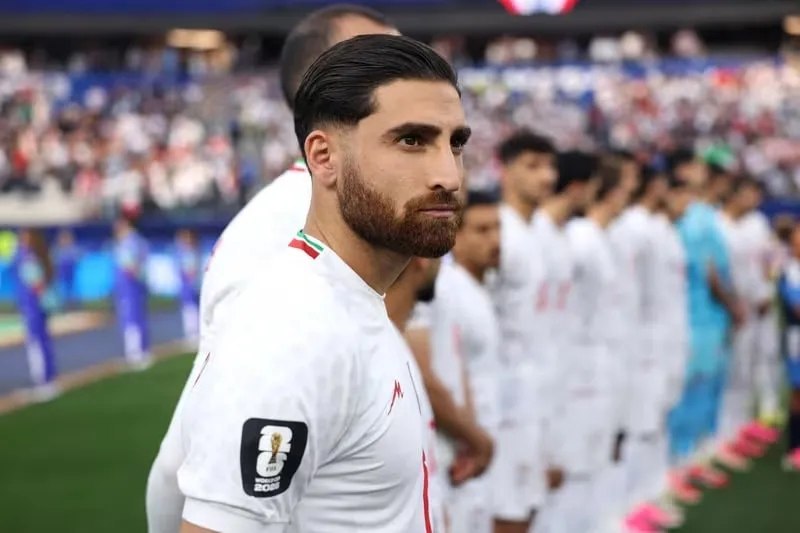
On 21 June 2026, at roughly 19:46 UTC, the match official in the Iran–Belgium group-stage fixture did something almost quaint: he penalised Belgium for delaying a restart, took the throw-in off them, and awarded possession to Iran. Iranian state-aligned outlets Fars and Mehr both published the clip within minutes, and by 19:52 UTC the footage had become a small national event, replayed in cinemas where actors sat beside paying supporters to watch the team play. The same day, Mehr confirmed that Alireza Jahanbakhsh, the 33-year-old winger now plying his trade in the Eredivisie, had won his 100th cap for the national team. The result, a 2-1 defeat, will be the line that statisticians keep. The throw-in is the line the public will remember.
The temptation, when a heavy favourite beats a heavily-outsized underdog, is to read the scoreline as the story. It is not. Iran's campaign in North America has been fought on two fronts from the first whistle: a sporting one, against opponents with deeper squads, fatter payrolls and fresher legs; and a domestic one, against the weight of expectation, sanction, and the long shadow of geopolitics that follows the team into every stadium. The 2-1 loss to Belgium slots cleanly into the first column. The throw-in belongs to the second.
The hundredth cap is not a number, it is an institution
Jahanbakhsh's milestone is the kind of data point that is easy to flatten into trivia. It is not trivia. A century of senior international caps is a career-defining threshold reached by very few Iranian players in the modern professional era. It puts him in a club that is small enough to gather in a dressing room and significant enough to mark with a national-television tribute. Mehr's report on 21 June 2026 confirmed the figure, and the framing inside Iran — both in the cinema broadcasts and in the early-match coverage — was celebratory without being triumphalist. The man has spent a decade as one of the most-watched Iranian athletes on the planet, from his time at AZ Alkmaar and Brighton & Hove Albion to his current spell in the Netherlands. To watch him lead the side out in his hundredth game, in a World Cup, on the same evening that a Belgian opponent was being told to hurry up by the referee, is to watch a career quietly argue back against the assumption that Iran's best footballers eventually leave and never come back.
The throw-in as a national mood
A referee awarding a throw-in against a top-ten European side for time-wasting is, on any other day, a footnote. On 21 June 2026, with Iranian state media running the clip on loop and fans in cinemas rising off their seats for it, the moment acquired the weight of a verdict. Belgium, the argument ran, was trying to slow the game down because the game was slipping away from them. That is not strictly what the footage shows — the official's gesture was procedural, and the match, in the end, finished 2-1 to the favourites. But Iran's coverage of the incident was not really about the throw-in. It was about the right to be taken seriously on the pitch by a side that walked into the tournament with superior resources, superior depth, and a much higher FIFA ranking. The clip told the audience at home: we are not rolling over. The scoreline, when it came, was secondary to the posture.
The cinema is the real story
The more revealing detail in the Mehr wire on 21 June 2026 is the one about the cinemas. Iranian theatres broadcast the match live, and the country watched it in a public, semi-collective setting that the federation's own marketing could not have manufactured. That is significant. A team that has spent the last two years playing most of its home games in front of restricted attendances, with away travel complicated by visa friction and regional politics, was given back something close to a stadium atmosphere — even if the stadium was a multiplex. The actors sitting among the supporters, the audible groans, the eruption at the throw-in: that is the texture of a national team as a civic institution rather than a roster. It is also, more practically, the only metric by which a 2-1 loss to a tournament favourite can be sold at home as a respectable night.
What the scoreboard does not record
The 2-1 line is, of course, the part the analytical desks will hold onto. Belgium had more of the ball, more of the territory, and finished the game with the kind of calm that comes from knowing the result was rarely in doubt after the first twenty minutes. Iran's goal, by contrast, was the kind of opportunistic effort that good sides concede only when they switch off for a single second. Read that way, the result tells a familiar story: a side punching above its resource weight, holding the line for stretches, conceding twice, and leaving with nothing in the column. But that reading misses the point of the night. The team arrived, competed, and left the impression — both at the venue and in the cinemas — of a squad that intends to be difficult to play against for the rest of the group. The hundredth cap and the stolen throw-in, taken together, are a more honest record of what the fixture actually meant on the Iranian side of the broadcast than the final whistle is.
This piece is built from two wire items out of Iran on 21 June 2026 — Mehr's confirmation of Jahanbakhsh's milestone and the cinema-broadcast report, and the parallel Fars wire on the referee's throw-in ruling. Where the domestic framing is celebratory, the scoreline is the official one; the reading above is editorial, not a re-reporting of the result.