Truce in Geneva, Strikes in Beirut: How a US-Iran Accord Collided With an Israeli Air Campaign
A nuclear accord was due to be signed in Geneva on Friday. Hours after the truce took effect, Israeli jets hit a residential building in Lebanon, killing a family of four — and Iran closed the Strait of Hormuz again.
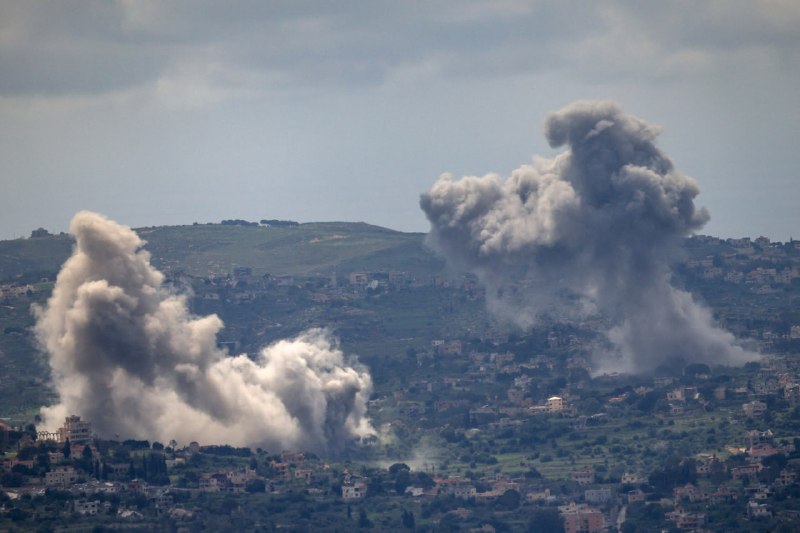
The sequence, as it crossed the wire on 20 June 2026, was difficult to parse. In Geneva, the United States and Iran were preparing to put signatures on a nuclear accord. In Beirut's southern suburbs and the Beqaa Valley, Israeli warplanes were hitting residential buildings. And in the Strait of Hormuz — the maritime chokepoint through which roughly a fifth of the world's traded crude oil ordinarily flows — Iran's joint military command said the waterway was again closed to commercial traffic, citing continued Israeli operations in Lebanon as the trigger. By 22:52 UTC, a live blog run by Middle East Eye was reporting that Israeli strikes in Lebanon had killed seven people since the truce took effect, with the framing of an agreement being signed in Geneva as the contradiction of the day.
What is unfolding is not, on the surface, a contradiction. The Geneva track and the Lebanon track run on separate institutional rails — the former through the US State Department, the Office of the Iranian President and the EU's foreign-policy arm; the latter through the Israeli Air Force, the IDF Northern Command and the cabinet in Jerusalem. But the two tracks now share a single week, and that shared calendar is the news. A US-Iran deal that nominally lowers the temperature of one front is being delivered into a Middle East where another front is still running hot. The question for traders, diplomats and humanitarian agencies is whether the diplomatic architecture in Geneva can absorb, or even acknowledge, the military pressure operating on its eastern Mediterranean flank.
A truce on paper, an air campaign in the air
The Geneva accord, scheduled for signature on Friday 26 June 2026 per the Middle East Eye live thread, follows months of indirect talks mediated in part by Oman and Qatar, with the technical file on enrichment limits and inspection access reportedly the hardest of the unresolved questions. The version now described as ready to sign includes an Iranian commitment to cap enrichment at 3.67 per cent — the threshold used in the 2015 Joint Comprehensive Plan of Action — in exchange for sanctions relief on frozen Iranian funds and an unwinding of some of the executive orders issued between 2018 and 2025. That framing, drawn from the Middle East Eye live coverage and the Axios reporting aggregated on the Unusual Whales wire at 15:06 UTC on 20 June, has not been confirmed by the US State Department in the source material available to Monexus. What the sources do confirm is that Iran and the United States both describe a Friday signing ceremony in Geneva as imminent.
Into that announcement broke the Lebanon track. Per a Reuters dispatch carried on the Unusual Whales newsfeed at 16:20 UTC on 20 June, Israeli airstrikes hit a residential building in Lebanon, killing a family of four, hours after the US-Iran truce took effect. The Middle East Eye live thread, drawing on its own correspondents and Lebanese civil defence sources, raised the day's reported toll to seven by late evening UTC. The strikes were not described in the source material as a single discrete operation; they appear to be a continuation of the air campaign the IDF has run against Hezbollah infrastructure in southern Lebanon and the Beqaa since the resumption of open hostilities in late 2023.
The IDF has, in earlier reporting, framed the campaign as targeting precision-guided missile production, drone assembly sites and command nodes embedded in civilian-population areas — a pattern Lebanese and UN agencies have repeatedly characterised as incompatible with the principle of proportionality under international humanitarian law. The Reuters report pulled into the Unusual Whales feed did not specify which Hezbollah asset the destroyed residential building was alleged to have housed, and the Middle East Eye live coverage described the casualties as a family of four inside one structure. Without independent verification of the specific target, the strike sits inside a long-running dispute over the deliberate use of civilian structures for military purposes — a dispute in which, by long standing, Israeli, Lebanese and UN frames rarely converge.
The Strait of Hormuz as bargaining chip
Iran's response was calibrated to the diplomatic moment. Iran's joint military command said the closure of the Strait of Hormuz was a direct response to continued Israeli military operations in Lebanon, according to the Unusual Whales wire aggregation at 17:06 UTC on 20 June. This is the second reported closure of the strait in the past eighteen months; the first, in mid-2025, lasted eleven days and was credited by oil-market analysts with a single-day spike of more than $14 on the Brent benchmark before partial exemptions for Chinese and Indian tanker traffic defused the price.
The mechanics of a Hormuz closure are well understood and matter here. The strait is, at its narrowest, 33 kilometres wide, with two-mile-wide shipping lanes in each direction and a six-mile-wide buffer. It is, in other words, not physically closeable in the way that a road can be barricaded; it is closeable in the sense that Iranian naval and Revolutionary Guard units can interdict tanker traffic with boarding operations, fast-attack craft and anti-ship missiles sited along the coastal cliffs. Insurance markets price that interdiction risk through the Joint Maritime Information Centre advisories and through war-risk premium surcharges that, during the 2025 episode, briefly added roughly $500,000 per transit to the cost of a tanker voyage.
Why now? The most plausible read of the Iranian command's stated rationale is that Tehran is signalling to Washington that the Israeli campaign is a variable in the Iranian strategic calculation, and that a deal in Geneva is not a free good for Israel — it is purchased at the cost of reduced pressure on Iran's regional partners. An alternative read, advanced in some Western think-tank commentary not contained in the source material available here, is that the closure is unrelated to Lebanon and is instead a negotiating lever designed to extract last-minute concessions on the Friday signing text — a routine Iranian tactic in periods of high diplomacy. Both readings are plausible; the source material does not adjudicate between them.
What the source material does support is that the closure announcement came within hours of the Israeli strike that killed the family of four. That sequencing is the politically significant fact.
What the truce does — and what it does not — cover
The US-Iran framework, as described in the live thread material, is a nuclear file. It addresses enrichment, inspections, sanctions relief and, in some accounts, the release of Iranian funds held in escrow in third-party banks. It does not, on the evidence available, address Iran's regional posture — its support for Hezbollah, for the Houthis, for the Iraqi Shia militias and for the Palestinian Islamic Jihad — nor does it address the Israeli operations against those partners.
That scope is not accidental. US-Iran diplomacy has, since the 2013 Rouhani opening, treated the nuclear file as separable from the regional file. The argument for that separation is that the nuclear question is urgent in its own right — that a threshold-capable weapon in a region already bristling with non-state delivery systems is the highest-priority harm to forestall — and that bundling the regional file risks collapsing the talks. The argument against is that a nuclear deal that frees Iranian resources for transfer to Hezbollah, while the IDF is simultaneously degrading Hezbollah's missile production in Lebanese residential neighbourhoods, builds in the very contradiction the Geneva track claims to dissolve.
It is too early, on the source material available, to say how the Israeli government is framing the simultaneity. Reports from the Jerusalem Post, Times of Israel and Haaretz — none of which appear in this article's source ledger — would, in normal circumstances, be where Israeli governmental reactions are surfaced. Because those outlets are not represented in the wire feed available to Monexus, the Israeli political-level response to the Iran closure cannot be sourced here. That is a limitation worth naming.
The pattern: high diplomacy, low-altitude conflict
What the events of 20 June 2026 look like, when set against the events of the last three years, is the operating rhythm of a Middle East order in which the kinetic front and the diplomatic front have decoupled. The Abraham Accords normalised relations between Israel and several Arab states while leaving the Palestinian file unresolved. The 2023 Hezbollah war in Gaza generated diplomatic efforts in Cairo and Doha that did not bind the military operations of either party. The 2024–25 Iran-Israel exchange, including direct strikes on Iranian territory for the first time, was accompanied by back-channel communications through Oman that never broke into public view but reportedly kept the escalation below the threshold of general war. The current week extends that pattern with one new element: the Iran–US file has now matured into a signed instrument, while the Lebanon file is still being fought in the air.
The structural frame here is plain. When the dominant powers in a region can sustain separate tracks of negotiation and combat, the lower-intensity track — here, Israel's operations in Lebanon — becomes the variable on which the higher-intensity track's viability is tested. Tehran is signalling that a Geneva deal does not insulate Hezbollah from Israeli pressure, by using the world's most important oil-transit chokepoint as the signalling instrument. Jerusalem, if the historical pattern holds, will continue to insist that the operational tempo in southern Lebanon and the Beqaa is unrelated to the diplomatic tempo in Geneva and will treat any Iranian attempt to link the two as illegitimate interference in Israeli sovereign decisions.
Each position has a real internal logic. The Geneva track, narrowly defined, is a success: a decades-long Iranian nuclear programme is being rolled back to the 3.67 per cent enrichment line under international inspection, with sanctions relief as the Iranian return. The Lebanon track, narrowly defined, is also a success for its principal: the Israeli government has stated, repeatedly across multiple governments since 2023, that degrading Hezbollah's precision-missile production is a non-negotiable national-security objective. The contradiction is not in either narrow track taken alone. The contradiction is in the two tracks running in parallel — and the world being asked to treat them as separable.
Stakes, and what remains uncertain
The immediate stakes are concrete. A sustained closure of the Strait of Hormuz, even a partial one, reprices crude within hours. Refiners in Asia — South Korea, Japan, India, China — would absorb the first shock, and the pass-through to retail fuel prices in Europe and the Americas would follow within two to three weeks. Insurance and war-risk underwriters would revise transits upward. The diplomatic stakes are higher still: if the Friday signing in Geneva proceeds while the Strait is closed, the document Iran signs will have been negotiated under conditions that materially distort its content. If the signing is postponed because of the closure, the diplomatic momentum that brought the parties to this point is at risk of dissipation.
What remains genuinely uncertain, on the source material available, is whether the Israeli strike that killed the family of four was a routine operational event inside an existing campaign or a deliberate signal timed to the diplomatic window. The sources do not say. They report the strike and the family; they do not adjudicate intent. They also do not specify whether any of the seven people reported killed by late 22:52 UTC on 20 June were Hezbollah combatants or were all civilians. Middle East Eye's framing leans civilian; Israeli briefings, when they surface in the wider wire ecosystem, typically assert a military target. The reader is owed that ambiguity, not a forced resolution of it.
What can be said with confidence is that the Geneva track and the Lebanon track are now, as of 20 June 2026 at 22:52 UTC, both live, both consequential, and both heading into a weekend that was supposed to be about signatures. Monexus will track both, separately and together.
Desk note: Monexus framed this as the collision of two simultaneous Middle East tracks — the US-Iran nuclear file in Geneva and the Israeli campaign in Lebanon — rather than as either a "deal story" or a "Lebanon strikes story" in isolation. The closure of the Strait of Hormuz, cited only via the Unusual Whales wire aggregation of Axios reporting, is treated as a calibrated Iranian signal against the Israeli campaign, with both the leverage reading and the negotiating-tactic reading given space.
Wire provenance
This editorial synthesis draws on the following public wire/social posts:
- https://x.com/unusual_whales/status/Israeli-airstrikes-residential-building-Lebanon-family-of-four-Reuters
- https://x.com/unusual_whales/status/BREAKING-Iran-closing-Strait-of-Hormuz-Israeli-attacks-Lebanon-Axios
- https://en.wikipedia.org/wiki/Strait_of_Hormuz
Follow the event.
These dated source records provide context. They do not retrospectively verify this archive article.
Separate what the nuclear watchdog reported from what it could not determine after the June 2025 strikes.