Friendly fire and the frame: what a Montreal shooting tells us about how the West reads its own violence
A Montreal shooting in a Jewish neighbourhood left one man dead, possibly from police fire. The incident has already fractured along the same fault lines that organise every Western gun debate — and exposes how quickly the frame hardens before the facts do.
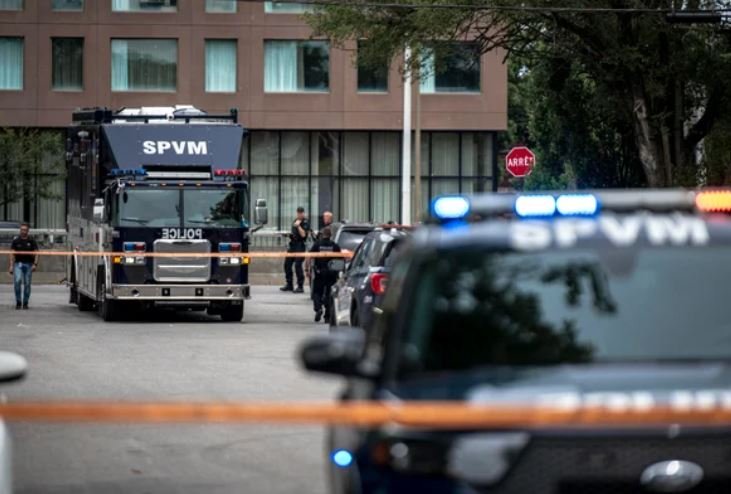
On the afternoon of 22 June 2026, a gunman opened fire on police in Montreal, Canada, in what is being treated as an attempted mass shooting in a Jewish neighbourhood of the city. One man — described in early reporting as Jewish — is dead, and one of the most consequential open questions is whether he was killed by the gunman or by officers returning fire. According to a brief from Israeli reporter Amit Segal circulating on Telegram at 19:09 UTC, the possibility that the bystander was accidentally struck by police shots is being actively investigated. By 19:20 UTC, OSINT-focused channels were circulating footage of the incident and noting, on the record, that the close-quarters nature of the engagement was reminiscent of the 2016 Dallas police shooting. The facts are still moving; the framing, predictably, is not.
The incident lands inside a Canadian public sphere that has spent the last two years arguing — often badly — about how to talk about antisemitism, policing, and the small but visible Jewish communities of cities like Montreal, Toronto, and Vancouver. It also lands inside a much older argument about how Western democracies narrativise violence committed by, against, or near their Jewish populations. Within hours, the story was being sorted into pre-existing buckets. Some accounts emphasised the antisemitic motive. Others emphasised police error. The footage itself — a bystander cut down in a doorway, officers firing past civilians in a narrow street — does not yet answer which framing is correct. Both may be.
What the early reporting actually says
The thread material is thin but consistent. Telegram channel @rnintel, at 19:18 and again at 19:20 UTC, reported a mass shooting attempt in Montreal in which a gunman opened fire on police; a female officer is seen in circulated footage firing at a bystander who appeared to be attempting to flee. Amit Segal, at 19:09 UTC, added the key fact: a Jewish man was killed in an attack in the Jewish neighbourhood, and the question of whether he was hit by police fire is under investigation. OSINTdefender, reposted by @osintlive at 19:02 UTC, drew the explicit comparison to Dallas in 2016 — a reference point Western readers will recognise. In that case, a lone gunman ambushed police at a Black Lives Matter protest, killing five officers; the structural lesson drawn afterward was about how rapidly a chaotic urban combat situation can produce civilian and officer casualties from friendly fire.
None of the source items in front of this publication contains a casualty count beyond the single death, a suspect motive, or named institutional spokespeople. The reporting is initial. It is also unusually direct on one point: the victim appears to have been a Jewish bystander, and the police are at minimum a candidate cause of his death.
The frame fight, pre-emptive
Within minutes of the footage circulating, the interpretive lanes had already formed. The lane that will dominate English-language conservative media treats the incident as an antisemitic attack first, a policing story second. The lane that will dominate progressive and francophone media treats it as a policing story first, with antisemitic targeting as a contingent fact about neighbourhood and victim. The lane that dominates the international wire will, predictably, hold both at arm's length and lead with the official investigation.
This publication finds that the dominant Western framing of attacks on or near Jewish communities has a consistent pattern: the antisemitism is named, then bracketed; the policing failure, when one exists, is downgraded to a procedural footnote. The reverse pattern holds for attacks in other minority neighbourhoods, where structural critique leads. The asymmetry is the story, not the incident. The Montreal case is unusual precisely because it forces both reads into the same frame at the same moment — the dead man was Jewish, and the dead man may have been killed by the police who were there to protect him. There is no clean frame available. That discomfort is informative.
Friendly fire as a structural fact
The Dallas comparison is the right one and it is worth saying why. The 2016 attack killed five police officers and wounded several civilians in a chaotic, close-quarters engagement; the post-incident analysis, much of it never popularised, treated friendly fire and crossfire casualties as a predictable feature of urban active-shooter response, not a freak. The training, the rules of engagement, the geometry of American and Canadian streets, and the speed at which information travels through 911 systems all conspire to make bystanders the most exposed category in these events. When a Jewish man dies in a Jewish neighbourhood during a police response to a Jewish-neighbourhood shooting, the question is not whether antisemitism matters — it does — but whether the entire frame can hold.
The structural answer is that Western media is structurally poor at running two narratives in the same paragraph. The attack was antisemitic in its targeting, if the motive holds. The response was potentially lethal to the very community it was meant to defend. These are not competing truths; they are sequential ones. A reporting culture that can hold both at once would say so plainly. A reporting culture that picks one and lets the other sit in the footnotes is the culture that produced the current distrust, on every side.
What remains genuinely uncertain
A lot. The source material does not name the gunman, the victim, the police service, the specific neighbourhood, or the suspect motive. It does not specify how many bystanders were injured, whether the gunman is in custody, or whether charges have been filed. It does not contain a single quote from a named official. The investigation is the investigation, and the framing is the framing, and the two will not arrive at the same time. Readers should treat any account that has already picked a lane as a political artefact, not a piece of reporting. The hard facts — who fired, in what sequence, with what intent — will be settled by Quebec's police watchdog (the Bureau des enquêtes indépendantes) and by whatever inquiry follows. Until then, the frame is doing more work than the evidence. It always does, in the first 24 hours. The question is what gets built on that frame, and by whom.
— Monexus News, 22 June 2026. The desk note: the wire coverage as of this writing consists almost entirely of short Telegram dispatches and footage clips; the Montreal story is being framed faster than it is being reported, and this piece deliberately runs both the antisemitism read and the policing read in the same paragraph rather than picking one. Restraint, here, is the editorial position.
Wire provenance
This editorial synthesis draws on the following public wire/social posts:
- https://t.me/rnintel
- https://t.me/amitsegal
- https://t.me/osintlive