A Late-Night Storming of Al-Fawwar: When the Wire Goes Quiet, the Camps Take Note
Four dispatches inside two hours, one channel, no Western wire confirmation: the architecture of late-night raids in the occupied West Bank is being reported almost entirely by actors with skin in the game.
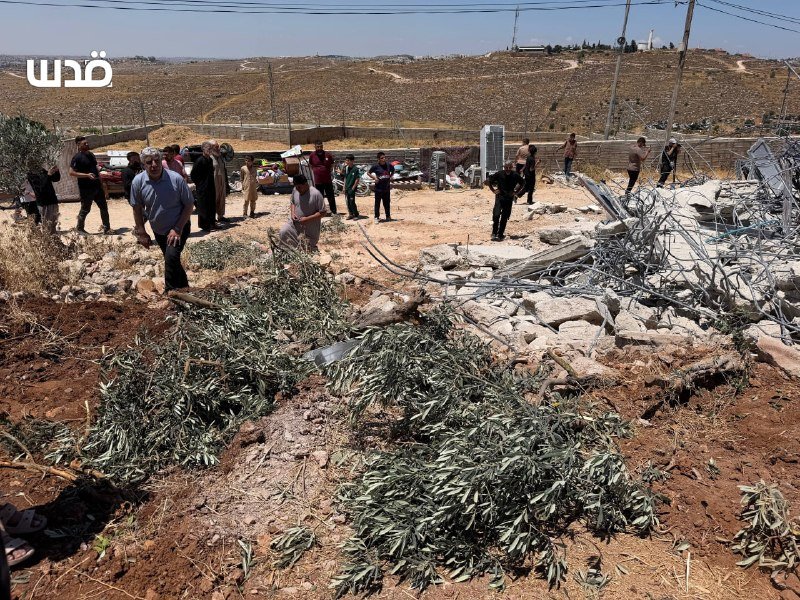
At 23:44 UTC on 22 June 2026, a single Telegram channel posted a four-line alert: Israeli forces were raiding homes and arresting young men inside Al-Fawwar refugee camp, south of Hebron. Twenty-eight minutes later, at 00:12 UTC on 23 June, the same channel reported a parallel operation in the eastern neighbourhood of Tulkarm. By 01:52 UTC, the storming of Al-Fawwar was still ongoing — three dispatches in 108 minutes from one outlet, with no English-language wire confirmation anywhere in the chain. The pattern is no longer novel. It is the pattern.
What is striking is not the raid itself, which fits a familiar operational rhythm of night-time incursions across the occupied West Bank. It is the informational ecosystem around it: a stream of urgent bulletins sourced to "local sources," translated and amplified through a channel whose editorial frame is openly sympathetic to the Palestinian side, and read out to an international audience that has no independent window on the ground.
The sourcing architecture
Al-Alam Arabic is a Beirut-based outlet affiliated with Iran's state broadcasting ecosystem; in plain English, it does not pretend to balance. Its bulletins use the term "occupation forces" by default and frame raids as a campaign against Palestinian civilians. That framing choice is not hidden from the reader. The problem is not bias in the abstract — every wire has it. The problem is structural: when the loudest signal on a raid comes from a channel with a declared editorial line, and no Israeli military spokesperson briefing, no Reuters or AFP confirmation, and no international NGO statement lands within the same news cycle, the ledger of "what we know" becomes effectively one-sided. Independent verification of the arrests named in the Al-Fawwar and Sa'ir reports — the latter posted at 22:31 UTC — requires local Palestinian civil society documentation (groups like B'Tselem or the Palestinian Red Crescent) that, on this night, had not yet posted.
The absence as story
The under-reported fact of the night is what did not arrive. A significant Israeli raid operation in two West Bank localities within a two-hour window would, in any previous news cycle, have generated a Times of Israel or Jerusalem Post follow-up by morning European time; an IDF spokesperson readout on the rationale (search for individuals, weapons seizure, dismantling of militant infrastructure) typically follows within hours. On this occasion, the silence is conspicuous. It does not mean the operations did not happen — the pattern matches hundreds of well-documented similar incidents over the past two years — but it does mean that the version of events reaching international readers is being shaped almost entirely by a single channel's editorial hand.
What that does to the record
The downstream effect is predictable. By 24 hours later, social posts citing "reports from Al-Fawwar" will reference casualty figures, arrest counts, and named individuals that no Western desk has independently confirmed. Some will turn out to be accurate; some will not. None will be traceable to a primary Israeli or international source. Coverage routinely defers to the language of whoever files first; when that filer has a declared interest, the reader inherits that interest without consenting to it. The structural fix is not editorial neutrality theater — that is impossible in real-time war reporting — but parallel sourcing on the same beat within hours, not days.
The stakes
For Palestinians on the ground, the operational reality of a raid — broken doors, held teenagers, hours of uncertainty — is unchanged by how the wire treats it. For the international reader, the absence of a competing read of the night means the framing baked into the headlines will be the framing carried forward. Over weeks and months, that asymmetry compounds. It is the asymmetry, more than any single night's raid, that deserves attention.
Wire provenance
This editorial synthesis draws on the following public wire/social posts:
- https://t.me/alalamarabic
- https://t.me/alalamarabic
- https://t.me/alalamarabic
- https://t.me/alalamarabic