Ethereum Foundation cuts a fifth of its staff as leadership turnover compounds a market that's already pricing distress
The Foundation is laying off roughly 20% of staff, the same day prediction markets put a 27% chance on ETH trading below $1,000 before year-end. A yen-linked stablecoin from SBI and a de-escalatory turn on Hormuz round out a turbulent morning for the broader crypto macro story.
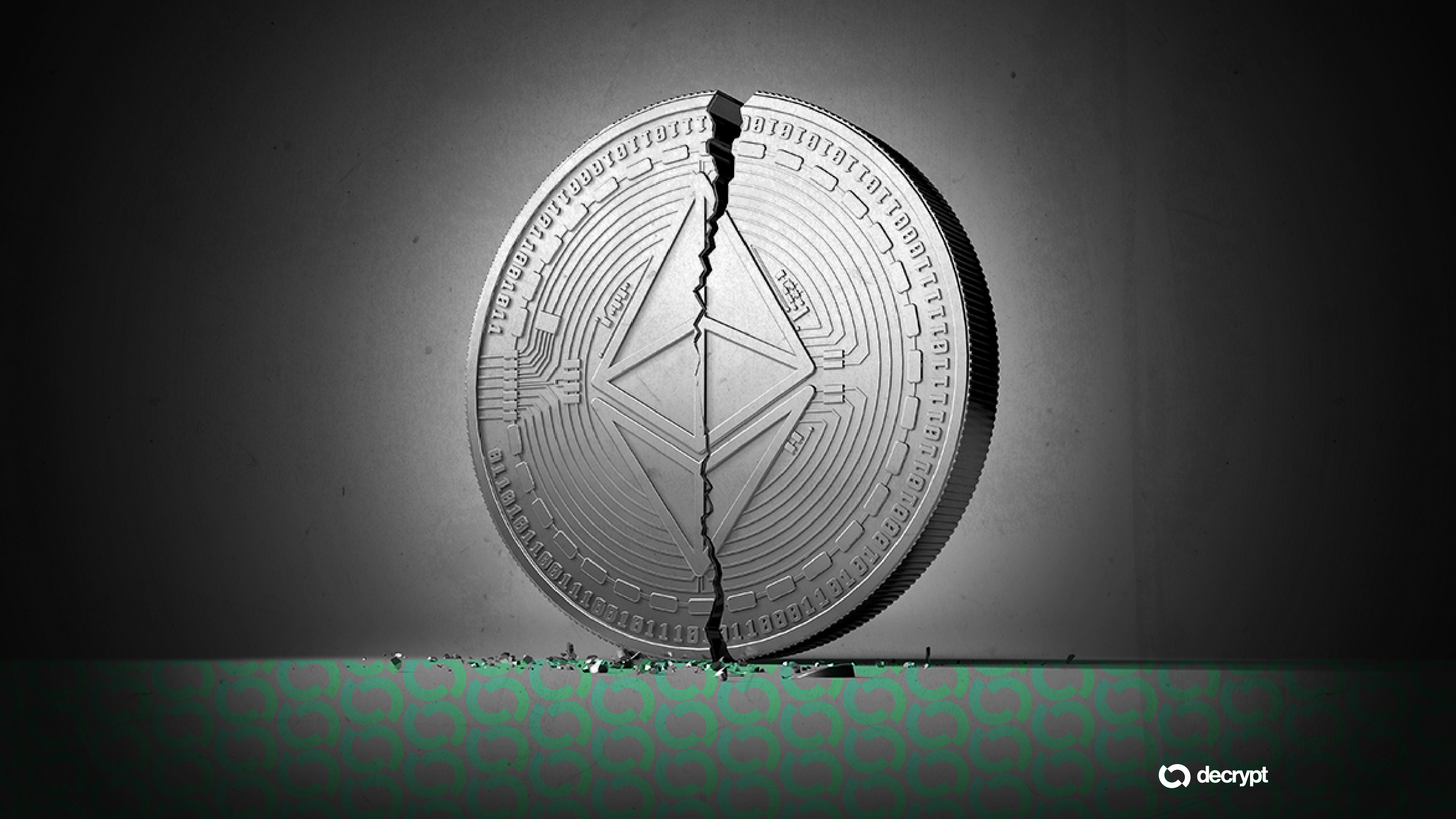
At 13:19 UTC on 23 June 2026, the Ethereum Foundation told the market it was cutting roughly a fifth of its workforce and reshaping its organisational structure. Cointelegraph's news desk flagged the announcement in real time; CoinDesk reported the cut at 20% of staff and tied it to a period of significant upheaval at the Foundation's leadership level. Within hours, Polymarket's contract on where Ethereum trades before 2027 had begun to register the news: a 27% implied probability that ETH closes a session below $1,000 by year-end. The Foundation's restructure landed on the same morning that Japan's SBI Group, a financial conglomerate the Nikkei values inside the $214 billion range, said it would issue a yen-linked stablecoin as early as this week, and that the United States and Iran appeared to step back from a naval confrontation in the Strait of Hormuz. For an industry already conditioned to read headcount as signal, the cuts confirm a read the prediction market had been pricing for weeks: this is no longer a momentum story, it is a cost-discipline story.
The cuts matter less for the number itself than for the timing. The Ethereum Foundation sits at the protocol's institutional core — the body that funds client teams, research grants, and the layer-2 roadmap that the rest of the ecosystem monetises. A 20% reduction announced without a recovery plan signals a Foundation that has decided to be smaller, more concentrated, and less publicly visible during a year when the asset it stewards is being repriced downward in real time.
What the announcement actually says
The wire copies are short, almost terse. Cointelegraph framed the news as the Foundation announcing a new structure and cutting roughly 20% of its workforce. CoinDesk added the colour that the reduction follows a period of significant upheaval at the organisation's leadership level — language that, in the careful register of crypto-business journalism, is the closest one gets to acknowledging open succession drama. The Foundation did not, in the materials immediately available, publish a detailed programme-by-programme rationale; the operative posture is structural, not strategic. That itself is the message: in a market where every Foundation dollar is being audited by tokenholders, the institution is choosing to shrink before it is asked to justify its footprint in dollar terms.
For context, the headcount figure lands against a backdrop in which protocol funding has come under structural pressure for two consecutive cycles. Layer-1 activity migrated to rollups; rollups monetised their own sequencers; the Foundation's grant pipeline, designed in a different fee regime, has been visibly stretched. None of that was a secret — but the cut converts the analysis into a chart line.
The market had already priced it
By 14:09 UTC, Polymarket's open-outcry contract on ETH's 2026 price path had moved to assign a 27% chance of a sub-$1,000 print before the year ends. That is not an extreme-tail number; it is a one-in-four shot, priced into a market where the median outcome is materially higher. Read plainly, it says participants no longer regard a deep drawdown as a tail event. The Foundation announcement did not invent that probability — the order book had been migrating toward it for weeks — but it accelerated the convergence between the institutional read and the on-chain reality.
The structural point is that prediction markets and corporate restructurings are no longer talking past each other. A 20% workforce cut at a protocol foundation is now an input to a binary contract that settles in real dollars. That coupling is new, and it tightens the feedback loop between the institution and the asset in ways neither side has fully internalised.
The macro frame: Hormuz, the yen, and the dollar corridor
Two other wires from the same morning colour the Ethereum story without naming it. SBI Group's $214 billion-asset plan to issue a regulated yen-linked stablecoin — reported by Nikkei and flashed by Cointelegraph at 12:03 UTC — is the second material stablecoin issuance out of East Asia this cycle, and the first with explicit Japanese regulatory cover. A yen stablecoin creates a non-dollar settlement rail at exactly the moment US-Treasury liquidity is being repriced globally; the Foundation's decision to contract is happening in the same macro current.
The Hormuz development, reported at 11:30 UTC, is the third leg. Donald Trump said he had agreed to allow the Strait of Hormuz to remain open with no further naval blockade, and claimed 19 million barrels of oil flowed through the strait on the prior day — a figure framed by the President's office as an all-time record. If the number holds, it removes an immediate oil-shock premium from the macro stack and, by extension, removes a tailwind from any risk asset that had been trading on a war premium. The Foundation did not cite geopolitics in its announcement. It did not need to. The price of energy, the price of the dollar, and the price of a protocol's runway are not separate conversations in 2026.
What remains contested
Three things are unsettled. First, the Foundation's announcement has not yet been matched by a public organisational chart; the 20% number is the headline, but the distribution of cuts across research, grants, and operations is not in the materials available at the time of writing. Second, Polymarket's 27% is a market-implied probability, not a forecast — and the same contract can compress quickly in either direction as the macro picture resolves. Third, the SBI yen stablecoin story rests on Nikkei reporting and a Cointelegraph relay; the official launch window, the issuing entity within the SBI Group corporate structure, and the regulator of record are details that the English-language wires have not yet fully substantiated.
The honest read: a protocol foundation that has decided to be leaner, a prediction market that has decided a deep drawdown is no longer a tail event, and a macro environment that has shifted from shock to accommodation within a single trading day. Whether the Foundation's cut proves to be a clearing event or the first move in a longer contraction is the question the rest of the year will price.
This publication frames protocol-foundation restructurings as institutional events with market consequences, not as personality stories. Where wire coverage reads headcount cuts as a referendum on a single leader, Monexus reads them as a read on the underlying economics — and on what those economics imply for the open contracts settling on the same asset.
Wire provenance
This editorial synthesis draws on the following public wire/social posts:
- https://x.com/polymarket/status/2037000000000000000
- https://t.me/cointelegraph/2037000000
- https://t.me/cointelegraph/2037000001
- https://t.me/cointelegraph/2037000002