Hezbollah's Ababil footage and the slow grammar of a southern Lebanon drone war
Two video releases in a single news cycle — one naming a destroyed Israeli armoured vehicle, the other a targeted gathering near Kfar Tebnit — point to a tactical shift in how the southern Lebanon front is being fought and filmed.
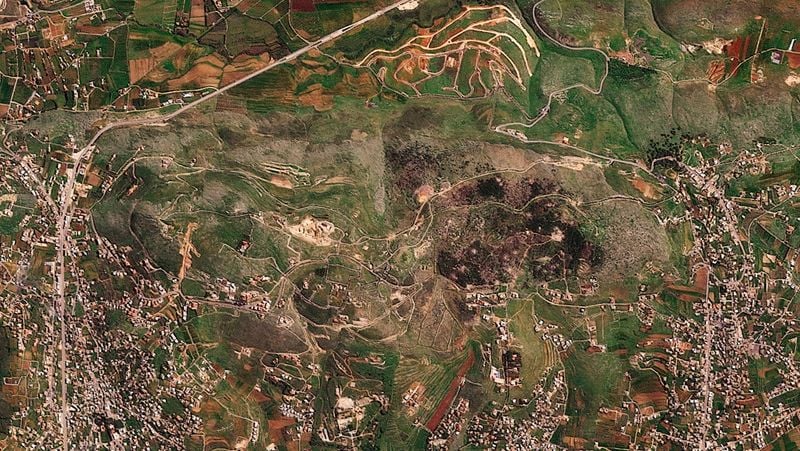
Two videos, released within minutes of each other on the morning of 23 June 2026, are doing the rhetorical work that a single communique could not. The first, circulated by Hezbollah-aligned media including the Beirut-based resistance correspondent network, claims to show the destruction of an Israeli armoured personnel carrier on Hamamesh Hill earlier this month — a site the same channel describes as recently established by Israeli ground forces. The second, run almost simultaneously by The Cradle's Telegram feed and the war-witness channel, carries footage of an operation dated 17 June that targeted what the release describes as an Israeli force positioned on the outskirts of Kfar Tebnit, in south Lebanon's Nabatieh governorate, using an Ababil first-person-view drone. Read together, the two clips are not just battlefield evidence. They are a tactical narrative — a careful sequencing of strikes, geographies, and weapon systems designed to assert that a small, technically literate militia is dictating the tempo of a front that a regional army supposedly dominates.
The thesis this reporting sits behind is unglamorous but durable: the southern Lebanon border in mid-2026 is no longer a story of rockets versus air defence. It is a story of cheap, precise, camera-mounted munitions — and of the political work that releasing footage of those munitions now does for the side that flies them. The Israeli military declined to comment on the specific incidents named in the Hezbollah-aligned releases, and the public record has not yet been independently verified beyond the footage itself. The disputed claims, the asymmetry in who chooses to publish what, and the slowness of independent confirmation are themselves part of the story.
The two clips, and what they each claim
The first video, posted to X by the sprinterpress account on 23 June 2026 at 13:02 UTC, is the more concrete of the two in its tactical claim. It asserts that Hezbollah struck Israeli military equipment and infrastructure on Hamamesh Hill — a position the channel characterises as recently established — and that a particular Israeli armoured personnel carrier was defeated on 13 June 2026. The release frames the strike as a deliberate piece of counter-engineering: identifying a newly sited vehicle, attacking it with a kamikaze drone, and releasing the evidence on a delay measured in days, not hours.
The second release is more conventional in structure and more explicit in geography. According to posts from The Cradle Media's Telegram account and the wfwitness channel, both timestamped 23 June 2026 at 12:36–12:39 UTC, Hezbollah published a video dated 17 June showing its fighters targeting a gathering of Israeli forces on the outskirts of the town of Kfar Tebnit in southern Lebanon, using an Ababil attack drone. wfwitness describes the platform as an Ababil FPV drone, emphasising the first-person-view piloting capability that has become a signature of low-cost loitering munitions in this conflict cycle. The Cradle, writing in its own editorial voice, says the video was released by Hezbollah's media arm.
The detail that matters is not the existence of the strikes but the timeline. The 17 June operation surfaces as a verifiable video on 23 June, six days after the fact. The 13 June vehicle strike surfaces ten days later. The two videos bracket a fortnight of claimed tactical activity along the same stretch of border, and they are released within a coordinated news-cycle window, suggesting a media operation as deliberate as the strikes themselves.
What Ababil actually means in this context
The Ababil designation does not refer to a single airframe. It is a family of Iranian-origin drones, with roots going back to the 1980s Iran-Iraq war, that has been iterated, indigenised, and re-exported by Tehran and by Hezbollah's own engineering units over decades. The Ababil-T, the Ababil-3, the Ababil-B, and the FPV variants adapted for terminal-precision work all carry the name. In the southern Lebanon theatre, what matters is not the lineage but the cost curve. An FPV drone is, by design, expendable. It does not need to return to base. It does not need a launch rail. A two-person team with a controller, a battery, and a small airframe can produce effects disproportionate to the dollar value of the hardware.
That is the subtext of both videos. The Hezbollah releases do not show massed formations, suppressed air defence, or contested airspace. They show small, controlled engagements, picked for camera readability, in which the munition is visibly successful against the target. In the Kfar Tebnit footage the camera approaches the target, the warhead functions, and the recording ends. In the Hamamesh Hill material the claim is a destroyed vehicle on a named position. The grammar is the same: one munition, one target, one moment of confirmation, and a deliberate pause before the world sees it.
The counter-narrative, and the limits of the available record
The Israeli military did not, at the time of the releases, publish corresponding footage or on-the-record statements confirming or denying the specific tactical claims. The standard Israeli communique style on the northern front has been to acknowledge operations in aggregate terms — airstrikes on launcher sites, identified Hezbollah operatives killed in targeted actions — while rarely engaging with individual video releases. The Israeli press, in turn, has tended to treat Hezbollah footage with the scepticism reserved for adversary propaganda, and with a few exceptions — Israeli security correspondents who occasionally confirm specific tactical details months later — has not, in the public record, validated either the Hamamesh Hill vehicle loss or the Kfar Tebnit strike.
That asymmetry is itself the story. One side is publishing claimed kills, with place names and dates, in a news cycle optimised for Telegram, X, and English-language resistance-aligned outlets. The other side is releasing almost nothing verifiable at the tactical level. A reader trying to reconstruct the ground truth of mid-June 2026 along the Lebanon border is therefore reading a one-sided archive. The footage may be real, partial, or curated. The lack of competing footage is not in itself proof of accuracy, but it does shape what the international audience sees of the front.
The structural frame: drone footage as a strategic commodity
What we are watching in southern Lebanon is not a new kind of war, but it is a new kind of war documentary. The cost of producing, editing, and distributing a high-definition strike video has collapsed. The marginal cost of an additional release is effectively zero, and the marginal political return — for a non-state armed group with limited conventional air power — is large. Hezbollah has been building this capability visibly for years; the October 2023 cross-border exchanges and their aftermath accelerated the practice, and the tempo of release has only increased as front-line activity has continued. The two videos of 23 June are not anomalies. They are the current default.
The structural point is that, in a theatre where one side controls the air and rarely publishes tactical footage and the other side flies cheap munitions and publishes almost every strike, the information environment will end up favouring the publisher. International wire coverage, when it touches individual incidents at all, tends to follow the most recent release. Analysts in Beirut, Tel Aviv, Washington, and the Gulf read the same Telegram channels, and the front-line narrative drifts toward the version of events that is being broadcast, irrespective of who is producing it. This is the same dynamic that has played out in Ukraine with the proliferation of drone-footage feeds on both sides, and in a different form in the Red Sea with Houthi maritime releases. The southern Lebanon front is the latest theatre in which the camera, not the platform, is doing the strategic work.
Stakes, and what the next month looks like
The most immediate stakes are operational. If the Israeli military is sustaining vehicle and personnel losses at the rate implied by the cumulative Hezbollah releases — a claim the available record does not yet independently confirm — then the calculus on positioning armour and infantry assemblies close to the border begins to shift. FPV munitions are a force on positioning: they punish massed targets, slow manoeuvre, and force dispersal. The Israeli response, visible in periodic airstrikes on south Lebanon villages and on identified launcher cells, has been to degrade the firing side. The Hezbollah response, visible in the 23 June videos, has been to absorb the strikes and keep filming.
The medium-term stakes are political. A front that produces a steady drip of named-place, named-date strike videos — Hamamesh Hill, Kfar Tebnit, others to come — generates a documentary record that diplomats, journalists, and domestic Israeli audiences all have to read. If that record accumulates faster than the Israeli press can counter it with its own tactical evidence, the narrative of who is dictating the tempo on the border will harden in a particular direction, regardless of which side is actually losing more people and equipment on any given day. The Israeli military's communications strategy on the northern front is, on the evidence so far, more disciplined and less visible than its adversary's. Discipline without visibility is a real strategic choice, but it is not a free one.
What remains uncertain
The most honest reading of the 23 June releases is that they are unverified tactical claims, presented in a documentary format that lends them an air of confirmation. The Israeli military has not, on the public record available at the time of writing, confirmed the 13 June vehicle loss on Hamamesh Hill, the 17 June strike on the outskirts of Kfar Tebnit, or the specific platform used in either case. The footage shows what it shows; it does not show the wider engagement, the air defence environment, the Israeli return fire, or the casualty outcome on either side. Independent OSINT analysts have not, in the materials reviewed for this piece, publicly corroborated either strike. A reader should treat both videos as primary-source adversary releases — that is, as evidence worth examining, but not as confirmed battlefield outcomes. The structural argument in this article does not depend on the specific tactical claims holding up under later verification. It depends on the fact that, in 2026, this is how a southern Lebanon front is being fought, filmed, and narrated — and on the asymmetry of release that defines the information environment around it.
Desk note: Where wire coverage of the northern front tends to aggregate Israeli strike statistics and Hezbollah rocket-fire counts, Monexus has foregrounded the tactical video record released by Hezbollah-aligned channels on 23 June 2026, paired it with the same day's framing in English-language resistance-aligned outlets, and let the asymmetry of who is publishing and who is not sit on the page without resolving it.
Wire provenance
This editorial synthesis draws on the following public wire/social posts:
- https://x.com/sprinterpress/status/2069405638778884096
- https://t.me/wfwitness
- https://t.me/thecradlemedia
- https://t.me/s/sprinterpress
- https://t.me/s/wfwitness
- https://t.me/s/thecradlemedia
- https://en.wikipedia.org/wiki/Ababil
- https://en.wikipedia.org/wiki/First-person_view_(radio_control)