Pakistan Plays Host to Pezeshkian as Tehran and Islamabad Open a "New Chapter" — Without the Ballistic-Missile File
Iran's president landed in Islamabad to a Pakistani fighter-jet escort and a public denial from Prime Minister Sharif that any missile question was on the table — a tightly scripted visit that says as much about what is missing as about what was signed.
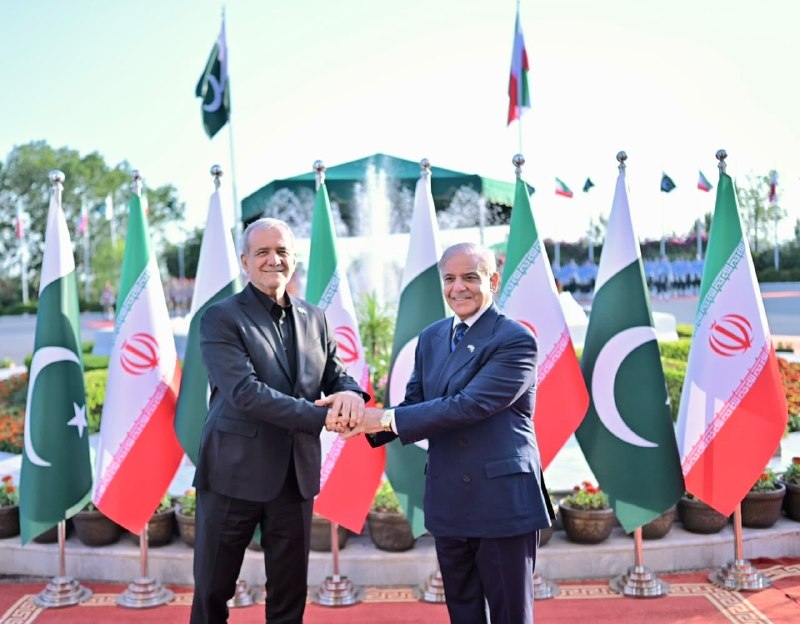
Iranian President Masoud Pezeshkian and Foreign Minister Abbas Araghchi touched down in Islamabad on the afternoon of 23 June 2026 to a Pakistani fighter-jet escort and a ceremony that Iranian and Pakistani state-aligned outlets described, almost in unison, as the opening of a "new chapter" between two neighbours that have spent most of the past decade talking past each other. By the time the cameras switched off, the most newsworthy line of the day had come from the host. Prime Minister Shahbaz Sharif, standing beside the Iranian delegation, declared that the memorandum of understanding signed in Islamabad "does not include any reference to Iran's ballistic missiles. This issue was not part of the negotiations," according to a verbatim readout posted by Israeli outlet Amit Segal from the Pakistani leader's remarks. The denial was almost certainly the story of the day — less for what it conceded than for what it pre-empted.
The visit is the highest-level Iranian delegation to Pakistan since the 12-day Israel-Iran war of June 2025 and comes against a backdrop of acute pressure on the Islamic Republic from the United States, Israel, and a sanctions architecture that has tightened rather than loosened over the past twelve months. Tehran's choice to invest diplomatic capital in Islamabad — a nuclear-armed state that is neither a treaty ally of Washington nor a member of any US-led regional security architecture — is itself a signal. So is Pakistan's decision to roll out the full ceremonial vocabulary: jets, joint statements, a warmly received guest, and an explicit frame of "strategic cooperation" rather than a transactional communique.
What was actually signed
Both sides are treating the memorandum as the substantive product of the visit, and the public language around it has been deliberately broad. Tasnim News, the Iranian state outlet closest to the security establishment, summarised the Iranian position in a single line: "Iran is starting a new chapter of strategic cooperation with Pakistan. The security of West Asia is ensured only with the participation of the countries of the region." That formulation — regional security by and for regional states — is the standard Iranian counter to extra-regional security architectures, and its placement at the top of state-media coverage is a tell. Mehr News, another Iranian state outlet, headlined Prime Minister Sharif's praise of Iran's Supreme Leader, Ayatollah Mojtaba Khamenei, whom Sharif said had "led his country well in a critical situation," with the Iranian people having "played their role well" alongside him. The reciprocal warmth is the visible product; the substantive MoU is the invisible one.
What the MoU does not contain is, for now, the more revealing fact. Sharif's own on-camera denial of any missile-related clause is more than the usual diplomatic caveat: it is a managed disclosure aimed at two distinct audiences. In Washington and Tel Aviv, it is designed to neutralise the headline that any Iran-Pakistan deal formalises missile cooperation — a story that would have moved markets, prompted sanctions designations, and complicated the back-channel nuclear diplomacy that US intermediaries have spent two years trying to keep on life support. In Islamabad and Tehran, the same denial gives both governments the room to keep talking about the missile file later, in a different venue and under different language, without being held to today's text. Read this way, the denial is not a closing of the file; it is a postponement with a public paper trail.
The Asim Munir factor
The most pointed single line of the day, however, came not from the Iranian side but from Sharif himself, who credited Pakistan's army chief, General Asim Munir, with brokering the broader regional opening. "Asim Munir's role-playing brought about a big agreement in the region," Sharif said, according to the Tasnim News English wire, before adding that he would travel to Tehran next week to meet the Supreme Leader. The framing is significant for two reasons. First, it places the uniformed military — not the foreign office — at the centre of Pakistan's regional diplomacy, a pattern that has hardened since Munir's elevation to army chief in late 2022 and that has come to define Islamabad's posture toward Iran, the Gulf monarchies, and the United States simultaneously. Second, it is a direct pitch to the Iranian security establishment, which has historically been more comfortable dealing with military counterparts than with civilian counterparts in neighbouring states. Sharif is, in effect, telling Tehran who is actually running Pakistani policy in this domain.
For Tehran, that is a useful message. The Islamic Republic's regional posture has been built for decades on relationships with the security services of partner states — the Iraqi paramilitaries, the Lebanese Hezbollah leadership, the Syrian security directorate in the pre-2011 era — and on a generalised scepticism of civilian-led Arab and South Asian governments that can be turned over by parliaments or courts. A Pakistan in which the army chief is publicly identified as the regional dealmaker is a Pakistan that Iranian interlocutors know how to read. The corollary, which neither side will say out loud, is that the MoU is backed by an institutional relationship that survives any future Pakistani prime minister.
Counter-narrative: what is missing from the picture
Two things are conspicuously absent from the public readouts. First, there is no reference to the China-Pakistan-Iran trilateral framework that has been under discussion in various forms since 2024, including a planned corridor that would link the Pakistani port of Gwadar to the Iranian border at Mand and onward to the Chabahar and Bandar Abbas nodes. The omission is almost certainly deliberate: in the present climate, any Chinese signature on a regional security track would harden the US response to the MoU and put Pakistan's IMF lifeline at risk. Second, there is no public discussion of the Afghanistan file, even though both Iran and Pakistan are dealing with the consequences of the Taliban's consolidation of power, with cross-border TTP attacks, and with the persistent problem of cross-border water management under the Indus Waters framework. A visit with this much pageantry and this little operational detail is, in part, a deferral of those questions to a quieter venue.
A second counter-narrative worth weighing is the possibility that the visit is, more than anything, a domestic-Iranian story. The Pezeshkian government has spent months fighting for political survival against a hardening line in Tehran that wants to restart the nuclear programme without Western interlocutors and that wants to close the door on any further de-escalation with the United States. A successful, well-photographed trip to Islamabad — a Muslim-majority neighbour of real strategic weight — gives the Iranian president something to show the domestic audience that he has not spent the year retreating. The warm public reception, the ceremonial escort, and the headline-level language of "strategic cooperation" are deliverables for a domestic audience as much as they are for a foreign one.
The structural read
What is being assembled, piece by piece, is a partial regional architecture built outside the US-led frameworks that have dominated the Middle East and South Asia since the early Cold War. The shape is familiar: a series of bilateral and trilateral understandings between states that are either sanctioned (Iran), partly sanctioned (Pakistan, in certain technology and defence categories), or otherwise outside the Western security mainstream, linked by infrastructure, energy, and increasingly by defence-industrial cooperation. The corridor politics are the most visible element, but the diplomatic vocabulary — "security of West Asia… with the participation of the countries of the region" — is the load-bearing one. That sentence is a direct repudiation of the US naval and air presence in the Gulf, of the Israeli security framing of the region, and of any architecture in which extra-regional powers claim the lead.
For Islamabad, this is a useful hedge in a moment of genuine friction with Washington over Afghanistan, over the IMF programme, and over the terms of any future US-Pakistan defence relationship. For Tehran, it is a partial answer to the regional isolation that the post-2023 sanctions environment has imposed. Neither side is betting the house on the new arrangement — the missile file is publicly off the table, the corridor remains under negotiation, and the security content of the MoU is, as of this writing, undisclosed — but both sides are clearly investing in the optics of a partnership with strategic depth.
The open question is whether the architecture can hold under the kind of stress that has broken similar arrangements in the past: a US administration willing to sanction Pakistan's financial system for movement on the missile file, an Israeli strike campaign that pulls Iran back toward confrontation, a Pakistani domestic political crisis that displaces Sharif or weakens Munir's hand. None of those contingencies is imminent, but none is exotic either. The "new chapter" announced on 23 June is a beginning, not a conclusion, and the most useful way to read the day's denials and affirmations is as the public opening move of a longer negotiation whose terms, for now, both sides have agreed not to write down.
Desk note: Monexus framed this around the public missile-file denial and the explicit naming of General Munir as the regional dealmaker — the two data points most likely to be flattened in Western coverage into a generic "Iran and Pakistan deepen ties" line. The structural argument, that what is being built is a partial extra-Western security architecture in West and South Asia, is rendered here without resort to academic framework name-dropping.
Wire provenance
This editorial synthesis draws on the following public wire/social posts:
- https://t.me/englishabuali/1
- https://t.me/amitsegal/1
- https://t.me/mehrnews/1
- https://t.me/tasnimnews_en/1
- https://t.me/tasnimnews_en/2
- https://t.me/alalamfa/1