Iran's Pezeshkian Lands in Islamabad With a Quiet Agenda
A presidential visit and a foreign-minister arrival land in Islamabad within minutes of each other — and almost nothing has been said about what is actually being negotiated.
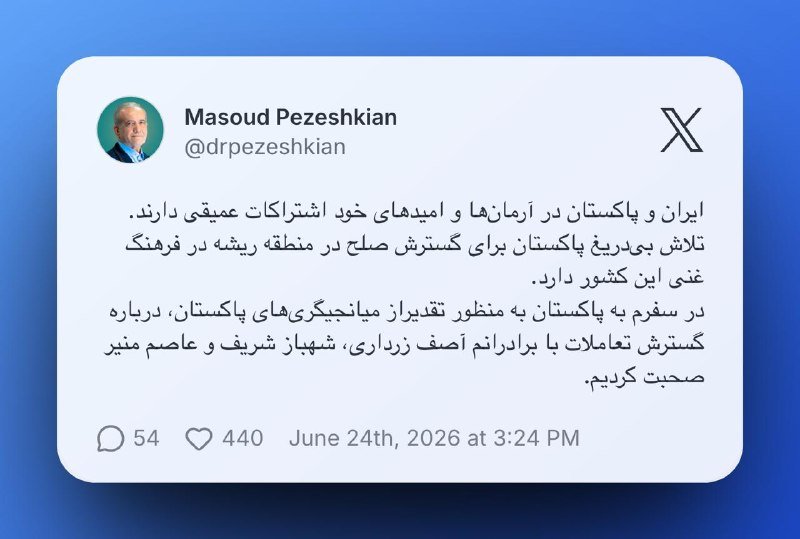
At 10:36 UTC on 23 June 2026, Iranian President Masoud Pezeshkian's plane touched down in Islamabad. Minutes earlier, his foreign minister, Seyed Abbas Araghchi, had crossed the tarmac from Muscat, where he was received by Pakistan's foreign minister, Ishaq Dar, before moving on to a Pakistan Air Force ceremony. The choreography was deliberate: a president and a top diplomat arriving almost simultaneously, on parallel tracks, into a country that sits on exactly the fault line Tehran most needs to manage — the long Iran–Pakistan border, the Arabian Sea coast, and the contested energy geography of the Gulf.
The official read-out, to the extent there is one, is thin. Tehran's state-aligned outlets led with the welcoming ceremony and the Dar meeting; there is no published joint communiqué, no headline agreement, no leak of a specific concession. What the visit signals, more than what it announces, is the real story. Tehran wants a stable interlocutor in Islamabad at a moment when its regional posture is being squeezed from multiple directions, and Pakistan — cash-strapped, energy-hungry, and sitting next door to Afghanistan's collapsing economy — is the cheapest, closest, most under-priced partner Iran has.
The energy question nobody is naming
Pakistan's chronic electricity shortage is the unspoken driver of almost every high-level Iranian visit to Islamabad. The two countries share a border that runs through Balochistan, and a natural-gas pipeline project — long delayed by US sanctions pressure on Islamabad and by financing gaps — has been on the table for nearly a decade. A presidential visit at this level is the kind of staging ground where such projects are revived in communiqué language rather than signed on the spot.
The absence of any published agreement so far is more revealing than a ceremonial one would be. Tehran has learned that Western secondary sanctions bite hardest on the country that builds the infrastructure, not the country that supplies the gas; Pakistan has learned that Washington does not forget who helps Iran monetize its reserves. Both sides know what is being negotiated. Neither wants it on the front page yet.
The Pakistan frame: an economy looking for any neighbour with hard currency
Read from Islamabad, this visit looks different. Pakistan is mid-cycle with the IMF, its foreign reserves remain thin, and the political calendar — government turnover, military prerogatives over foreign policy — pushes the civilian leadership toward low-cost wins. Iran offers oil on terms, barter arrangements, and a partner that does not lecture about governance. The optics of a presidential welcome at Nur Khan Airbase are worth something in domestic terms, even before any concrete deal is signed.
The counterweight, rarely voiced in Iranian state media, is that Pakistan's military and intelligence establishment still coordinates closely with Saudi Arabia and the Gulf states. Tehran gets the photo opportunity; it does not necessarily get a durable strategic reorientation. Any deal struck this week sits inside that tension, and the durability of whatever is announced will depend on whether Riyadh chooses to absorb the optics or to push back quietly.
The structural frame
What is unfolding is a familiar pattern of regional hedging. Iran's diplomacy has shifted visibly toward its eastern and northern neighbours — Pakistan, Russia, Central Asian states, China — as its western and southern positions have come under sustained pressure. The pivot is not new; it has been underway since at least the early 2020s. What has changed is the speed. Each high-level visit now carries more freight, because each one is being read against a tighter regional clock.
The piece that western wire coverage routinely misses is that Pakistan gains from this rebalancing too. A more diplomatically active Iran is a more useful Iran for Islamabad — useful for energy, useful as a buffer on the western border, useful as a counterweight to the dominance of Gulf money in Pakistani politics. The visit is not Iranian charity; it is two governments trading access and face for tangible deliverables that have not yet been specified publicly.
What remains uncertain
The sources reporting the arrival — Iranian state outlets and their Telegram channels — are not sources that will surface any internal disagreement or friction. The official framing is uniformly positive, and there is no independent wire confirmation of the substantive agenda as of this writing. It is plausible that the visit produces only a memorandum of understanding on cultural or consular matters and that the energy and security questions are handled through existing back-channels. It is equally plausible that a major pipeline or sanctions-circumvention arrangement is being staged for announcement later in the week, after the principals have departed. The thread context does not let this publication distinguish between the two. Readers should treat the next 72 hours as the window in which the actual content of the visit will either surface or quietly fail to.
What is not in dispute is that two governments considered this visit important enough to send both a head of state and a foreign minister within an hour of each other. That alone is the news.
— Monexus framed this visit against the regional rebalancing that the Western wire has been slow to name: Iran's eastern pivot is a function of pressure on its western flank, and Pakistan's hospitality is a function of its own liquidity crisis. Both reads sit inside one trip.
Wire provenance
This editorial synthesis draws on the following public wire/social posts:
- https://t.me/presstv/1234
- https://t.me/mehrnews/1234
- https://t.me/alalamfa/1234
- https://t.me/JahanTasnim/1234
- https://t.me/tasnimnews_en/1234