Messi's record night and the long shadow of a fading empire: notes on Argentina, Okinawa, and the architecture of soft power
A 38-year-old breaks a World Cup scoring record in Austin while, on the other side of the Pacific, Okinawan teenagers digitise the testimony of a war most of the world has already filed away. Two stories in the same 24 hours say more about the politics of attention than either does on its own.
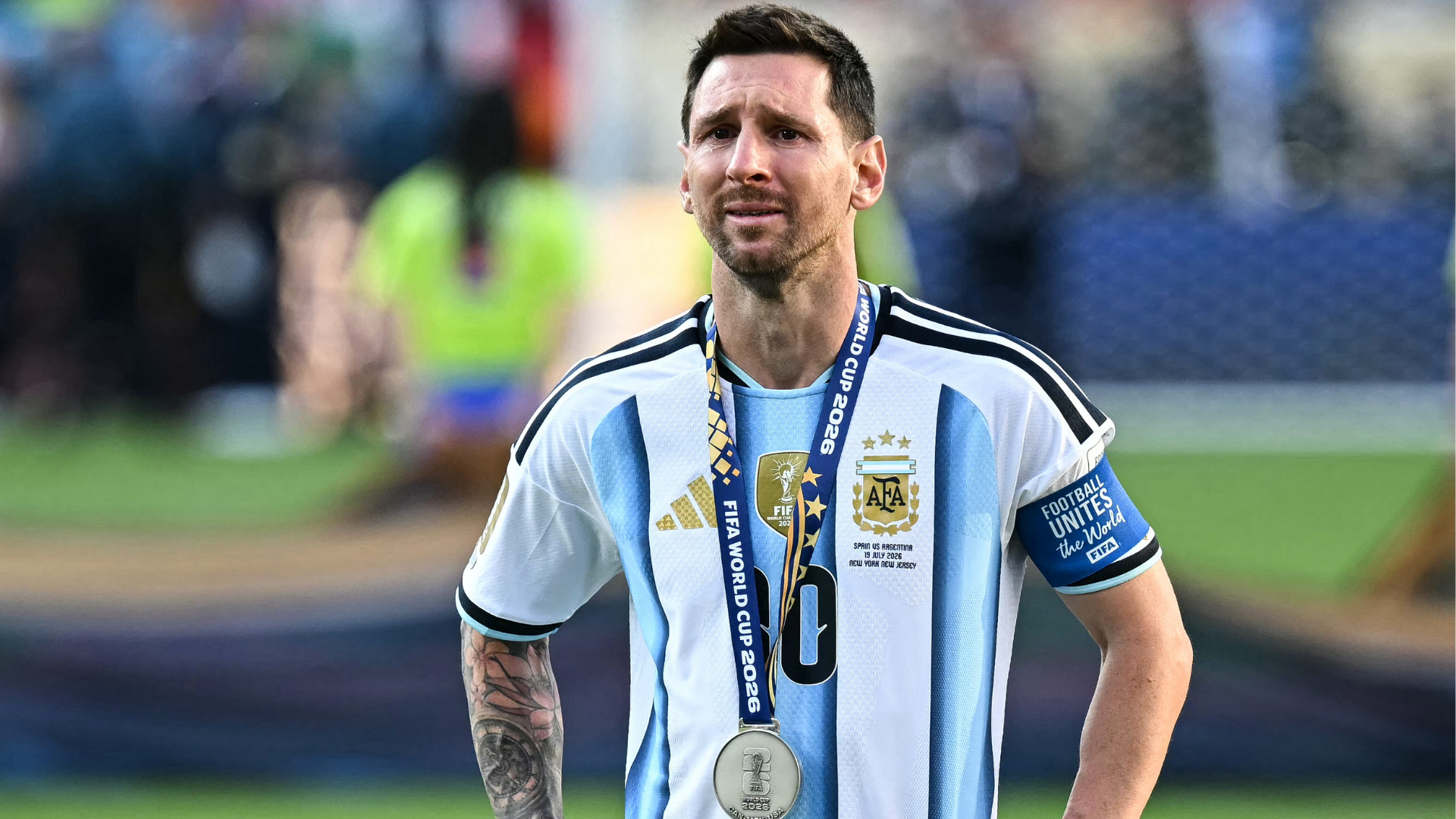
On the night of 22 June 2026, in Austin, Texas, a 38-year-old Argentine forward did something no player in the history of the World Cup had done before: he moved, by himself, to seventeen goals, and kept moving. The opening goal against Austria arrived in the first half from the kind of one-timer that makes statisticians reach for their laptops, and the second arrived later in the same match, turning a tight group-stage game into the sort of result that gets read backwards, as the start of something. Argentina won 2-0. The venue — a stadium in Texas, broadcast to an estimated audience that runs into the high hundreds of millions — sat at the centre of a tournament the United States is hosting, co-hosting, and politically absorbing for the first time in three decades. That is the record. Everything else is interpretation.
The same 24 hours produced a quieter piece of news on the other side of the Pacific. According to reporting by Nikkei Asia published 22 June 2026, young Okinawans — born decades after the last shells fell on the island — are using Instagram to record the testimonies of elders whose direct memories of the Battle of Okinawa, eighty-one years on, are about to become a closed archive. The platform is the same platform that carries Messi's highlights; the audience is younger, more local, and the subject is the kind of history that empires prefer to file away. The two stories share a date and almost nothing else. Read together, they describe something useful about the present: how attention is allocated, who gets to set the terms, and what survives when the last witness dies.
A record in the house the dollar built
The Argentine victory matters first as sport. Argentina entered the match needing a result to consolidate position in the group after a difficult opening stretch, and the forward — already the most decorated player of his generation and almost certainly the most followed individual account on the planet — delivered. The first goal, struck low and early after a sequence that began on the left, took him clear of the all-time World Cup scoring record. The second, added later, made the conversation less about history than about form. Austria, organised and disciplined, did not collapse; they were simply out-finished by a forward operating at the far edge of his athletic career.
What makes the night politically interesting is the architecture around it. The 2026 World Cup is being staged across the United States, Mexico and Canada — the first tri-nation hosting in the tournament's history, and the first in which the United States is the principal stage. FIFA's choice, ratified years ago, was sold as a commercial decision. It is also a soft-power decision. Stadium financing, broadcast rights, and visa policy for travelling supporters have all been negotiated as instruments of statecraft as much as sport. When Argentina plays in Texas, the optics travel further than the result.
For Argentina specifically, the political valence is layered. The country is in the middle of a stabilisation programme negotiated with the International Monetary Fund, with austerity measures that have hit real wages and prompted street protests in Buenos Aires over the past year. A deep World Cup run offers the country's political class something no stimulus package can: a fortnight of consensus, a stage on which the flag means something other than the economy. The forward has been careful, throughout his career, to keep his public statements tied to the team rather than to any faction. That posture is itself a form of governance in a country where the captain's press conference is parsed for signals.
The counter-frame: a sport that refuses to behave
The dominant Western framing of the 2026 tournament treats it as a logistical and commercial story — stadiums built, visas issued, broadcast deals signed. That framing is accurate as far as it goes, and it leaves out the more interesting question. FIFA's own governance has been under sustained scrutiny for years: investigations into the bidding processes that awarded this tournament and the next, the labour conditions on stadium construction sites in Qatar that were documented through the previous cycle, and the federation's chronic inability to enforce human-rights standards across its supply chain. A tournament hosted partly in the United States inherits that record, whether or not American organisers want it.
There is also a counter-narrative from the Global South that deserves airtime. The expansion of the World Cup to forty-eight teams — the format under which this tournament is being played — was sold as inclusion. It has, in practice, diluted the group-stage quality and stretched the calendar in ways that benefit broadcasters more than players. African and Asian federations that pushed hardest for expansion have begun to ask, in private, whether they negotiated a better deal or simply a longer one. The matches themselves remain compelling; the structure around them is contested.
Argentina's win, in other words, is happening inside a tournament whose every assumption — the host, the format, the financial model — is being argued over in real time. The forward's goals do not depend on the argument. They sit on top of it.
Okinawa, and the architecture of forgetting
On 22 June, the island of Okinawa marked the formal end of a major battle that began eighty-one years ago in the closing stages of the Second World War. The battle killed an estimated quarter of the island's civilian population and a higher proportion of its military-age adults. It was, by any honest accounting, one of the defining land battles of the Pacific war — and it has occupied a peculiar place in Japanese postwar memory: present, but edged; recognised, but rarely centred in the national curriculum.
According to Nikkei Asia's reporting, a generation of Okinawans born after the war has concluded that the existing channels — school textbooks, museum exhibitions, annual commemorations on 23 June — are insufficient. They have begun, instead, to record the testimonies of elders on Instagram. The format is short. The audience is younger. The political effect, over time, is to relocate the memory of the battle from an institutional setting to a vernacular one, where it competes for attention with everything else on the platform rather than receiving the protected framing of a memorial.
That relocation matters. Imperial and postwar Japan alike have managed the memory of Okinawa carefully. The island's experience — including its long postwar occupation by US forces, the presence of bases that continue to occupy a disproportionate share of the island's most developable land, and the unresolved question of how the battle's civilian toll should be taught — has rarely been allowed to set the terms of national debate in Tokyo. A memorial on 23 June is, in part, an instrument of that management. An Instagram account run by a twenty-two-year-old in Naha is something else.
Soft power, attention, and the platforms that sit between them
Read together, the two stories describe a single structural shift. The institutions that used to control who saw what, and in what order — national broadcasters, federations, ministries of education, the curatorial staff of national museums — no longer hold that position by default. The platforms do. A goal in Austin and an elder's testimony in Naha now compete for the same scroll, optimised by the same algorithms, monetised by the same advertising stack.
The implications are not symmetrical. Messi's goals benefit enormously from this arrangement: the platform amplifies them, the attention compounds, and the federation and the host nation extract the soft-power dividend. The Okinawan testimony project is doing something harder — using the platform against its grain, in a format that resists the kind of compression the algorithm prefers. That it has to do so at all is itself a measure of how thoroughly the older institutions of memory have been outflanked.
There is a longer historical pattern underneath this. Empires that lose the capacity to broadcast their own story rarely lose it in a single dramatic reversal. They lose it in a long sequence of small displacements: a stadium here, a platform there, a curriculum dropped from a syllabus, a flag waved in a stadium built with someone else's money. The 2026 World Cup and the Okinawan Instagram project are not the same story. But they sit on the same calendar, and the calendar is the point.
Stakes, and what remains uncertain
For Argentina, the immediate stakes are sporting and reputational. A deep run in a tournament the country is hosting politically as much as geographically would reinforce the federation's leverage in future FIFA decisions and shore up the cultural position of a player who will not play another World Cup. The economic stakes are real but bounded; Argentina's IMF programme will not be moved by a result in Texas.
For Okinawa, the stakes are historical in a way that the sporting story is not. The number of living Okinawans with direct testimony of the battle is shrinking every year, and the institutional channels that should be preserving that testimony have not, by the admission of the young people doing the work, done enough. The platforms are filling a vacuum. Whether the result is a more durable public memory or a more fragile one — dependent on accounts, on policies, on the commercial decisions of companies headquartered in California — is the open question.
What the sources do not specify, and what deserves to be said plainly, is the long-term resilience of either arrangement. Instagram's policies, content moderation practices, and recommendation algorithms are not stable variables; they are the product of corporate decisions made a long way from both Austin and Naha. A goal scored in a stadium financed in part by public money is recorded on hardware and distributed over networks that are, in the last instance, governed by private boards. The Okinawan testimony project depends on those boards continuing to permit the project, and on the project continuing to find an audience against the background noise the platforms are optimised to produce.
Two stories, then, separated by twelve thousand kilometres and by every category of newsroom taxonomy — sport, memory, foreign affairs — and bound together by the structure of attention that now organises all three. The record in Austin is real, and so is the testimony in Naha. The platform that carries both of them is, increasingly, the politics.
This article treats two unrelated wires as a single editorial frame. Monexus does so deliberately: the same 24 hours, the same platforms, very different stakes.
Wire provenance
This editorial synthesis draws on the following public wire/social posts:
- https://t.me/epochtimes
- https://t.me/NikkeiAsia
- https://t.me/nikkeiasia
- https://t.me/epochtimes
- https://t.me/NikkeiAsia
- https://t.me/nikkeiasia
- https://t.me/epochtimes
- https://t.me/NikkeiAsia