Messi becomes the World Cup's all-time top scorer — and the record that won't move
Argentina's captain scored a brace against Austria to take his World Cup tally to 18, surpassing Miroslav Klose. The harder question is what — or who — could ever catch him.
At 19:37 UTC on 22 June 2026, FIFA's official account posted a two-word verdict on what had just happened in the Group A match between Argentina and Austria: "History is made." The occasion was Lionel Messi's brace in a 2-0 win that took his World Cup tally to 18 goals, taking him clear of Germany's Miroslav Klose, who finished on 16. By the time the post landed, The Athletic had already pushed the same line through its news feed. FIFA confirmed the figure inside an hour, and by 21:37 UTC the Olympics channel was carrying the headline: Messi, top scorer in World Cup history.
The achievement is straightforward in form and heavy in implication. A 38-year-old has just put a distance between himself and the field at the single most scrutinised tournament in the sport. The harder question — the one that will occupy the next four years — is whether the number is now structurally unreachable.
A record defined by longevity, not a single tournament
Messi's path to 18 has not been the kind of explosive single-tournament climb that usually defines these milestones. It is a slow accumulation across five World Cups — 2006, 2010, 2014, 2018 and 2022 — with the 2022 campaign in Qatar producing the bulk of the late-career surge that brought him level with Klose in the first place. The Austria brace, his 17th and 18th tournament goals, separates him by two in a competition where most strikers finish with single digits across an entire career.
The pertinent detail is not the goal count itself but the age curve. Most elite No 9s are in decline by 30. Messi is still starting for Argentina at 38, still taking penalties, still finishing moves inside the box at a rate that defenders a decade his junior struggle to read. A BBC Sport analysis published at 18:32 UTC on 22 June noted that the Argentine is "still delivering on the biggest stage in his late 30s" — a framing that doubles as a quiet rebuke to the assumption that the modern game's physical demands had closed off that kind of late-career arc.
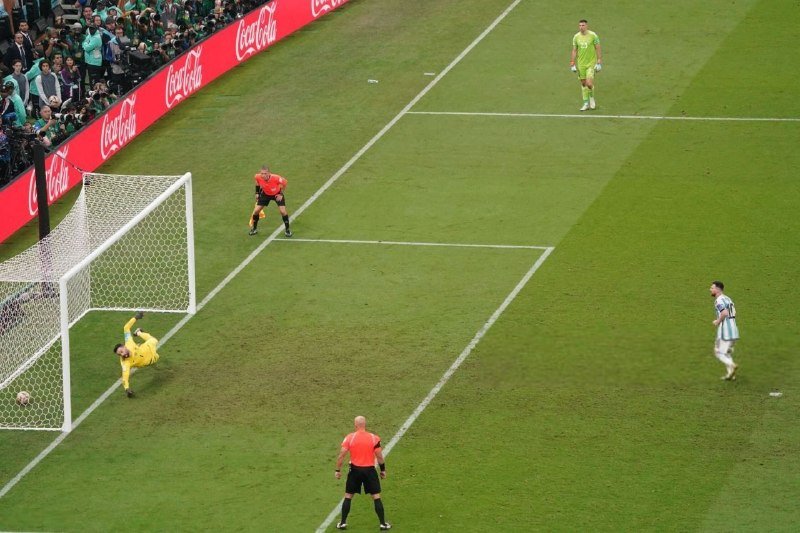
The earlier BBC dispatch at 17:32 UTC had caught the moment the record nearly didn't happen. Messi missed a first-half penalty against Austria that would have made him the outright record-holder before half-time. He made amends after the break, converting the spot-kick he had earlier fluffed and adding a second from open play. The miss is the more revealing of the two data points: even on the night he breaks the record, the margin between Messi at his best and Messi on an off day is small enough that a single kick can deny him the headline.
Counter-narrative: the goal record as a soft metric
The conventional critique of any individual goalscoring record is that it is hostage to era, role and fixture count. Klose's 16 came largely as a poacher's tally for a Germany side that reached four semifinals and won the 2014 title. Messi's 18 has been built across more games, in more varied tactical roles, and on a team that did not have the structural dominance Klose's Germany did.
A second, less flattering read is that the record benefits from the expansion of the World Cup itself. The 2026 edition in the United States, Canada and Mexico is the first to feature 48 teams, which lengthens the knockout bracket and creates more games for the deep runners. CBS Sports' pre-match betting column at 14:35 UTC on 22 June treated the Argentina-Austria fixture as a routine group-stage line rather than a coronation. For an Argentine fan, that is good news: more games ahead. For the record's prestige, it is a softener.
There is also the tactical argument that the modern No 10 — which is what Messi effectively remains, even as he ages into a false-nine role at times — accumulates goals that earlier generations of inside-forwards would have set up rather than finished. Goals and assists are now pooled in ways that flatter the playmaker archetype. None of this erases the record. It does contextualise it.
Structural frame: a record shaped by squad depth
The deeper pattern is not about Messi personally. It is about what Argentina's depth chart has allowed him to do for a decade and a half. A player accumulates this kind of longevity total only when his national federation keeps producing midfielders and wide forwards capable of carrying the structural workload in the games he does not score. Argentina's conveyor belt — from Ángel Di María through Lautaro Martínez to the Julián Álvarez generation — has done that job. Compare that with Brazil, where the post-Neymar centre-forward succession has been choppier; or with France, where Olivier Giroud's late-career goals came in a side whose attacking identity was always shared. Longevity records tend to be records of institutional patience as much as individual talent.
That framing also explains why the next challenger is hard to identify. Kylian Mbappé, the obvious candidate, would need to score at a higher per-tournament rate than Messi while playing into his late 30s — a combination that has rarely been sustained. Erling Haaland's Norway has not qualified for a World Cup. The expansion to 48 teams widens the funnel for goals but not for elite-centre-forward minutes; the top players still face the same compressed fixtures and injury load.
Stakes: what the record is worth
For Messi personally, the record settles a small but persistent argument. The 2022 final in Lusail was the career-defining performance; the goalscoring mark is the actuarial addendum. For Argentina, it adds a layer of protection around a tournament the team entered as defending champion. The Standard Kenya wire at 21:51 UTC on 22 June noted the wider consequence: Argentina has reached the Round of 32 — the expanded term for the new round-of-32 knockout stage — and does so with their captain now the statistical anchor of the competition's entire history.
For FIFA, the timing is convenient. The federation has spent two years selling the 48-team expansion as a tournament that produces more goals, more drama and more fairy tales. Messi breaking the all-time record in the second match of his country's campaign is the kind of storyline that the broadcast partners can run for free. The remaining uncertainty is whether the record will outlast his retirement — and whether the next player to approach it will be able to do so in a 48-team format where the early rounds offer easier opposition than the old eight-group, 32-team bracket ever did.
This piece was filed from the wire — the goal count, the previous record-holder and the 2026 tournament structure are drawn from FIFA's official channels, The Athletic's match wire and BBC Sport's reporting on the 22 June fixture. Where the analysis ventures beyond the available sources — on tactical role, on squad depth, on what might come next — it does so as inference, not report.
Desk note
Monexus treated the record as a longevity story with structural undercurrents, rather than as a hagiography. The two BBC dispatches — the 17:32 UTC piece on the missed penalty and the 18:32 UTC analysis of late-career endurance — provided the spine; the FIFA and Athletic wires anchored the score and the record itself. The Standard Kenya note on the Round of 32 progression supplied the immediate competitive context. CBS Sports' pre-match coverage was used only to establish the betting-market framing of the fixture, not as a source for the scoreline itself.
Wire provenance
This editorial synthesis draws on the following public wire/social posts:
- https://t.me/FIFAcom/
- https://t.me/TheAthletic/
- https://t.me/StandardKenya/