Pakistan's Strait of Hormuz moment: Sharif draws a line Tehran will read carefully
On a single day in June 2026, Islamabad and Rome publicly converged on the same red line over Tehran: a non-negotiable Strait of Hormuz and an end to nuclear double standards. The message was aimed as much at Washington as at Iran.
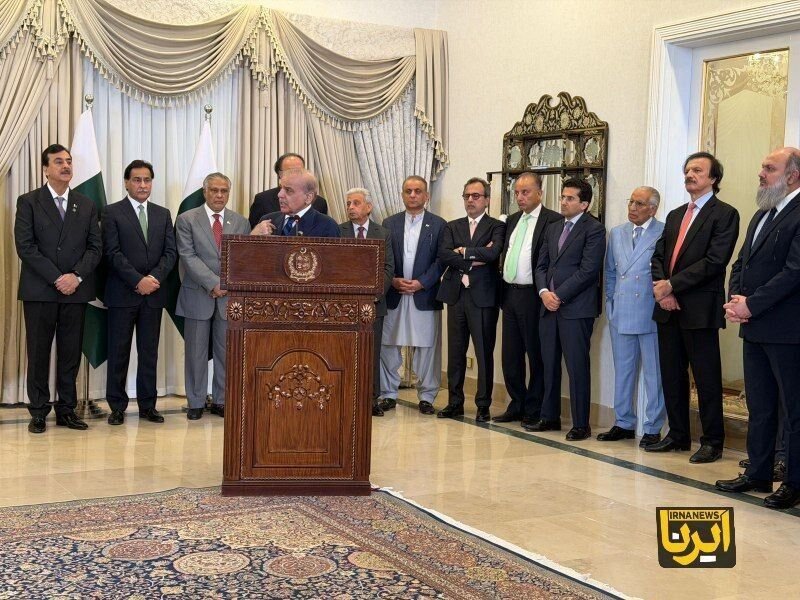
At 20:33 UTC on 23 June 2026, an audio address attributed to Italian Prime Minister Giorgia Meloni warned that if Iran were permitted to "impose tariffs in the Strait of Hormuz," every strategic trade route on the planet would become a potential weapon. Thirty-nine minutes later, in a separate appearance, Pakistani Prime Minister Shehbaz Sharif declared that "there can't be double standards when some countries can have ballistic missiles, but Iran shouldn't," and praised Tehran as a "sincere friend, neighbor and mediator" whose leadership had guided the Iranian people through a difficult stretch. Two capitals, half a world apart from each other but bound by the same seaway, had converged on the same hour on the same message: the strait is not negotiable, and the nuclear conversation is not, either.
The convergence is the story. For years, Western commentary has treated Pakistan and Italy as poles apart on Iran — Islamabad as a quiet enabler of the Islamic Republic, Rome as a compliant Atlanticist. The 23 June alignment complicates that picture. Both governments are now publicly drawing the same two lines, in public, in English, and in the same news cycle: no extraterritorial control of the strait, and no selective non-proliferation regime that tolerates Israeli and Indian missile and warhead programmes while sanctioning Iran's. That second line, in particular, is the one Washington will read most carefully.
Two capitals, one chokepoint
The Strait of Hormuz carries roughly a fifth of global oil shipments. Sharif's framing — friendly, deferential, but pointed — was delivered as Iran was again being readied for a new round of sanctions pressure in Western legislatures. By calling the Islamic Republic a "sincere friend" on the same day a European leader invoked tariffs in the strait, Islamabad positioned itself as Iran's most consequential diplomatic interlocutor at the precise moment the Gulf was tilting toward escalation. The Italian intervention, framed in the language of trade-route "weaponisation," echoed a position that Gulf monarchies have held for years: the strait is international water, and any attempt to tax or close it is an act of war against the global economy.
What changed on 23 June is that a nuclear-armed Muslim-majority state, Pakistan, and a G7 European capital, Rome, ended up on the same page. The Italian warning, in particular, narrows the diplomatic space for any Iranian attempt to convert the strait into a revenue stream — the kind of arrangement that hardliners in Tehran have periodically floated as a counter to sanctions. If Rome is willing to say so on the record, the coalition that would respond to a Hormuz shutdown is wider than Tehran's strategists may have assumed.
The non-proliferation line, translated
Sharif's most consequential line was not about the strait at all. The Pakistani prime minister's complaint — that some states are permitted ballistic missiles while Iran is denied them — is a near-verbatim restatement of a position the Islamic Republic has held for two decades, and one that Riyadh, Ankara and Islamabad have all echoed in private at various points. By saying it on camera and attaching Pakistan's diplomatic weight to it, Sharif elevated the argument from a talking point into a declared policy of a 230-million-person, nuclear-armed state with deep ties to both Beijing and the Gulf.
This is the line Tehran has long wanted the global South to adopt, and which it has usually had to argue for itself. On 23 June, a sitting prime minister with a conventional diplomatic profile — not a revolutionary government, not an Axis-of-Resistance voice — said it instead. The structural effect is to make any future sanctions package harder to frame as a disinterested rule-of-law exercise. The question is no longer whether Iran's programme is unique, but why some programmes are policed and others are not.
What the framing papers over
The alignment is real, but it is partial. Rome and Islamabad disagree on a great deal: on Russia–Ukraine, on China, on European defence financing, on the future of the Middle East peace process. The Italian statement framed the strait in free-trade language; the Pakistani statement framed Iran in anti-hegemonic language. Those are not the same argument. The coalition that emerged on 23 June is situational, not strategic — a shared veto on a single narrow question, not a shared worldview.
And there are gaps the sources do not close. The Italian audio is circulating without an immediate, official government transcript; the Pakistani remarks are being distributed in clip form by outlets that cover the Iran file closely but that are not, themselves, neutral observers of the Islamic Republic. The number of states that would actually join a naval response to a Hormuz closure — and the legal basis on which they would do so — is not specified in any of the available material. Treat the convergence as a signal of where the diplomatic temperature now sits, not as a treaty.
What to watch next
The next test is whether the non-proliferation line Sharif has now drawn becomes a BRICS- or OIC-level demand, or remains a one-prime-minister statement. The second test is whether the European Union, the Gulf Cooperation Council, or the United States treats the Italian intervention as a green light to harden its own Hormuz posture, or as a useful escalation that can be quietly walked back. The third, and most consequential, is what Tehran does in response: whether it reads 23 June as proof that the global South is finally speaking its language, or as evidence that even its friends are now setting limits.
This publication reads the 23 June alignment as a realignment in the rhetorical architecture around Iran — not yet a coalition, but already more than a coincidence. The sources do not yet specify whether a follow-up communiqué is in the works, or whether Sharif's line will be picked up by Ankara and Riyadh in the days ahead. We will update as that picture firms up.
Wire provenance
This editorial synthesis draws on the following public wire/social posts:
- https://x.com/sprinterpress/status/2069529084892426240
- https://t.me/alalamarabic
- https://t.me/alalamarabic
- https://x.com/sprinterpress/status/2069519149647241216
Follow the event.
These dated source records provide context. They do not retrospectively verify this archive article.
Separate what the nuclear watchdog reported from what it could not determine after the June 2025 strikes.