Pezeshkian in Islamabad: a fighter-jet escort that reads louder than any communiqué
Iran's president landed in Pakistan to a fighter-jet escort on 23 June 2026 — a protocol gesture Tehran's own media cast as evidence of a deeper security partnership than routine diplomacy would suggest.
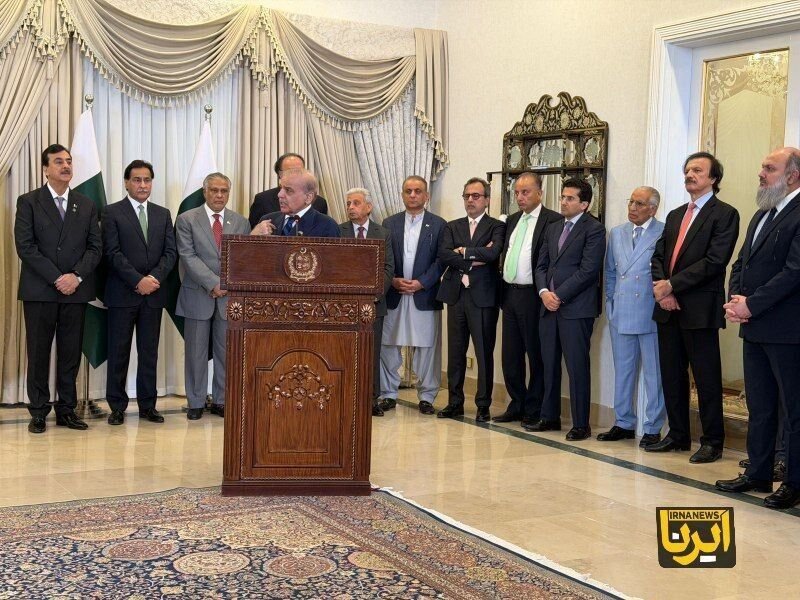
Iranian President Masoud Pezeshkian touched down in Islamabad on the morning of 23 June 2026 to a formation of Pakistani fighter jets that flanked his aircraft as it crossed into Pakistani airspace, a ceremonial escort that state-aligned outlets on both sides were quick to elevate well above routine protocol. IRNA, Iran's state news agency, framed the gesture at 12:50 UTC as one that "transcended routine protocol, reflecting the profound ties, security partnership" between the two governments; an aggregator item circulated by Insider Paper at 12:56 UTC carried the same escort headline into the broader English-language feed; and a third IRNA dispatch at 12:34 UTC documented the official welcome on the tarmac in the Pakistani capital. Taken together, the choreography suggests a visit being staged less as a working stop than as a piece of visible statecraft.
What distinguishes this arrival from the standard regional courtesy of a pair of escort fighters is the volume of state media attention that accompanied it. IRNA's framing did not present the escort as a perfunctory honour guard; it treated the gesture as evidence of an underlying strategic alignment. That is a deliberate editorial choice by a state outlet, and it deserves to be read as such — but the choice does not exist in a vacuum. Pakistan and Iran have spent the past several years deepening cooperation along their shared border, in energy pipelines, and in quiet diplomatic coordination over Afghanistan. An escort framed as a security-partnership signal is consistent with that trajectory.
Reading the escort
Fighter-jet escorts for visiting heads of state are common enough to be almost invisible in coverage of major Western trips. They become news when the relationship between host and guest is itself contested, and when the host wants the optics to communicate something beyond politeness. The IRNA framing — putting "security partnership" in the same breath as the escort — points in that direction. Pakistani officials did not, on the visible record, push back on that characterisation. The Insider Paper aggregation carried the escort headline without qualification, which is the kind of echo chamber behaviour that tends to amplify state framings in either capital. That dynamic is worth naming plainly: when state outlets on both sides converge on a single interpretive line, English-language aggregators reproduce it at face value, and the underlying visit can end up discussed entirely in the host-and-guest vocabulary that the two governments have pre-selected.
What the wire shows — and what it does not
The publicly visible material on this arrival is thin and largely ceremonial. Three items from two Telegram-distributed sources document (a) the escort itself, (b) Tehran's interpretive framing of the escort, and (c) the tarmac welcome. None of these items specifies the agenda of the visit — the working sessions, the signed memoranda, the bilateral communiqués that would ordinarily anchor a state visit of this profile. The sources do not name the counterpart Pakistani principal at the airport, do not record a joint statement, and do not specify the duration of the stay. Monexus treats that gap as a feature of the reporting cycle rather than a failure of attention: state-arrival visuals tend to surface first, substantive readouts follow.
The structural frame
Bilateral pageantry between Pakistan and Iran has rarely travelled on its own in recent years; it has tended to track two larger currents. The first is the deepening of border management between two states that share a long, lightly governed frontier and an interest in denying that space to militant outfits on either side of the line. The second is the broader repositioning of middle powers in a region where Gulf security architecture, US force posture, and Indian strategic weight are all in motion simultaneously. An Iranian president landing in Islamabad under a fighter-jet escort is a small fact whose interpretive weight depends almost entirely on which of those currents a reader foregrounds. Read narrowly, it is protocol. Read in context, it is one more piece of evidence that the Pakistan-Iran relationship is being upgraded from cautious neighbourliness to something closer to structured partnership — and that both governments want that upgrade to be visible.
Stakes and what to watch next
The immediate stakes are concrete enough. A working visit of this visibility will be expected to produce a bilateral readout covering energy cooperation, border security, and the long-stalled Iran-Pakistan gas pipeline project, which has been a recurring item in diplomatic communiqués for years. If the post-visit statement names specific deliverables in those areas, the escort retroactively reads as the opening scene of a substantive agenda. If the readout is generic, the choreography will end up having done more diplomatic work than the meetings. The honest reading at this point is that the escort is a confident opening bid, not a finished story.
Monexus framed this piece around the visible choreography of the arrival rather than the speculative agenda behind it, on the principle that the IRNA framing deserves to be quoted and characterised without being laundered into neutral fact.
Wire provenance
This editorial synthesis draws on the following public wire/social posts:
- https://t.me/insiderpaper
- https://t.me/Irna_en
- https://t.me/Irna_en