Pezeshkian's Pakistan visit reads as regional re-engagement, not diplomacy as usual
Tehran is pitching a freshly signed memorandum as a stabilizer for a region still rattled by its June war. Pakistan is the first stop on the sales pitch.
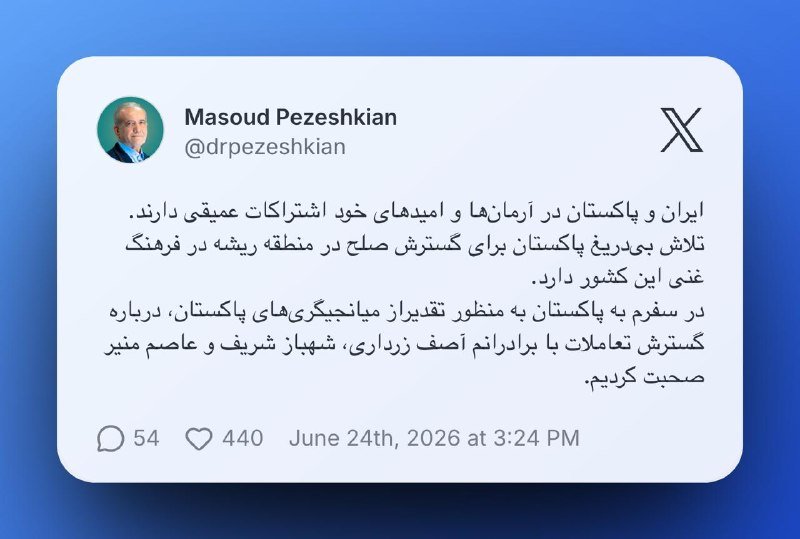
President Masoud Pezeshkian left Tehran for Islamabad on the morning of 23 June 2026, casting the trip in unusually expansive terms before wheels-up. According to Iranian state outlet Tasnim, the president told reporters that the foundation of his government is "to pursue the rights of the Iranian nation and strengthen regional peace and security," and described the visit as a chance both to "appreciate the support" of regional partners and to push implementation of a memorandum he argues can "reduce many problems in the Middle East." [07:09 UTC, 07:20 UTC]
The framing matters. Iran has spent the better part of June recovering from a short, sharp war whose civilian toll — including, per Tehran's official count, 168 students killed at a school in Minab — still defines the domestic conversation. The Pakistan visit is the first major outward-facing diplomatic move of the post-war window, and the language being used is calibrated for an audience that wants to hear a country pulling levers, not absorbing blows.
A memorandum doing the heavy lifting
The trip is anchored around a cooperation memorandum rather than a treaty or formal bilateral accord. That is a deliberate signal of scope. Memoranda, in regional practice, signal political alignment without committing either side to the legal weight of a treaty — easier to sign, easier to walk back, useful when the principal goal is signalling intent to a wider audience.
Pezeshkian's own framing leans into this. "The implementation of this memorandum," he said per Tasnim, "can reduce many problems in the Middle East." The Middle East, notably — not just the Iran-Pakistan border, not just the Gulf. The wider horizon is doing work in the sentence. It positions Tehran as a convening actor in a region where, post-June war, several governments are recalculating how exposed they want to be to either Washington or to the Chinese and Russian-led diplomatic tracks that have gained traction since 2022.
The counter-read
The honest counter-read is that a memorandum-heavy visit is also the kind of diplomacy that produces communiqués rather than outcomes. Pakistan's government has its own incentives for hosting — border management, energy import diversification, the residual prestige of being courted by a large neighbour — and is unlikely to publicly commit to anything that complicates its relationships with Saudi Arabia, the Gulf monarchies, or its ongoing IMF programme negotiations.
The framing also tells you what is not on the table. There is no public reference in the readouts to the joint Iran-Pakistan gas pipeline (IP), to sanctions architecture, or to the Balochistan border question — three issues that would convert a memorandum tour into a substantive agenda. The readouts lean instead on martyrs, regional peace, and the Iranian nation's rights. That is the language of a government speaking primarily to its own public, with Islamabad as the backdrop.
What the structural pattern looks like
Set against the post-June-war regional landscape, this visit sits inside a familiar pattern: states that absorb a kinetic shock reach for diplomatic motion in the immediate aftermath, partly to lock in any gains, partly to project normalcy. Iran did this after the 12-day exchanges of 2024 as well — a flurry of foreign-minister travel, joint commissions, photo-op summits, and a slower accumulation of concrete deliverables. The structural question is whether the implementation language around the new memorandum ever translates into working groups, timetables, and dollar-denominated projects, or whether it remains at the level of dignified communiqués.
The role of public framing here is also worth naming plainly. State outlets function, on both sides of any bilateral, as the primary vehicle for setting the narrative of the visit — what was discussed, what was agreed, what was appreciated. Reporting that takes those readouts at face value misses how selective the genre is. The useful question to ask of any presidential visit framed this way is which constituency the language is being optimised for, and which issues have been carefully left out of the readouts.
Stakes, and what to watch
If the memorandum survives its first hundred days and produces a functioning joint commission with named working groups, the trip will look, in retrospect, like the opening move of a regional re-engagement that held. If it does not, it will read as Iran using a friendly capital to project post-war composure to domestic audiences while the harder bilateral agenda — energy, sanctions, border security — sits exactly where it was.
The near-term tell is whether Islamabad is named in any subsequent Iranian readout on regional security coordination in the weeks after 23 June, or whether the visit recedes from the official narrative within a month. The sources available at the time of writing do not specify either trajectory; the readouts are aspirational, and the implementation language is a promise, not a delivery.
This publication reads Pezeshkian's Pakistan stop as a deliberate post-war re-engagement tour rather than a routine bilateral. The memorandum is the vehicle, the regional framing is the message, and the audience being addressed runs through Tehran as much as Islamabad.
Wire provenance
This editorial synthesis draws on the following public wire/social posts:
- https://t.me/tasnimnews_en
- https://t.me/tasnimnews_en
- https://t.me/tasnimnews_en
Follow the event.
These dated source records provide context. They do not retrospectively verify this archive article.
Separate what the nuclear watchdog reported from what it could not determine after the June 2025 strikes.