Pakistan's PM praises the man who may run Iran — and the line between condolence and coronation blurs
On 23 June 2026, Prime Minister Shahbaz Sharif publicly praised Ayatollah Mojtaba Khamenei — the son most often named as a leading candidate to succeed Iran's supreme leader — while offering condolences over the death of his father. The two registers, read together, look less like diplomacy than a foreign endorsement of an internal succession.
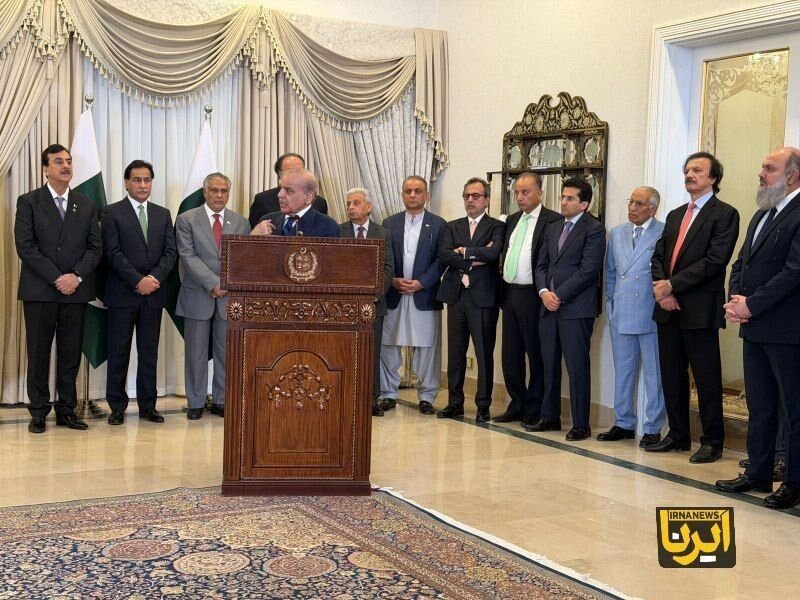
At roughly 16:03 UTC on 23 June 2026, Pakistan's prime minister, Shahbaz Sharif, stood before cameras in Tehran and offered condolences on what Iranian state media described as the martyrdom of Ayatollah Seyyed Ali Khamenei, Iran's supreme leader. Within minutes, the register of his remarks shifted. By 16:21 UTC, Sharif was lavishing praise on Ayatollah Seyyed Mojtaba Khamenei — the supreme leader's second son, the cleric who has spent years positioning himself as heir-apparent to the post his father has held since 1989. By 16:27 UTC, Sharif's comments were being replayed across Iranian outlets as something close to a foreign endorsement of a succession that the Iranian state has not formally announced.
The remarks matter not for what they say about Sharif, who is performing his role, but for what they reveal about how Iran's neighbours are preparing for the post-Khamenei settlement. Pakistan has a 900-kilometre border with Iran, a Shia minority of its own, and a long history of balancing between Tehran, Riyadh and Washington. For its prime minister to publicly identify Mojtaba Khamenei as the man who "led his country well in critical situations" — while the supreme leader's funeral rites are still being organised — is a diplomatic signal that cuts several ways at once.
What Sharif actually said
The statements that circulated across Iranian state and quasi-state channels on Tuesday afternoon were short, almost telegraphic. Per Fars News, Sharif "offered condolences on the martyrdom of the supreme leader of Iran, Ayatollah Seyyed Ali Khamenei" and then, separately, said he "admire[d] Ayatollah Seyed Jotabi Khamenei, the leader of the Iranian revolution, who led Iran in this critical situation." Al-Alam Arabic, the Iranian state broadcaster's Arabic service, framed the same words as Sharif "appreciating" Mojtaba because he "led his country well in the sensitive circumstances it is going through." Mehr News, the official outlet of the Iranian state broadcaster, gave the remarks their widest circulation in Persian, characterising Sharif as admiring "Ayatollah Seyyed Mojtaba Khamenei who led his country well in critical situations."
Two translations diverged: Fars rendered the son's name as "Seyed Jotabi" — a transliteration glitch — while Mehr and Al-Alam settled on "Mojtaba," the Arabic for "the chosen one." The substance was identical across the four Iranian outlets that carried the clip: an expression of condolence, a word of thanks to the Iranian leadership for "its confidence in Pakistan's role," and an explicit, named tribute to Mojtaba.
Why the Mojtaba reference is the news
Iran's assembly of experts, the clerical body constitutionally tasked with selecting the next supreme leader, has never publicly named a preferred successor. Mojtaba Khamenei is, however, the candidate most frequently identified in regional reporting as the front-runner: a mid-ranking cleric with no formal marja'iyyat of his own, but with the patronage network, the security relationships, and the symbolic capital of his father's office. Public praise for him by a serving head of government — at this precise moment — is therefore not neutral.
Iranian state outlets did not have to broadcast the clip. Fars, Mehr, Al-Alam Arabic and Al-Alam Farsi all carried it within roughly twenty-five minutes of one another on Tuesday afternoon, in a coordinated push that suggests the framing was approved centrally. The reading most favourable to Tehran is that Sharif's remarks were a courtesy, and that Iranian media amplified them because any external validation of the post-Khamenei settlement is useful at a moment of internal vulnerability. The reading less favourable — and the one Sharif's office is unlikely to disavow in writing — is that Pakistan is putting itself on record early, on the assumption that Mojtaba's elevation is the path of least resistance.
The structural read
This is the kind of moment where diplomatic choreography and domestic politics converge. Iran's neighbours have a habit of reading the succession question in their own interest: Turkey watches for an opportunity to consolidate its eastern energy corridor; the Gulf monarchies watch for any opening to re-engage Tehran on terms that sidestep the revolutionary project; Pakistan watches because a Shia Iran with a distracted leadership is a quieter neighbour on the Balochistan border, and a Shia Iran with a confident new supreme leader is one Islamabad would rather be on the right side of.
Sharif's framing — "we admire the resistance of the Iranian people," "the Iranian people played their role well" — is the language of a leader who has decided Tehran is the safer bet to flatter in public. It is also the language of a prime minister who needs Iranian cooperation on border management, on energy imports through the parity dollar, and on the quiet diplomatic channels that have kept Pakistan out of the worst of the regional fallout from the war that killed the elder Khamenei. None of that is in the clip. All of it is around it.
What remains uncertain
The sources for this article are the four Iranian outlets that carried the clip on Tuesday afternoon and a fifth, Fars News, that published the condolence statement separately. None of them is independent of the Iranian state, and none of them has published the full transcript of Sharif's remarks, his prepared text, or the order in which the comments were delivered in the room. The transliteration of Mojtaba's name varies across the four outlets, and at least one — Fars — rendered it as "Seyed Jotabi." The term "martyrdom" applied to the elder Khamenei reflects Iranian state framing and should be read as that.
What the clips do not settle is whether Sharif named Mojtaba unprompted, or whether the question was put to him. They do not show who else was in the room, whether the Iranian side asked for the tribute, or whether Sharif's aides vetted the line before he delivered it. They do not say what Pakistan's foreign office has said privately to Saudi, Gulf and Turkish counterparts in the hours since. They tell us that the words were said, that the Iranian state wanted them heard, and that the Pakistani prime minister did not retract them when given the chance to do so.
That, for now, is the news.
— Monexus framed this as a succession story first and a condolence story second, on the grounds that the Mojtaba reference is the operative signal — and that the convergence of four Iranian state outlets within twenty-five minutes is itself part of the story. The Western wires have not, as of publication, named Sharif or carried the clip.
Wire provenance
This editorial synthesis draws on the following public wire/social posts:
- https://t.me/mehrnews
- https://t.me/alalamfa
- https://t.me/alalamarabic
- https://t.me/farsna