US Senate moves to curb Trump's war powers over Iran in rare rebuke
A 50-48 Senate vote demanding withdrawal of US forces from the Iran war marks the sharpest congressional rebuke of Trump's military posture to date, while the administration scrambles to reassure Israel that a deal still holds.
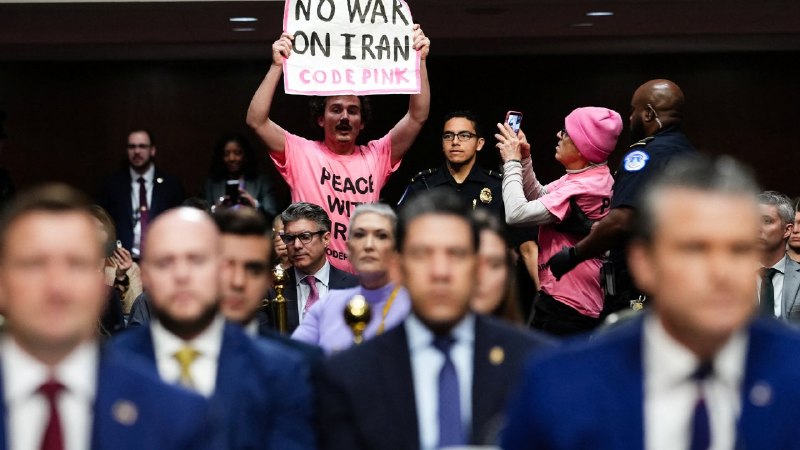
The US Senate voted 50-48 on 23 June 2026 to approve a concurrent resolution demanding the withdrawal of American forces from the war with Iran, delivering what CNN framed as a rare congressional rebuke of President Donald Trump and inserting the legislature, however briefly, into the chain of command over an active conflict. The Jerusalem Post reported the resolution had already passed the House of Representatives earlier in the month, meaning the measure now travels to the president's desk at a moment when the administration's diplomatic track with Tehran is being held up as the principal alternative to further escalation. Iran's state-aligned Mehr News Agency carried the wire framing on its English channel within hours, translating the vote into the language of international legitimacy. Al Jazeera English, for its part, led with the diplomatic reassurance effort rather than the vote itself, reporting that Trump allies were working the phones with Israeli counterparts to keep the US-Iran track from collapsing under the political shock of the rebuke.
The substantive question the vote raises is not whether Congress can stop a war in motion — it cannot, on its own — but whether the political cost of continuing one has just risen sharply inside the Republican coalition. A 50-48 line, with two senators crossing the aisle, is narrow enough to be symbolic and wide enough to be news. The next forty-eight hours will determine which of those readings survives.
What the resolution actually does
The text of the concurrent resolution, as reported by The Jerusalem Post, calls for the withdrawal of US forces engaged in operations related to Iran and frames the deployment as lacking sustained congressional authorisation. It is a war-powers vehicle, not a spending bill: it does not by itself cut off funding, and its legal weight depends on whether the president treats it as binding. The 50-48 margin, with the House having already cleared the measure, gives the White House a choice between signing and veto. A veto would then require a two-thirds majority in both chambers to override — a threshold the vote's headline margin does not clear. The resolution is therefore best read as a political instrument with a procedural tail, not a switch.
CNN's framing, picked up and re-broadcast by Mehr News in English, stressed the rarity of the move: open congressional pushback against a sitting president's active military operations has happened in living memory on Korea, Vietnam, and the 2003 Iraq authorisation, but never often. The fact that coverage is reaching that comparison is itself a signal about how the cable networks expect the story to land.
The diplomatic track that won't sit still
The war-powers vote did not arrive into a vacuum. Al Jazeera English reported, citing its own sources, that Trump allies were reassuring Israeli counterparts throughout 23 June that the Iran track — the diplomatic channel meant to cap the fighting — remained live and that the resolution was a domestic political artefact rather than a strategic re-orientation. That framing matters: Israel's read of US reliability in the middle of an exchange with Iran is one of the single most consequential variables in whether the fighting de-escalates or widens, and the reassurance campaign is, in effect, a separate piece of statecraft running in parallel to the congressional action.
Iran's English-language outlets, including the Mehr News wire carried on Telegram, gave the vote heavy play precisely because Tehran's interests are served by publicising any sign of internal US division. The Iranian framing is that the war "lacks international support"; the corollary Tehran wants Western and Asian capitals to draw is that endurance is on its side. That framing is partial — no resolution has passed the UN Security Council, and Gulf states have been quieter than the headlines suggest — but the fact that Iranian state media can credibly run the line is a measure of how the optics have shifted in Washington.
A narrow majority, a wider signal
Read narrowly, 50-48 is a procedural note. Read as a signal of where the centre of gravity in the Senate sits in late June 2026, it is something else. The two Republican defectors are, by definition, the senators whose states or donor bases are most exposed to the costs of an extended Iran war — whether measured in fuel prices, deployment tempo, or the political overhead of an open-ended commitment without a clear theory of victory. The administration now has to manage those two votes on every subsequent authorization, nomination, and continuing resolution. That is not a crisis. It is the slow corrosion of a mandate.
There is a plausible counter-read: the resolution could be a one-day story if the diplomatic track produces a framework within a week, and if the Israeli reassurance campaign succeeds in convincing Jerusalem that the vote is a domestic episode rather than a strategic pivot. The administration's capacity to package a deal quickly — and to keep the headlines running on the deal and not on the vote — is the variable that decides whether the rebuke ages into a precedent or fades into a procedural footnote.
What remains uncertain
The thread materials do not specify which two Republicans crossed over, nor do they name the principal negotiators on the Iran track or describe the architecture of any draft framework the administration may be preparing. The exact text of the concurrent resolution, beyond the withdrawal demand, is not in the materials Monexus reviewed on 23 June 2026. Casualty figures, operational tempo, and the location of any active US-Iran ground exchange were also not in the inputs that produced this piece; this publication does not estimate them from secondary chatter. Readers should treat the diplomatic-reassurance reporting from Al Jazeera English, the procedural detail from The Jerusalem Post, and the framing language in the Iranian and Arab wires as complementary rather than identical, and should expect the picture to sharpen within forty-eight hours of the vote.
Desk note: Monexus led on the war-powers vote rather than the diplomatic reassurance track because the vote is the verifiable, dated, numerically specific event of the day; the reassurance campaign is real but harder to pin to a single act. Western-wire framing and Iranian state-media framing were both given structural airtime, with the judgment deferred to the next forty-eight hours of reporting.
Wire provenance
This editorial synthesis draws on the following public wire/social posts:
- https://t.me/alalamarabic
- https://t.me/The_Jerusalem_Post