France's Narbonne killing and the politics of the next news cycle
A 17-year-old's death in southern France is being read in real time as a national referendum on migration, justice and who gets to set the terms. The story is already outrunning the evidence.
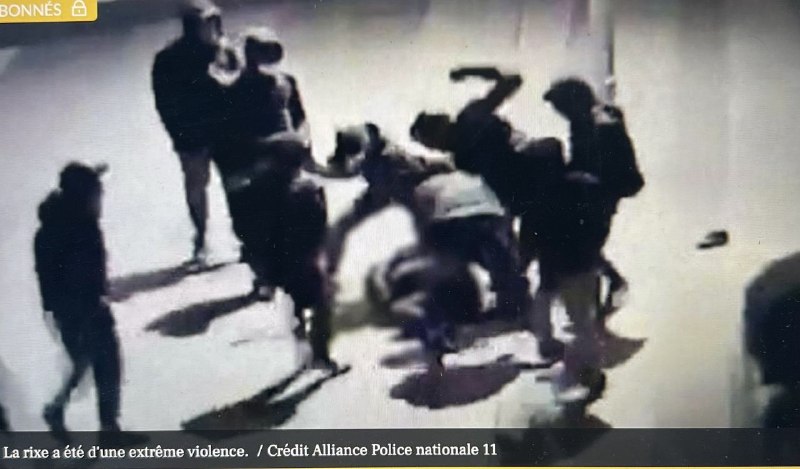
The sequence is now familiar. A 17-year-old Frenchman, identified as Louis, is reported to have been ambushed in Narbonne by a group of five people described as illegal immigrants, attacked with intent to kill, placed in a coma, and declared dead on 23 June 2026, three days after the assault. By 24 June, his family had authorised the public release of a video of the attack — footage described in early distribution as extremely violent, though not graphic. A police syndicate, citing its own report, circulated a still image from the scene. The case has the architecture of a story that does not wait for courts: it waits for cameras, slogans and a press conference at Place Beauvau.
This publication is interested not in the moral horror, which is plain, but in the choreography that follows — the way a single death is metabolised, within hours, into a national argument about borders, law and the limits of the state. France has been here before. The country that invented the politics of the Dreyfus Affair has not lost the habit of letting a single case carry a national verdict.
What the public record actually says
Strip the case to its provable scaffolding: a young man was attacked in Narbonne; five suspects are described in the circulating reporting as being in France illegally; he died in hospital after three days; the family has agreed to the video's release. Each of these sentences is sourced to a single Telegram channel, @rnintel, operating in the 24 June wire cycle, with the family authorisation and the police-syndicate image attached as documentary material. The thread context does not yet contain confirmation from a named French court, a parquet statement, or a national outlet such as AFP, Le Monde, Le Parisien or France Bleu Occitanie, and that absence is itself part of the story.
A first-pass reading would be: violent death of a minor, suspects in irregular administrative status, judicial process to follow. In another country, in another month, that would be the end of the lead. In France, in this moment, the framing is the event.
The right has a script, and it is being read at speed
Within hours of the family's authorisation, the attack slotted into a script the Rassemblement National has been refining for years. The beats are recognisable: a French victim, foreign perpetrators, an absence of clear state response, a media class accused of euphemism, a demand for the toughest available penalty. That script does not need a conviction; it needs a body and a press cycle. The video's release, with the family's consent, accelerates the cycle by making the visual evidence citizen-circulated rather than judicially mediated. The argument that follows — that only a politics of maximum force protects French life — is a political argument, not a legal one, and it is being made before any of the five suspects has been tried.
It is worth saying the obvious: the same script is available because the underlying violence is real. Families do not authorise the release of footage of their children's final minutes for political theatre. They do it because they want the state to act, and because they have often concluded that ordinary procedure will not.
The left's trap, and the media's
The harder question is for those who oppose that politics. There is a reflex, visible across European centre-left commentary after every comparable case, to either minimise the event — by foregrounding the suspect's age, mental health, or social background — or to switch immediately to the politics of the attacker, which is a way of switching away from the victim. Both reflexes are losing reflexes, in the precise sense that they are losing the argument in the polling booths of the towns where these events are reported. A political language that cannot name a victim without qualifying him has already conceded the moral ground to the side that can.
The media, meanwhile, faces its own trap. The legitimate journalistic response is to report the case, to name the suspect profile as reported, to follow the parquet's communiqués, and to refuse the binary in which either the death is everything and the context is nothing, or the context is everything and the death is nothing. The temptation, in 2026, is to do neither: to wait for the algorithmic verdict, and to publish toward it.
What remains genuinely uncertain
It is the day after the family's authorisation, and several things are still unknown. The exact immigration status of the five suspects, the relationship between them, whether the attack was premeditated in the legal sense or erupted from a confrontation, the existence of any prior connection between victim and attackers — none of this is established in the material currently in circulation. The reporting that exists is initial, partisan-adjacent, and moving faster than the parquet. The case will be tried, in due course, by a French court. Whether it will also be tried first, and for longer, by a political class that treats every such death as a closing argument is the question this publication will be watching.
Desk note: Where the wires lead with a bare fact line, this publication is interested in the second-day argument — the one the wires will not write.
Wire provenance
This editorial synthesis draws on the following public wire/social posts:
- https://t.me/rnintel
- https://t.me/rnintel
- https://t.me/rnintel