Hammon stands by her outlier: the coach, the Knicks title, and a debate about small guards
Las Vegas Aces coach Becky Hammon is refusing to walk back her characterisation of the Knicks' title-winning guard — and the dispute is reopening a stale positional argument.
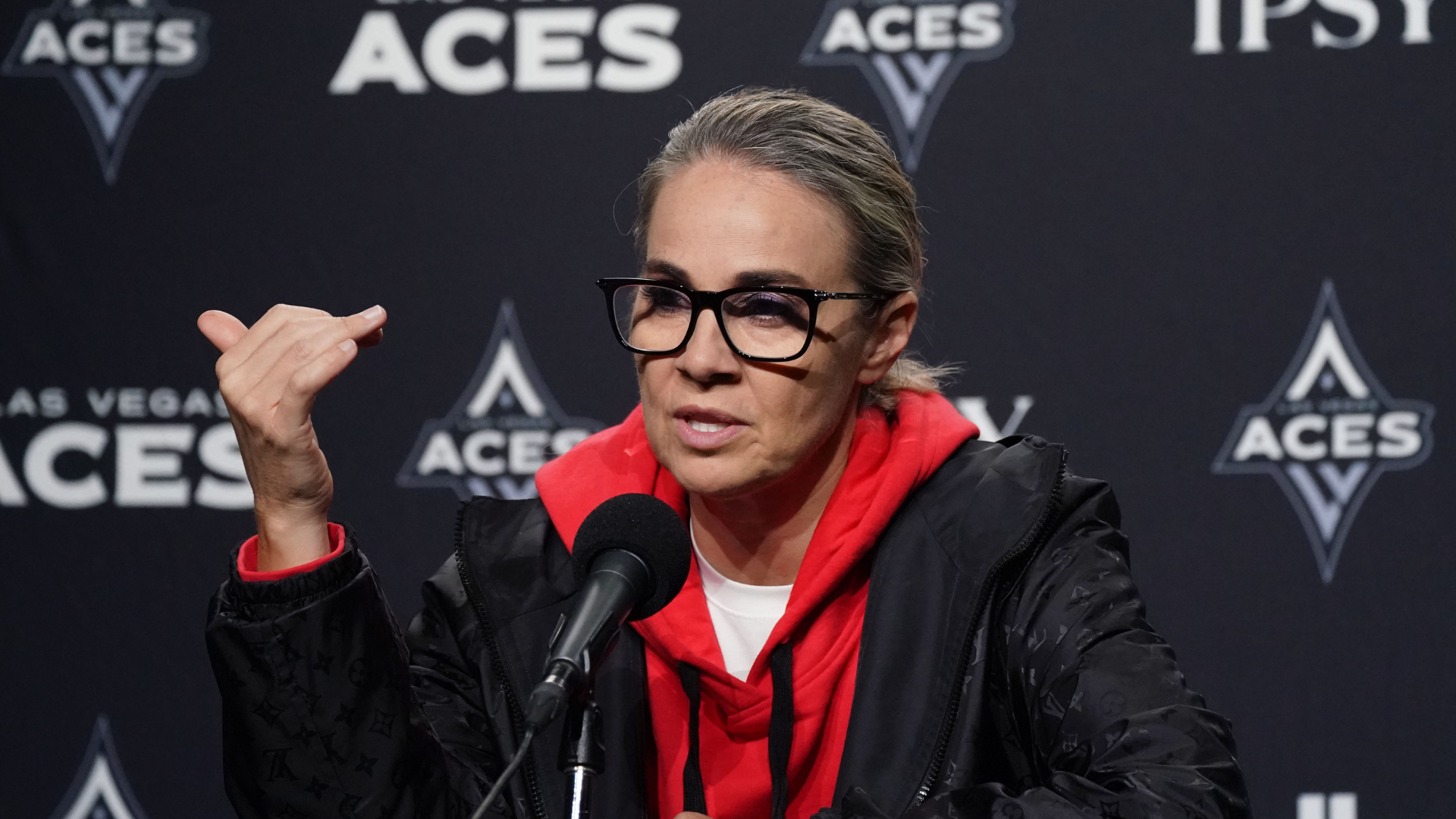
The debate Becky Hammon did not intend to start has followed her into mid-summer. On 23 June 2026, the Las Vegas Aces head coach told reporters that New York Knicks star Jalen Brunson had separated himself from a class of point guards she had previously written off as championship-ceiling players — and that she would not be walking the comment back. "He's an outlier," Hammon said, restating a view she had originally delivered while Brunson was still leading the Knicks through the Eastern Conference bracket. ESPN's wire story of 23 June 2026 carries the exchange, and CBS Sports headlines the same day frame the comment cycle as "refuses to apologize."
What began as a tactical observation has become, fairly or not, a referendum on how a coach with a championship pedigree talks about a guard who just finished hoisting silverware. Hammon's argument is positional and statistical: small lead guards rarely tilt a finals, the league keeps producing counter-examples, and Brunson is the most credible counter-example of his generation. Her detractors — and they are louder now that the Knicks have a banner — read the same record and see a coach hedging her priors only when the box score forces her hand.
The comment, in plain language
Hammon's original framing, surfaced during the Knicks' playoff run, drew a line through the league's lead-guard population: most players under six-foot-two cannot, as the primary creator, carry a team to a title. The implicit exception list was thin. Brunson, who finished the 2025-26 campaign as New York's closer and the Eastern Conference's most reliable fourth-quarter scorer, has now forced his way onto it. Hammon acknowledged the promotion on 23 June 2026 but declined to retract the underlying rule, telling reporters that one player does not invalidate a trend. CBS Sports's headline captures the stance bluntly: "I'm never gonna apologize for having an opinion."
ESPN's reporting from the same day notes the Knicks wrapped their title with Brunson as the offensive hub — a configuration Hammon had publicly questioned as recently as the conference finals. The two facts, taken together, are why the story has legs: a championship coach is not reversing course, and a championship guard is not being credited in the terms she had previously set for that credit.
The case against the carve-out
The pushback is straightforward. Brunson is not a system point guard surviving on a finisher's gravity; he is the system. Over the 2026 playoffs he posted usage rates and fourth-quarter scoring totals that put him in rare historical company, and the Knicks' half-court offence ran through his pick-and-roll reads. Treating his success as a statistical "outlier" — language Hammon herself used, per ESPN — risks flattening what is actually a new template. Several rival backcourts, the argument goes, are now trying to copy the Brunson-on-ball model precisely because the finals said it could win a title.
There is a subtler counter-point too. Hammon coaches in the WNBA, where she has spent a decade working with smaller guards at the highest level. The temptation to read her bracket as a coded commentary on the women's game is real, and it is being read that way in some fan corners. The sources do not support that reading — neither the ESPN nor the CBS Sports write-ups draw the cross-league line — but it sits underneath the discourse, and a serious account of the story has to acknowledge it.
Why the framing matters beyond the bracket
Coaches' priors shape the league's transaction economy. When a respected bench boss publicly categorises a player archetype as championship-uncapped, front offices hear it as draft and trade guidance. Hammon's framing, in other words, does not just describe a debate about Brunson; it influences how teams value the next 6'1" lead guard who comes up in the lottery, and how agents pitch their clients. The Knicks have now provided a counter-example worth — at minimum — a recalibration. Hammon is offering a recalibration of one player, not of the rule.
That distinction is the actual story. She is not dismissing Brunson; she is insulating her broader thesis from a single data point. It is the kind of move a coach makes when she expects to be quoted for a long time and wants her record to read consistently in five years. Whether that is intellectual honesty or face-saving is exactly what the commentariat cannot agree on, and the sources are not going to settle it. ESPN and CBS Sports both carry her on the record, and neither outlet interviewed Brunson or the Knicks for a response in the threads available for this article.
The plausible alternative reads
There are at least two other ways to read the same exchange. The first is that Hammon is doing what champions' coaches often do: accepting a result, but declining to surrender the principle that produced the prediction. The second is that the original comment was always less about Brunson and more about a coaching worldview — a belief that possession quality and rim protection, not on-ball creation by a small guard, decide June basketball. If that is the operative belief, the Knicks' title is an inconvenient data point, not a falsifying one.
The nuance worth holding: the sources do not specify what Hammon said privately to Brunson, what she has told her own Aces backcourt this summer, or whether the Knicks organisation has registered a complaint through the league office. What is on the record is two news cycles of her repeating a single sentence. That repetition is itself the news.
— Monexus framing: where the wire focused on the apology question, this publication reads the exchange as a coach protecting a coaching philosophy from a single championship counter-example — and a league now deciding whether to treat that counter-example as a rule change.