A lone defection across the DMZ, and the structural strain it exposes
A single North Korean soldier walked across the world's most fortified border on 23 June 2026 and was taken into South Korean custody — a routine event that exposes the quiet structural pressure inside the Kim regime.
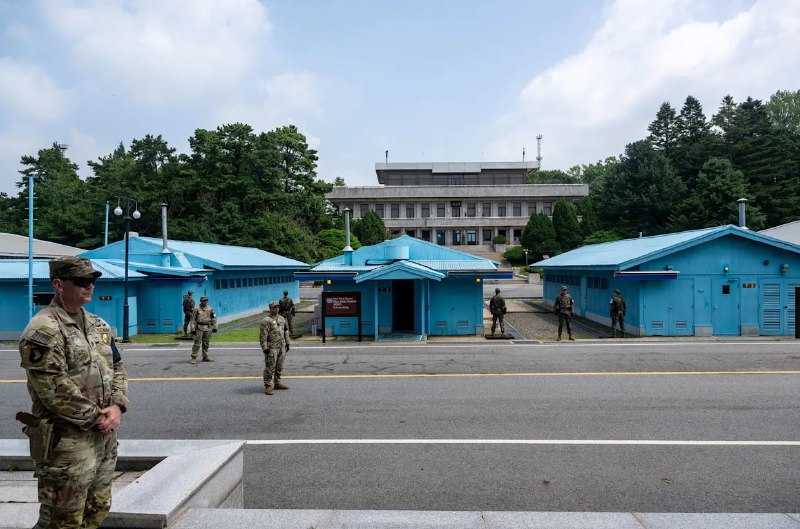
Lead
A single North Korean soldier crossed the Demilitarized Zone on the evening of 23 June 2026 and was taken into South Korean custody shortly afterwards, Seoul's Joint Chiefs of Staff said on 24 June. The defection — confirmed independently by Telegram channels citing South Korean military briefings — is the kind of episode that has recurred in fits and starts since the mid-1990s, and it is also the kind that reveals more about the structural condition of the Kim regime than any one soldier's individual decision can carry on its own.
Nut graf
Three different Telegram feeds carried the news within roughly twenty-five minutes of one another: the Russian-linked rnintel channel at 08:29 UTC on 24 June, the conflict-monitoring outlet Clash Report at 08:18 UTC, and Iran's state-affiliated Tasnim News English at 08:04 UTC, the last citing South Korea's Yonhap news agency. None of the three published casualty figures or named the individual soldier; all three described the cross as occurring late on Tuesday 23 June across the heavily fortified inter-Korean border. The convergence matters less for what it adds than for what it concedes: the underlying report traces back to a single South Korean military source, and the rest of the global feed is downstream of it.
What Seoul actually said
According to the Joint Chiefs of Staff, as carried by Clash Report, the soldier reached South Korean positions late on Tuesday and was taken into custody without exchange of fire. The South Korean military framed the incident as a successful interdiction under standing protocols for dealing with border-crossers from the north. Yonhap, the wire service quoted by Tasnim, has historically been the first South Korean outlet to confirm defections, and its reporting tends to be released in coordination with the JCS — a reminder that what looks like multiple independent confirmations is, in practice, a tightly choreographed information flow from a single source.
The brevity of the official readout is itself significant. Past defections across the DMZ — most prominently the 2017 case of Oh Chong-song, who was shot during his sprint across the Joint Security Area — produced hours of competing claims, footage, and medical updates. This time, the South Korean side appears to have moved quickly and quietly. Whether that reflects a desire to avoid provocation at a sensitive moment on the peninsula, or simply that nothing dramatic occurred on the ground, the available reporting cannot say.
The counter-narrative on why it happened
The dominant Western framing of North Korean defections treats each crossing as evidence of pressure on the Kim regime — sanctions biting, information seeping across the border, the inducement of South Korean prosperity pulling at the edges. That framing is not wrong, but it is incomplete. Defections by uniformed soldiers, as opposed to the more heavily publicised crossings by civilians in recent years, are read inside South Korea's intelligence community as a different kind of signal: not necessarily political disillusionment, but a calculation that a soldier with combat training has a higher chance of being resettled under favourable terms than an ordinary border-crosser.
The alternative read is less flattering to Seoul and to the conventional narrative. Some crossings are opportunistic — staged by individual soldiers seeking food, medical care, or a path to resettlement rather than expressing any ideological distance from Pyongyang. The South Korean government has financial incentive to characterise each defection as a propaganda win; the North Korean government has the inverse incentive to dismiss any defection as criminality, ideological drift, or mental illness. Both filters shape what reaches the public.
A third possibility, less often voiced in Western coverage, is that the DMZ itself has become structurally harder to cross from the south than from the north. South Korean guard posts have been reinforced over the past decade; surveillance density on the southern side is high. A crossing that succeeds is almost by definition a one-way trip — which means whatever the soldier chose to leave behind, he chose to leave permanently.
The structural picture, in plain terms
What makes the DMZ defection worth reading as a structural event rather than a human-interest one is the asymmetry of information around it. The Korean Peninsula is one of the most heavily militarised spaces on earth, yet the public record on incidents inside it is thinner than for almost any comparable flashpoint. News flows from a small number of official mouths on both sides of the border; everything else is reconstruction.
This is a recurring feature of closed-frontier reporting: the wire of record is the government of the side that controls the ground where the soldier ended up. Telegram channels like the three that carried this story do not investigate; they relay. Their value is speed and corroboration, not depth. When the underlying primary source is one JCS statement, three Telegram posts are not three independent sources — they are one source reproduced.
The deeper pattern is this: the Korean Peninsula's information environment is engineered, on both sides, to be opaque. Defections break the opacity for a moment and then the window closes. Readers who want to draw conclusions about what the defection "means" are working from a very small sample of confirmed facts — a soldier, a date, a custody transfer — and a much larger volume of interpretive noise.
What remains uncertain
The sources do not specify the soldier's rank, unit, or motivation. They do not state whether he was armed at the time of crossing, whether he crossed alone or with others, or whether any North Korean return fire occurred. Yonhap's original report, cited by Tasnim, was not directly published in the Telegram items reviewed, which means the chain of attribution runs Telegram → Yonhap → JCS, with the JCS as the originating primary source.
It is also worth noting what the framing does not address: the timing of the defection, two days after a period of reported strain between Pyongyang and Beijing over the reported transfer of certain military-adjacent equipment, falls into a calendar that none of the available items discuss. Whether the calendar matters is a question the public record cannot yet answer.
Stakes
For Seoul, each successful defection is a small, controllable win and a routine operational task. For Pyongyang, each one is a quiet loss the regime prefers not to amplify. For the broader regional picture, the practical stakes of a single soldier crossing are low; the political stakes depend almost entirely on whether the North chooses to acknowledge it and on whether South Korea's political cycle — heading into the next round of domestic attention on unification policy — treats the defection as routine or as a moment.
The more durable stake is informational. Each defection that reaches the public without serious follow-up reporting entrenches a one-sentence version of a story that is structurally much larger. The DMZ is not just a border; it is a firewall for the news about itself.
Desk note: Monexus carried this item on the strength of three Telegram wires converging on a single South Korean JCS readout. We have stripped the reporting back to the verifiable facts — date, custody, source chain — and resisted the temptation to treat three Telegram posts as three independent sources.
Wire provenance
This editorial synthesis draws on the following public wire/social posts:
- https://t.me/rnintel
- https://t.me/ClashReport
- https://t.me/tasnimnews_en