Senate war-powers rebuke collides with Trump's nuclear push as gas-price pressure mounts
The Senate's 23 June war-powers rebuke and the Energy Department's nuclear-loan rollout, filed in the same 48-hour window, are two branches of the US government reading the same price signal. The collision is the story.
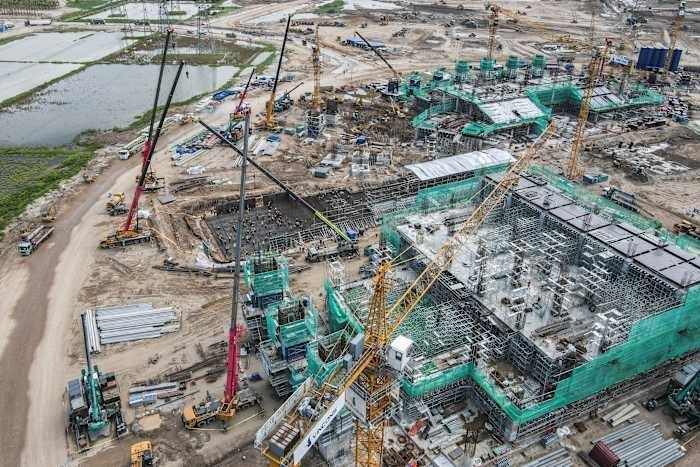
On 23 June the US Senate delivered a rare, bipartisan rebuke of the executive's war-making authority, voting to claw back the administration's authority to continue strikes related to the Iran conflict that began on 28 February. Forty-eight hours later the White House is moving in the opposite direction: a new Department of Energy loan guarantee, sized to underwrite a small-modular reactor buildout, was rolled out as fuel costs at the pump refuse to fall in line with crude. The two acts are not the same story. Read together, they are.
The vote in the Senate, which crossed the chamber on a margin unusual for a war-powers resolution in this Congress, lands as the political ceiling of the administration's Middle East posture comes into view. It is one thing to launch a campaign against Iranian nuclear and proxy infrastructure. It is another to keep the campaign funded, justified, and tolerable at the gas pump four months in. The Senate has now put a marker down on the first question. The Energy Department has, in the same 48-hour window, tried to answer the second.
The political ceiling of an oil war
War-powers resolutions are, on paper, mostly symbolic. They pass the House, occasionally the Senate, and gather dust on the Resolute Desk. The 23 June vote is different in degree, not just in kind. The resolution, which would have required the president to terminate the use of US armed forces against Iran and Iranian-aligned targets absent a fresh authorisation from Congress, drew a coalition that included members of the president's own party. That coalition did not form because senators discovered a new attachment to constitutional procedure. It formed because the cost of the war has begun to arrive at the kitchen table.
According to a Nikkei Asia dispatch filed on 26 June, crude oil prices have now fallen back to roughly where they stood before the US–Iran conflict began on 28 February. That is the good news, and it is the news the administration has been waiting for. The bad news is that the fall in crude has not travelled the way it usually does. Asian importers, Nikkei reports, are continuing to shift away from Middle East oil even as the price signal normalises, a structural repricing rather than a tactical discount hunt. A 26 June BBC explainer on UK petrol prices makes the same point from a different angle: oil is back, petrol is not, and the lag is the story.
The lag is the political story in Washington too. US gasoline retail prices, by the administration's own rhetorical standard, were supposed to follow crude down once the Strait of Hormuz crisis eased. They have not, in any politically useful way. The Energy Department's response, a multi-billion-dollar loan guarantee programme for advanced nuclear deployment framed as a long-run price-suppression tool, is a confession embedded in a press release. The administration is telling voters, in effect, that the next era of cheap electrons will arrive after this era of expensive liquid fuel has already bitten.
The nuclear loan as a political instrument
The loan-guarantee architecture now being rolled out is not new in form. The Department of Energy's Loan Programs Office has been the federal government's principal vehicle for subsidising capital-intensive energy projects for two decades. What is new is the timing and the framing. The announcement, which pairs the loan authority with a small-modular-reactor deployment schedule, is being sold as a domestic industrial-policy win. It is also being sold, in the same news cycle, as a response to gas prices that will not cooperate.
Small modular reactors are not a near-term answer to retail gasoline. The first commercial units under any plausible deployment schedule come online in the early 2030s, and the loan-guarantee pipeline is, by design, a financing instrument rather than a price control. The political question is whether voters will read the announcement as a serious industrial bet or as a deflection from a fuel market that is no longer delivering the price prints the administration needs. On current evidence, the read will depend almost entirely on the next few weeks of pump prices.
What the wires are not connecting
Most wire coverage has, sensibly enough, treated the 23 June war-powers vote and the loan-guarantee announcement as parallel bulletins. One is a legislative story. The other is an energy story. They run on different days, in different sections, and the bylines do not overlap. That separation is the kind of craft decision that makes daily news readable. It is also, at this moment, a mistake. The two items share a single underlying fact: the war against Iran has a price, and the price is now a domestic political fact rather than a foreign-policy abstraction.
The Nikkei dispatch is the clearest articulation of the structural point. Even with crude back to pre-war levels, the conflict has produced a measurable, durable shift in Asian buying patterns away from Middle East barrels. That shift will, over time, raise the embedded risk premium in every alternative supply route and, in turn, the floor under retail fuel in the United States. The war-powers vote and the nuclear loan are, each in their own way, attempts by two branches of the US government to manage a price signal that the market has already absorbed and the consumer has not yet finished paying.
The collision and the calendar
The calendar matters. The war-powers resolution now moves to the House, where the arithmetic is less favourable for the administration but the underlying political pressure is the same. The nuclear-loan authority is, by statute, a multi-year programme, and the first conditional commitments will be announced on a separate schedule from any vote. But the news cycle is not. By the time the House takes up the war-powers question, the Energy Department's loan announcement will be a week old, and the question every reporter will ask is whether the loan authority will lower the price of gasoline before the next election. It will not. Everyone in the room knows that. The vote on the resolution will, in the meantime, have given senators of both parties a written record of where they stood on the war's continuation, dated to the week the pump price refused to move.
That is the collision the 23–24 June news flow actually describes. The executive is trying to extend a war and to underwrite the energy system that will, eventually, replace the one the war is disrupting. The legislature is trying to claw back the authority to conduct the war and to redirect the political cost of it. Neither side is going to win quickly. The voters, who pay the bill at the pump in the meantime, will decide which side of the collision they were on at the ballot box, and the loan guarantees will be a footnote in that decision, or they will be the decision itself. Watch the next retail gasoline print. It is the only number in this story that the Senate, the White House, and the Department of Energy are all reading off the same sheet.