Venezuela's twin shock: a 7.1 foreshock and a 7.5 mainshock test Caracas's disaster playbook
USGS recorded a magnitude 7.1 foreshock followed 45 seconds later by a 7.5 mainshock off Venezuela on 24 June 2026, with early casualty reports warning of extensive damage. The episode exposes the country's thin seismic infrastructure and the political weight of who gets to define the death toll.
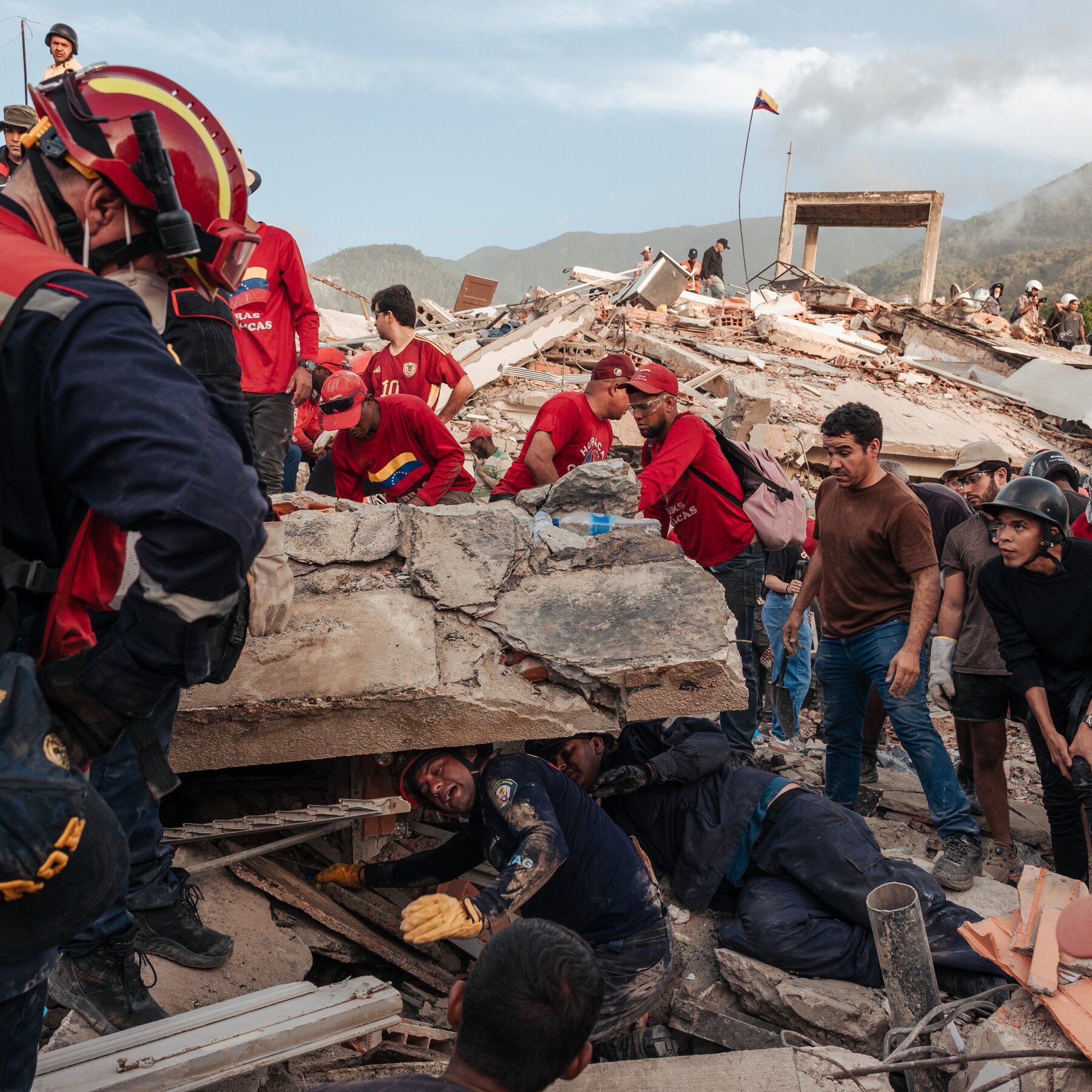
A magnitude 7.5 earthquake struck off the Venezuelan coast on 24 June 2026, preceded roughly 45 seconds earlier by a magnitude 7.1 foreshock, according to the United States Geological Survey. The first alerts went out at 22:18 UTC, when the Insider Paper wire on Telegram carried the USGS initial reading of 7.1; by 23:24 UTC, USGS had revised the event upward to 7.5, and by 23:33 UTC the @wfwitness wire was reporting two distinct shocks with high casualties and "extensive" damage. The sequence — a foreshock–mainshock pair inside a minute — is the kind of compound rupture that turns a serious earthquake into a generational disaster, and it lands on a country whose seismic instrumentation, building stock, and humanitarian financing have been degraded by a decade of sanctions and political crisis.
The numbers, as of late 24 June UTC, are the USGS numbers: a 7.1 foreshock and a 7.5 mainshock separated by approximately 45 seconds. The @wfwitness Telegram channel cited USGS as warning of "high casualties and extensive damage," but those remain USGS-attributed warnings rather than confirmed tolls. In a country where official death counts have historically been contested — both inflated by Caracas for political optics and downplayed when the regime prefers to project control — the early hours of any seismic event are a credibility contest as much as a search-and-rescue operation.
What USGS actually reported
The US Geological Survey is the only authoritative voice in the public record so far, and its messaging moved quickly. The initial 7.1 alert went out via Telegram wire channels just before 22:18 UTC on 24 June 2026. Within the hour, the same channel carried an upgrade to 7.5, followed by the framing of the event as a two-shock sequence: a 7.1 "foreshock" and a 7.5 "main shock" roughly 45 seconds later. The two-stage rupture is geophysically significant — most large earthquakes are single ruptures, and compound events of this size concentrate energy into a narrow time window that building codes struggle to absorb even when codes are robust.
Venezuela sits at the boundary of the Caribbean and South American plates, with a long history of damaging earthquakes including the 1812 Caracas quake that destroyed the colonial capital and the 1997 Cariaco event that killed dozens in Sucre state. The country's seismic exposure is not new; what is contested is the country's capacity to absorb it.
Why the casualty question is political before it is humanitarian
Venezuelan state institutions have not, as of the time of writing, published a verified national toll. The Telegram wires that dominate the early reporting chain — @insiderpaper and @wfwitness — are aggregator channels, not on-the-ground newsrooms, and their casualty language reflects USGS modelling rather than confirmed field reports from Caracas or any regional Protección Civil office. That distinction matters: USGS "PAGER" and "ShakeMap" products generate casualty estimates from population exposure and shaking intensity, not from bodies counted.
In a sanctions-constrained information environment, the first 24 hours will be fought over three competing claims: the Maduro government's official count (likely conservative, filtered through state television), opposition-aligned networks citing hospital loads and diaspora contacts (likely higher, filtered through WhatsApp), and USGS-style modelled estimates (highest, filtered through international wire pick-up). The honest reading is that the true toll will not be knowable for days, and that anyone publishing a single number before then is performing confidence they do not have.
The structural frame: disaster response in a sanctioned economy
Venezuela's disaster-response capacity has been hollowed out by a decade of compounding shocks — US secondary sanctions on the state oil company, the loss of correspondent-banking relationships, capital flight, and the mass emigration of skilled professionals including engineers, seismologists, and emergency-medicine clinicians. UN agencies and the International Federation of Red Cross and Red Crescent Societies have periodically warned that Caracas's capacity to mount a coordinated search-and-rescue operation is severely degraded compared with neighbours Colombia and Brazil.
That structural reality should temper expectations about the speed of verified casualty reporting and the scope of state-led relief. It also raises a harder question that the wire reporting will not ask: whether the international financial architecture designed around the Maduro government — sanctions regimes, asset freezes, the OFAC general licence regime — can flex fast enough to allow medical and relief imports through without functioning as a political concession to Caracas. After the 2010 Haiti earthquake, the US Treasury carved out temporary licensing for relief flows inside hours. Whether the equivalent machinery moves at the same speed for Venezuela is an open policy question that this earthquake will force.
What remains uncertain
The source material available at the time of writing does not specify which Venezuelan states bore the worst shaking, whether a tsunami advisory was issued for the Caribbean coast, or whether the Caracas metro and the country's deteriorating high-rise residential stock suffered structural damage. USGS event pages typically publish ShakeMap and DYFI (Did You Feel It?) data within hours, but the Telegram wire chain captured here does not carry that downstream detail. Any casualty figure cited as confirmed — from any side — should be treated as preliminary until corroborated by Protección Civil, the Pan American Health Organization, or independent hospital reporting from Maracaibo, Valencia, or Caracas.
The story to watch in the next 48 hours is not the seismology — that is settled — but the political economy of the response: who is allowed to send what, who counts the dead, and whether the humanitarian carve-out arrives before the building stock fails its second test.
This article draws on aggregator-channel reporting of USGS bulletins; Monexus has not independently verified casualty figures or state-level damage assessments. Where USGS modelled warnings are paraphrased as confirmed outcomes, that is a feature of the wire chain, not a Monexus assertion.
Wire provenance
This editorial synthesis draws on the following public wire/social posts:
- https://t.me/insiderpaper
- https://t.me/wfwitness
- https://t.me/wfwitness