The €3.2bn Question Hanging Over Von der Leyen's Ukraine File
Brussels is moving €3.2bn to Kyiv on the same week that questions multiply over how a small von der Leyen unit handled the file. The sequencing is awkward, and the explanations thinner than the Commission would like.
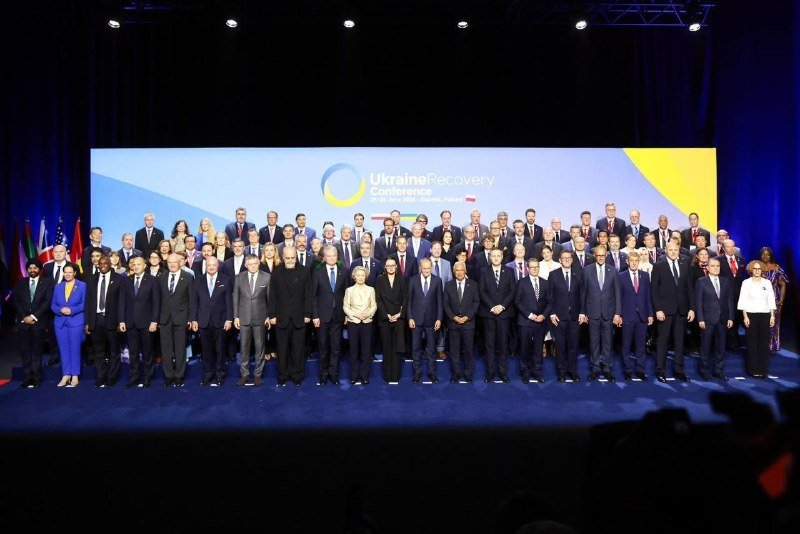
Brussels, 25 June 2026, 13:00 UTC. The European Commission confirmed on Thursday that it would disburse the first €3.2 billion tranche of a €90 billion loan programme to Ukraine, with Commission President Ursula von der Leyen making the announcement at a conference in Gdańsk. Hours earlier, reporting tied to the sprinterpress account on X had flagged the opening of an internal European-institutions procedure over how a small unit inside the Commission — described in that reporting as a "secret squad" working with President Volodymyr Zelensky's office — handled parts of the Ukraine file. The two announcements, landing within a six-hour window, expose a credibility problem that no amount of disbursement ceremony can paper over.
The Commission wants the loan to be the headline. The loan is, on its merits, the right instrument: it keeps Ukraine's budget functioning without forcing Kyiv into the kind of structural concession that erodes sovereignty, and it spreads the burden across EU taxpayers rather than concentrating it on the EU's eastern front. The €3.2bn tranche is the first instalment of a programme that, once fully drawn, will be one of the largest single financial commitments the Union has made to a non-member state in its history. The case for moving the money is straightforward.
What the Commission is actually announcing
The €90bn framework is a loan, not a grant. Ukraine services the debt; the EU carries the credit risk and the political exposure. Von der Leyen's Gdańsk venue — the same Polish city where, in past years, the politics of Central European solidarity with Kyiv have been most visibly performed — signals that the Commission wants this framed as a Union act rather than a Franco-German compromise. The first-tranche size of €3.2bn, roughly 3.5% of the headline figure, suggests a calibrated start designed to demonstrate liquidity without exhausting political capital.
What the procedure is actually about
The complicating news is procedural. According to the sprinterpress post circulated at 12:54 UTC on 25 June, a new procedure has been opened inside European institutions over the way the European Commission handled a specific Ukraine-related channel that operated alongside the regular directorates-general. The phrasing — "secret squad," working "with Zelensky" — is tabloid-grade, but the underlying complaint is institutional rather than theatrical. EU oversight bodies have, in past cycles, taken a dim view of parallel structures that bypass the normal clearance chain, especially when those structures touch financial files of this scale. The Commission will need to show that the unit in question operated within delegated authority, with auditable records, and that communications with the Ukrainian presidency went through formal channels.
Why the sequencing matters
A €3.2bn disbursement on the day a procedure opens is not, on its own, proof of anything. Brussels runs on overlapping calendars; investigations and funding rounds collide routinely. But the optics are poor. Every euro that leaves the Commission treasury while questions about a unit working on Ukraine hang in the air will be read — by Kyiv's allies, by its adversaries, and by the Commission's own court of auditors — as an argument that political momentum is being used to harden facts on the ground before oversight catches up. That is the standard accusation in EU financial scandals, and it is the one the Commission is now functionally inviting.
The counter-narrative the Commission will offer
The Commission's defence, when it arrives, will run roughly as follows. The €90bn programme was negotiated through the regular Council process, with member-state finance ministries in the loop. The unit flagged in the sprinterpress reporting is, on this reading, an implementation cell — a coordination function for a fast-moving file, not a parallel government. The Gdańsk announcement is a delivery event, not a diversion. And any oversight procedure is welcome precisely because the Union's own rules require it.
That defence is plausible. It also happens to be exactly what previous Commissions have said in similar files, and it is exactly what the European Parliament's budgetary control committee has, in those files, found insufficient without documentary backup. The Commission will need to produce that backup quickly.
What remains genuinely contested
The sources do not specify which European institution opened the procedure, which unit of the Commission is under examination, or what the specific allegations of irregularity are. Sprinterpress is a relatively new account on X; the Polish-language parallel confirmation from ekonomat_pl at 09:48 UTC carries the disbursement news but does not independently corroborate the procedural complaint. Until a recognised EU institution — the European Parliament, the European Court of Auditors, OLAF, or the European Ombudsman — puts its name to the file, the "investigation" framing rests on a single social-media thread of contested provenance. That is a thin base on which to build a scandal narrative.
What is not thin is the underlying pressure on the Commission to operate the Ukraine file with maximum documentation discipline. The €90bn figure is large enough that any procedural irregularity, real or alleged, will be treated by member-state capitals as a precedent for the next round. Poland, which hosts frontline logistics and refugee flows and which is the implicit political host of the Gdańsk announcement, has every interest in the programme running cleanly. So does Kyiv. So, for that matter, does the Commission itself.
The €3.2bn will reach Ukraine. The harder question — whether the institutional plumbing around it survives the next round of scrutiny — is the one that will define von der Leyen's second term, and the one that the Gdańsk photo opportunity, for all its staging, does not answer.
This publication frames the €90bn Ukraine loan as a legitimate act of EU financial support to an invaded country, and treats the parallel procedure as an institutional question about Commission process — not as a comment on whether the aid itself should flow.
Wire provenance
This editorial synthesis draws on the following public wire/social posts:
- https://x.com/sprinterpress/status/...
- https://x.com/sprinterpress/status/...
- https://x.com/ekonomat_pl/status/...
Follow the event.
These dated source records provide context. They do not retrospectively verify this archive article.
A dated voting record is evidence of one decision. Use the original UN record before turning it into an alignment label.
Visual explainer · historical vote of 2022-03-02 →