The 48-team World Cup is already exposing the seams in Fifa's design
Two fixtures in the final round of group games can be played to a mutually convenient draw, a structural flaw baked into the 48-team format. Off the pitch, banned brands are dominating the conversation anyway.
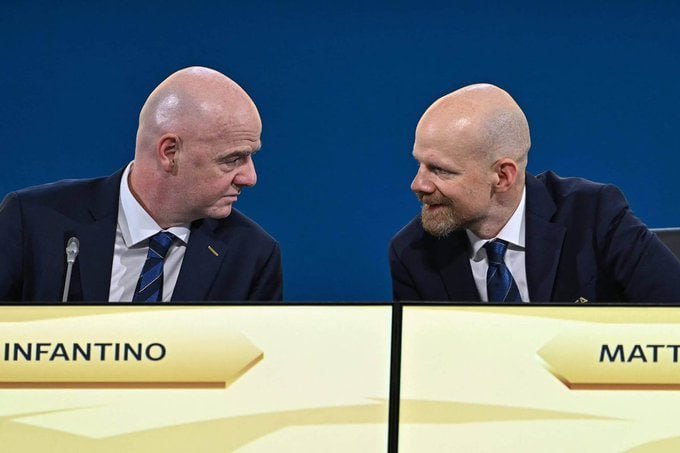
The first World Cup staged across three countries has not yet kicked off in earnest, but the architectural problems of the 48-team format are already legible in the fixture list. According to a BBC Sport analysis published 25 June 2026, two matches in the final round of group games present a textbook case: the two sides involved can simply play out a draw and both progress. The incentive structure is not a quirk of this draw. It is built into a 48-team bracket that FIFA president Gianni Infantino spent the last cycle selling as more inclusive, more global, more representative of the game's footprint.
The 48-team World Cup is, in short, a tournament whose sporting logic and its commercial logic have started to diverge — and the seams are showing before a ball is kicked in anger.
The draw problem
The mechanics are unglamorous and well-known to anyone who has watched European football in the autumn. When two teams level on points meet on the final matchday with advancement secured by avoiding defeat, the game becomes a transaction. BBC Sport's piece, published 25 June 2026 at 13:38 UTC, lays out the specific scenario: two fixtures in the closing round of group games reward both sides for a draw. The format's expansion from 32 to 48 teams created 12 groups of four, and the cascading reshuffle of how third-placed teams advance — the best four of 12 third-placed sides progress — opens up the kind of result-engineering possibilities that smaller, cleaner brackets tend to close off.
The counter-argument from the sport's administrators is that 48 teams is a political and developmental project: more nations, more broadcast hours, more sponsors, more revenue for member associations. Infantino's pitch, repeated across FIFA's communications channels, has framed the expansion as a democratisation of access. The structural flaw is that democratisation and competitive integrity pull in opposite directions. The more teams you admit, the more final-round games become coordination problems rather than sporting contests.
The brands problem
If the on-pitch design is straining, the off-pitch reality is stranger. A second BBC Sport piece, published 25 June 2026 at 10:53 UTC, catalogues the brands FIFA has officially sidelined — gambling operators, certain cryptocurrency platforms, others — and notes the inevitable consequence: the suppression has amplified them. The piece makes a clean editorial point about the Streisand effect, applied to a federation that has spent recent cycles tightening its commercial perimeter.
The Telegram wire on 25 June 2026 at 04:48 UTC, from both the FIFA channel and The Athletic's feed, captured a parallel phenomenon: a query to xAI's Grok asking which nation will "dominate" the tournament. The fact that the question is being routed to an AI oracle, by fans and by the algorithm, says something about how this World Cup is being consumed in real time — not as a sporting event analysed by human experts, but as a content surface that any large language model can be asked to predict. The brands FIFA has banned from the touchline are still showing up in the conversation. The questions FIFA would prefer to anchor — who is favoured, who is the story, who is the underdog — are being redistributed through channels the federation does not control.
The commercial logic
The two threads are connected. FIFA's expansion is a revenue project, and the revenue project depends on scarcity of official association. A 48-team field dilutes the sporting product; controlling which brands can buy access to the field reconstitutes the scarcity on the commercial side. The banned-brand problem is the predictable cost: when a federation tries to be both an inclusive sporting body and a tightly-curated marketing platform, the gap between those two identities is where the news cycle lives.
The counter-narrative — that FIFA is doing what every governing body does, and that brand-screening is just risk management — is real and has merit. Major sports federations routinely exclude categories of advertiser for legal, regulatory, or reputational reasons. What is unusual here is the visibility of the result. Banned brands do not usually become the story; this tournament, the BBC reporting suggests, is a case study in attempted suppression producing the opposite effect.
What to watch
The structural takeaway is straightforward. The 48-team format trades competitive cleanliness for political reach, and the trade-off is becoming legible in the very first matchday's fixture design. Whether FIFA adjusts the bracket logic before 2030 — the next expansion is already under quiet discussion in federation circles — is the question that matters more than any individual group-stage result.
The commercial question is sharper. FIFA has, in effect, outsourced its tournament narrative to whichever actors — banned brands, AI models, social channels — can grab attention outside the federation's official grid. The federation's response will set the template for the next decade of mega-event governance: double down on control, or accept that the story of a 48-team World Cup will be told, increasingly, by parties FIFA did not invite to the table.
Desk note: Monexus treats the 48-team format as a sporting-and-commercial story in the same frame, on the view that the bracket design and the sponsor list are two outputs of one underlying governance choice. The counterpoint — that these are separable issues — is acknowledged above and not dismissed.
Wire provenance
This editorial synthesis draws on the following public wire/social posts:
- https://t.me/FIFAcom
- https://t.me/TheAthletic