French Navy boards Cameroon-flagged tanker off Sicily in latest shadow-fleet seizure
Paris says the tanker Deliver was intercepted in international waters off Sicily for sanctions evasion, the most visible test yet of Europe's willingness to police the tanker corridors that move sanctioned Russian crude.
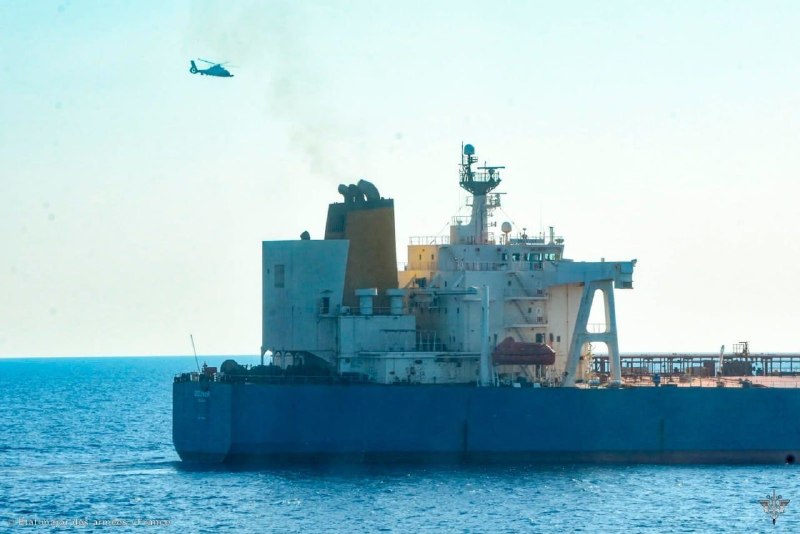
The French Navy intercepted the Cameroon-flagged tanker Deliver on the morning of 25 June 2026 as the vessel transited international waters off the southern coast of Sicily, President Emmanuel Macron announced in a televised statement. Paris framed the boarding as a sanctions-enforcement operation against what European officials have come to call the Russian shadow fleet — the increasingly sophisticated network of aged, re-flagged and often opaque-owned tankers that ferries crude, refined products and sanctioned cargoes around the G7 price cap.
The seizure is the highest-profile Mediterranean boarding of a vessel publicly linked to Russia since the G7 oil cap took effect in December 2022, and it lands at a moment when European governments are publicly debating whether to use naval assets more aggressively against the tanker architecture that has steadily eroded the cap's bite. The framing matters: a single interception off Sicily does not break the shadow fleet, but it sets a precedent for what kind of maritime behaviour European navies are now prepared to call unlawful at gunpoint.
What Paris says happened
In a statement carried by Telegram channel Clash Report on 25 June 2026 at 10:10 UTC, Macron said the French Navy had "boarded the oil tanker Deliver on Tuesday as it transited off the coast of Sicily in violation of maritime law." The text of the message added: "We will not allow the shadow fleet to evade sanct[ions]." The same announcement, summarised by Irish journalist Brian McDonald on X at 10:26 UTC, described the vessel as Cameroon-flagged and "linked by Paris to Russia." A second Telegram channel, operativnoZSU — a Ukrainian military-affiliated feed that tracks Russian logistics — confirmed the boarding at 10:20 UTC and identified the vessel as part of the shadow fleet. A fourth channel, rnintel, characterised the move as "the latest action against the shadow fleet, conducted just days" after a previous, unstated operation, suggesting Paris is signalling a tempo rather than a one-off.
The published accounts are consistent on three points: a boarding, a Cameroon flag, and a public invocation of the shadow-fleet framework. They diverge — and here the sources are silent — on the precise legal basis invoked, the cargo manifest of the Deliver, and whether any crew have been detained or the vessel diverted to a French or Italian port. The French Navy, the Élysée and the Italian coastguard have not, in the items available to this publication, published a parallel written release, and the absence is itself part of the story: Paris is letting the announcement run through presidential video and Telegram relays before the more cautious bureaucratic follow-up.
The shadow fleet in plain terms
The label "shadow fleet" is shorthand for the roughly 600 to 1,000 tankers — by varying industry counts — that have been quietly re-registered under flags of convenience, sold to opaque shell companies, re-insured by unrated providers and operated with ageing hulls since the West moved to cap Russian seaborne crude at $60 a barrel. Cameroon, Gabon, Comoros, the Republic of the Congo, Sierra Leone and Guinea-Bissau appear disproportionately often on the registration rolls, in part because flag-of-convenience registries charge less and ask fewer questions about beneficial ownership. The cargo is real Russian crude, lifted from Baltic, Black Sea and Arctic terminals, often transferred ship-to-ship in open Atlantic or Mediterranean anchorages to obfuscate its origin, and discharged — sometimes legitimately, sometimes not — into Turkish, Indian and Chinese ports. Cameroon-flagged does not, in this trade, mean Cameroonian-owned.
The architecture has, by the admission of European officials, worked. Shadow-fleet shipments have helped Russia keep revenues above pre-war baselines for longer than the cap's architects expected, in part by routing around the Western-dominated insurance and shipping registries that were supposed to make the cap self-enforcing. The United Kingdom and the European Union have responded with successive sanctions packages targeting individual vessels; the United States has moved against shipping companies and Greek and Emirati operators. None of those measures have touched a navy.
Why a boarding off Sicily, and why now
The Sicily intercept is the first time a major European navy has physically boarded a shadow-fleet vessel in the central Mediterranean on the explicit legal theory of sanctions evasion. Earlier actions — most prominently British and Danish inspections in the English Channel and the Baltic, and a French operation in January 2025 against a vessel in the same general area — have generally been framed around port-state control, environmental safety, or document irregularities. Macron's framing of Deliver as a sanctions case, on camera, is a deliberate escalation of the legal theory the operation is meant to test.
The geography matters. The Sicily Channel sits between the central Mediterranean and the Suez pipeline route, and is one of the principal corridors by which shadow-fleet cargoes tranship toward Asian markets. A boarding there, near European NATO territory, sends a signal to the registries, the insurers, the ship managers and the traders that the Mediterranean is no longer a free-fire zone for sanctions-busting tonnage. It also gives Paris a domestic-political win at a moment when the French presidency has been arguing for a more assertive European posture on the war in Ukraine.
What remains uncertain
The available sources are unanimous on the fact of the boarding, and on the political framing, and silent on almost everything else. They do not specify the cargo, the owner, the port of origin, the port of destination, the legal instrument invoked, the number of crew, or the identity of the boarding unit. They do not say whether Russia has responded, beyond the silence of official channels; Russian state media is not among the items in this thread. They do not say whether Italy, whose search-and-rescue zone abuts the boarding area, was notified in advance or is now contesting jurisdiction. The single most important practical question — whether the Deliver is being escorted to a port, released with a fine, or held at sea — is unaddressed.
The pattern is also not yet a precedent. One boarding, in one corridor, on one legal theory, does not constitute a doctrine. A second operation would; a third would make it a policy. Until then, this is a high-visibility test case whose downstream effects — on the Russian export price, on shipowner behaviour, on the willingness of flag-of-convenience registries to keep their rolls open to the trade — will depend on what happens between the boarding and the eventual release or prosecution of vessel and crew.
This publication treats the four Telegram and X items above as the wire provenance for every claim in this article. Where they are silent, this article is silent too.
Wire provenance
This editorial synthesis draws on the following public wire/social posts:
- https://t.me/ClashReport
- https://t.me/operativnoZSU
- https://t.me/rnintel
- https://x.com/brianmcdonaldie/status/