Haiti's Atlanta Statement: Isidor's Strike Reshapes the Group F Calculus
Wilson Isidor's second-half strike gave Haiti a lead Morocco could not answer in Atlanta, a result that reframes Group F less than 72 hours after the opening whistle.
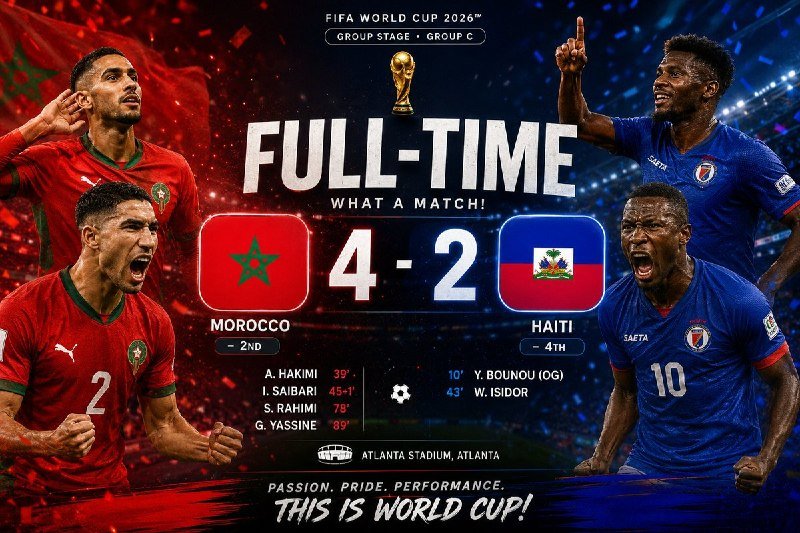
Wilson Isidor's second-half finish at the Atlanta Stadium gave Haiti a lead Morocco could not erase on Wednesday, a result that has reset the arithmetic of Group F within 48 hours of the tournament's opening fixtures. The strike, described by BBC Sport at 23:38 UTC on 24 June 2026 as "phenomenal" and "incredible", arrived at the end of a sequence that pulled the Haitian back line forward and left the Moroccan centre-backs flat-footed. For a Caribbean side written off by most pre-tournament models, the goal was not just a scoreline — it was permission to believe the group stage could be more than a formality.
What looked like a mismatch on paper has produced the most disruptive result of the opening round. The question is no longer whether Haiti can survive the group; it is whether a confederation accustomed to one slot in the knockout rounds now has two serious contenders, and what that does to Morocco's carefully constructed approach to a tournament they entered with quiet confidence.
A goal that changed the optics
Isidor's finish did not arrive in a vacuum. Haiti had absorbed pressure through the first hour, defended the channels, and waited for transitions — the kind of game plan smaller confederations rely on against the sport's established powers. The reward came on a break that exposed the space behind Morocco's advancing full-backs. Isidor's finish, slotted low past the goalkeeper after a pass from the left channel, was the kind of moment BBC's touchline commentary correctly identified as extraordinary rather than merely good.
The visual is unmistakable: a forward who has spent much of his career in the lower tiers of European football, finishing past a defence assembled from Premier League and Ligue 1 starters. That contrast is now the story of the group. It is also the story Monexus expects to dominate Caribbean coverage through the rest of the week.
The pre-match line had Haiti as the outlier
CBS Sports's match-day note, published at 20:22 UTC on 24 June, framed the contest as a Morocco win with a spread designed to reflect the gap in confederation pedigree. SportsLine expert Jon Eimer's model, built on a 21-12 run into the tournament, installed Haiti as significant underdogs. The betting line is not gospel, but it is a useful proxy for how the wider football economy — oddsmakers, federations, broadcast partners — sized the two squads before kick-off.
That framing is worth lingering on. Morocco arrived in Atlanta with a generation of players who have already proven they can beat Belgium, Croatia, and Spain at the previous World Cup. Haiti's recent competitive history has been thinner, its diaspora-fuelled talent pool deeper on paper than on the pitch. The market priced the gap accordingly. A 1-0 Haitian lead, even a temporary one, complicates that read.
What the group table actually means
Group F now has a result that does not fit the seedings. If Morocco drop points here, the path through the group narrows considerably: they would likely need a result against the group's other seed in the final matchday while keeping an eye on goal difference. Haiti, conversely, pick up the kind of moral and table-influence victory that can sustain a tournament campaign even when qualification remains a stretch.
There is a structural point hiding inside the result. FIFA's expansion to a 48-team tournament has been sold, in part, as a route for confederations outside Europe and South America to build depth through competitive minutes rather than through qualifying thrashings. A Haitian side taking points off a North African heavyweight is exactly the kind of data point the expansion's architects point to when defending the format. Whether that argument holds across the group stage is a different question, but Isidor's finish is now part of the evidence.
Stakes and what to watch next
The next 72 hours matter more than the result itself. Morocco's response — tactical and psychological — will signal whether this was a stumble the side can absorb or a structural problem against low-block opponents. Haiti's next fixture offers a chance to convert a memorable goal into the kind of points that reframe an entire tournament cycle for the federation.
The honest uncertainty: the sources available do not yet specify the full-time result, the goal sequence beyond the Isidor strike, or the post-match reactions from either technical staff. What is verifiable from the wire is the goal itself, its timing, and the scale of the upset it implies. The remainder will clarify as post-match briefings and group-table updates land.
For now, the takeaway is clean. A Caribbean side built on diaspora talent and disciplined defending produced a goal that the global highlight reels will replay long after the group stage ends. The market had this priced one way; the pitch, briefly, priced it another. That is the story of day two.
Desk note: Monexus framed this around the structural weight of the result for Group F and the tournament's expansion logic, rather than as a single-goal match recap. Wire copy emphasised the goal's quality; the more durable question is what it does to the group arithmetic.