Three tankers turn back from Hormuz as Iran tightens the chokepoint
Vessels have already begun abandoning the shipping lane parallel to Oman's coast after the IRGC Navy signalled it would police unapproved routes — a slow-motion escalation that puts roughly a fifth of seaborne oil back in play.
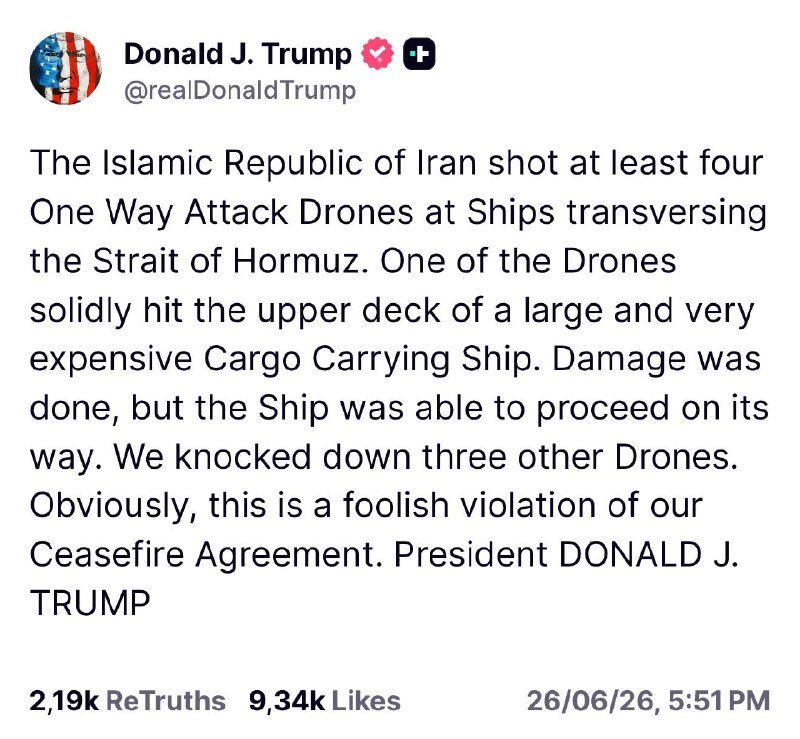
A cargo ship travelling near Oman on a route not authorised by Iran's Islamic Revolutionary Guard Corps Navy came under attack on 25 June 2026, according to the Telegram channel Intelslava, in an incident that has already pushed commercial vessels off the parallel corridor through the Strait of Hormuz. Within hours, at least three ships — including two large oil tankers — had changed course and abandoned plans to transit the strait via the route running close to the Omani coast, according to reporting relayed by Bloomberg and cited on X by @sprinterpress and on Telegram by PressTV. The episode marks the sharpest test yet of Iran's intent to assert granular control over one of the world's most consequential shipping lanes, and the first time in the current escalation cycle that commercial tonnage has visibly rerouted on the same day as an IRGC-linked attack.
The economic geography is unforgiving. The Strait of Hormuz carries roughly a fifth of global seaborne oil. Even a partial rerouting — measured in days rather than weeks — pulls insurers into a higher premium band, stretches voyages around the Arabian peninsula, and resets the calculus for Asian refiners who depend on Gulf crude landing within a tight delivery window. The new variable is not Iran's ability to close the strait, which Western and Iranian analysts have long considered operationally improbable, but its willingness to designate which corridors are usable on any given day.
What the IRGC Navy is signalling
The reporting describes a selective, route-specific enforcement posture rather than a blanket shutdown. Intelslava's account frames the strike on the cargo ship as punishment for travelling a lane the IRGC Navy had not approved, language that closely tracks Tehran's longstanding doctrine of "managed access" through Hormuz. The channel ties the episode to the broader pattern of Iranian seizures and harassment incidents that have become routine since 2019, but the framing this week is narrower: it is the corridor, not the vessel flag, that is being regulated. Bloomberg's figures — at least three diversions, two of them supertankers — corroborate that commercial operators are reading the signal as binding. Insurance markets typically follow physical events by 24 to 48 hours; if the reroutings hold into Friday's trading session, war-risk underwriters are likely to widen Hormuz premia regardless of whether further strikes occur.
The asymmetry is deliberate. Iran does not need to interdict every ship to dominate the news cycle; it needs only enough ambiguity that operators begin self-deterring. PressTV's English-language coverage, amplifying Bloomberg's reporting, underscores that the Iranian state considers the reroutings themselves the message. From Tehran's perspective, the strait is sovereign Iranian-claimed water and any vessel entering without IRGC coordination is operating at its own risk — a position Tehran has maintained through successive maritime complaints at the International Maritime Organization.
The counter-narrative from the Gulf and the West
The framing on Western and Gulf wires is more cautious. Bloomberg's reporting, as relayed by @sprinterpress and PressTV, treats the diversions as commercially rational caution rather than as proof of a new Iranian closure doctrine. Officials in Oman and the United Arab Emirates have historically played down the prospect of an Iranian shutdown, on the grounds that Tehran's own export volumes depend on the same corridor. Lloyd's market chatter in recent months has stressed that most operators can absorb short reroutings around the Arabian peninsula without invoking force majeure on cargo contracts.
Yet the corridor under pressure is not incidental. The route parallel to Oman is the preferred track for southbound traffic exiting the Gulf toward East Africa and the Cape, in part because Oman's Musandam peninsula offers a measure of Omani naval oversight. If the IRGC Navy is asserting authority specifically over that lane, the operational signal points to a contest with Muscat over which state's writ runs in those waters — a friction that has simmered since at least the 2019 limpet-mine incidents but rarely surfaced in operational terms.
What the reroutings actually move
Three tankers is not a closure, and two VLCCs displaced from one corridor do not, on their own, reorder the seaborne oil market. But the marginal behaviour matters more than the headline number. Each day that the Oman-parallel lane is read as uncleared pushes incremental cargo onto the longer northern route via the UAE's approaches, where shipping density is higher and navigation more constrained. That is the lane where Iran's periodic seizures have historically concentrated. The net effect is to concentrate risk on a single, more easily policed corridor — which, depending on Tehran's intent, is either an operational feature or an operational bug.
For Asian buyers — primarily Indian, Chinese, and South Korean refiners who take the bulk of Gulf crude — the calculus is even tighter. Crude cargoes loaded under voyage charter contracts carry lay-time penalties that begin accruing once a vessel fails to make its nominated discharge window. A two-day diversion adds roughly $80,000 to $150,000 in bunker and opportunity costs per VLCC at current freight rates, costs that flow back into the realised price refiners pay. That is a small number against a cargo of two million barrels, but a large one if it persists across a fleet.
The pattern underneath the story
The reporting this week sits inside a familiar pattern: Iran's preference for ambiguous, deniable pressure that forces commercial actors to internalise the risk rather than confront it directly. The IRGC Navy has, since 2019, used seizures, drone surveillance, and tanker collisions as a calibrated repertoire rather than as a single doctrine. What the 25 June reporting suggests is the repertoire being narrowed to a specific lane — an attempt to convert a contested legal claim over Hormuz into an operational reality, one cargo ship at a time.
That is also the pattern's vulnerability. Gulf states and the United States have spent the better part of two decades building redundancy into their exposure to Hormuz: the Abu Dhabi–Fujairah pipeline bypasses the strait entirely for some Murban crude; Saudi Aramco's East–West pipeline offers similar optionality for certain grades. None of those alternatives operates at the scale of seaborne transit through Hormuz, but each one narrows Iran's leverage. Tehran's read may be that the political moment — with US attention split across multiple theatres and Gulf Arab capitals preoccupied with their own post-Gaza realignments — favours a more assertive posture. The market's read, judging by the tanker diversions, is that the read is at least plausible enough to act on.
What remains uncertain
The reporting does not specify the flag state of the cargo ship struck near Oman, the nature of the damage, or whether any crew were injured. Intelslava, the channel carrying the initial account, aggregates open-source footage and claims from the Iranian-aligned information environment; its reporting should be read as the opening version, not the last. The Bloomberg figures on diversions — at least three vessels, including two oil supertankers — are robust insofar as they reflect ship-tracking data, but the channel has not, in the public reporting so far, named the vessels or their owners, which limits independent verification. Whether the IRGC Navy issues a formal notice declaring the Oman-parallel corridor off-limits, or whether the pressure stays selective and unwritten, is the variable that will determine whether 25 June 2026 becomes a footnote or an inflection point.
For the moment, the cargo ship struck near Oman is not a closure of Hormuz. It is something harder to price: the visible start of a market that has decided to price the route itself as a variable rather than a constant.
Desk note: Monexus is sourcing this piece from the Telegram and X channels that first carried the Bloomberg reporting on 25 June 2026. Where Iranian state outlets amplify the wire figures, we treat those numbers as Bloomberg's, not Tehran's; where Telegram channels like Intelslava break the initial operational account, we read them as the first iteration of a story that will likely firm up over the next 24 to 48 hours once ship-tracking data is independently reviewed.
Wire provenance
This editorial synthesis draws on the following public wire/social posts:
- https://t.me/intelslava
- https://t.me/presstv