Hormuz tolling is dead before it begins — and that tells us who runs the Gulf
Washington has declared a transit-fee scheme for the Strait of Hormuz unworkable before it was ever formally tabled. The episode exposes who actually sets the terms of Gulf maritime traffic.
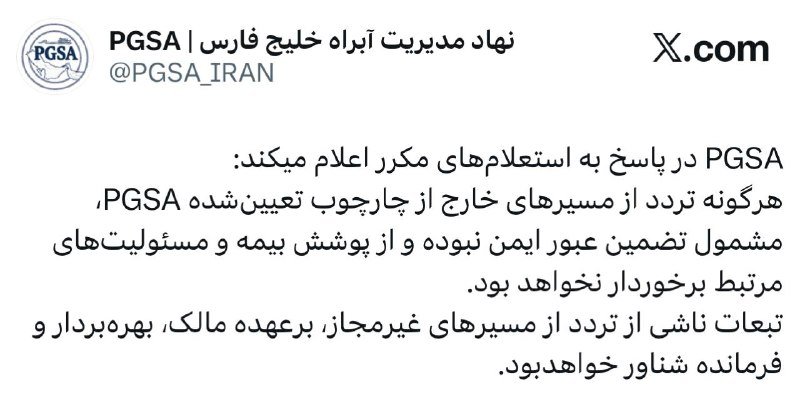
The Strait of Hormuz has a new rule, written before the meeting. On 25 June 2026, U.S. Secretary of State Marco Rubio declared that "no country has the right to impose transit fees for the Strait of Hormuz," calling a tolling arrangement "not even workable" and asserting there was "zero support among Gulf countries" for such a scheme. The remarks, carried on social channels and relayed by open-source monitors, arrived within hours of each other, at 12:35 UTC and 11:41 UTC respectively. There was no draft resolution on the table. There was a verdict.
What we are watching is not a policy debate. It is the public adjudication of one. A transit-fee proposal that had been circulating in regional commentary — the idea that a Gulf littoral state could monetise the chokepoint through which roughly a fifth of global oil passes — has been declared stillborn by the outside power that would, in any actual contest, decide whether such a fee is collectable. The United States does not need to impose a toll of its own. It only needs to declare that no one else may.
The chokepoint that isn't for sale
The Strait of Hormuz is the narrow seal between the Persian Gulf and the Gulf of Oman, bordered by Iran to the north and Oman to the south, with the United Arab Emirates and Qatar in close proximity. Its shipping lanes carry the bulk of crude exports from Saudi Arabia, Iraq, Kuwait, the UAE and Qatar, plus LNG from Qatar — the volume that anchors global benchmarks from Brent to JCC. Any disruption moves price within hours; any sustained closure moves it within days.
A tolling regime — formal levies on each tanker transiting, collected by a littoral state — has long been the implicit leverage of the strait's geography. Iran's Revolutionary Guard naval units have, in recent years, intercepted and briefly seized commercial tankers in waters near the strait, in episodes that officials in Tehran framed as enforcement of domestic and sanctions-related rules. The escalation ladder has generally stopped short of a permanent, written tariff system. Rubio's intervention makes clear that Washington would treat such a step not as a domestic regulatory choice but as a unilateral rewrite of a transit regime the United States considers itself the senior guarantor of.
Why a Gulf state isn't really the addressee
It is worth saying plainly: the loudest reader of these remarks is not Riyadh, Abu Dhabi or Doha. The Gulf monarchies run their own security architecture, host U.S. Central Command's forward headquarters in Qatar, and have spent two decades integrating their air and missile defence with U.S. systems. Rubio's claim that there is "zero support among Gulf countries" for tolling is almost certainly accurate on its face, because the Gulf states are not the constituency that would benefit from a tariff at Iran's end of the water.
The framing is therefore aimed at two audiences at once. First, Tehran: a public signal that any move to formalise fee-collection on tankers will be treated as a confrontation with the U.S. Navy's Fifth Fleet, based in Bahrain, rather than as a routine act of coastal-state jurisdiction. Second, a domestic American audience for whom "freedom of navigation" has, since the 1970s, been the through-line of every Hormuz confrontation — and a useful one, because it allows the U.S. role to be cast as defender of global commerce rather than as the senior security patron of a particular order of Gulf monarchies.
The structural fact under the rhetoric
Strip the rhetoric and the underlying structure is older than any transit-fee debate. A maritime chokepoint this consequential does not monetise itself; it is monetised by whoever credibly threatens to close it, or credibly promises to keep it open. For most of the past half-century that guarantor has been the United States, operating through carrier strike groups, mine-countermeasure capabilities, and a network of bilateral defence pacts that give Washington operational reach without territorial claim. The U.S. has never paid Iran, Iraq, or the Gulf monarchies for the privilege of patrolling the strait; the implicit return has been the dollar-pricing of Gulf hydrocarbons and the strategic dependence that pricing creates.
A formal transit fee, by contrast, would convert the strait from a strategic asset denominated in security guarantees into a revenue line denominated in cash. That is the deeper reason the U.S. position is "not even workable": the framework would substitute commercial billing for the existing arrangement in which the dominant outside power absorbs the cost of keeping the lanes open and is repaid in geopolitical alignment. Rubio's declaration is not a position on tolls; it is a position on who pays for the order that keeps the oil flowing.
Stakes — and what remains contested
If the U.S. line holds, the immediate effect is stability of pricing assumptions: tanker insurance rates in the Gulf stay anchored, Brent's risk premium does not reprice for a new tariff scenario, and the existing Gulf monarchies continue to operate inside the U.S.-led security framework without pressure to negotiate an alternative arrangement. If the line slips — if a confrontation in the strait forces the question back onto the table — the same chokepoint becomes a contested asset whose monetisation will be the central question of any settlement.
What the public sources do not yet show is whether Tehran has formally responded to Rubio's remarks, whether any Gulf state has confirmed or denied the "zero support" claim on the record, or whether the U.S. has paired the rhetoric with any operational move — additional naval deployments, sanctions designations, or bilateral demarches. The framing has been set; the instruments behind it have not been disclosed. That is the usual sequence, and it is the part worth watching next.
Wire provenance
This editorial synthesis draws on the following public wire/social posts:
- https://x.com/sprinterpress/status/2070123651609845761
- https://t.me/osintlive
- https://t.me/osintlive