Iran eyes $40bn Strait of Hormuz toll regime as tanker traffic fragments
Tehran is laying the legal scaffolding for a $40bn Strait of Hormuz toll regime, and the world's oil and LNG markets are already repricing the assumption that the chokepoint is open. The drones of 26 June were the trigger, not the strategy.
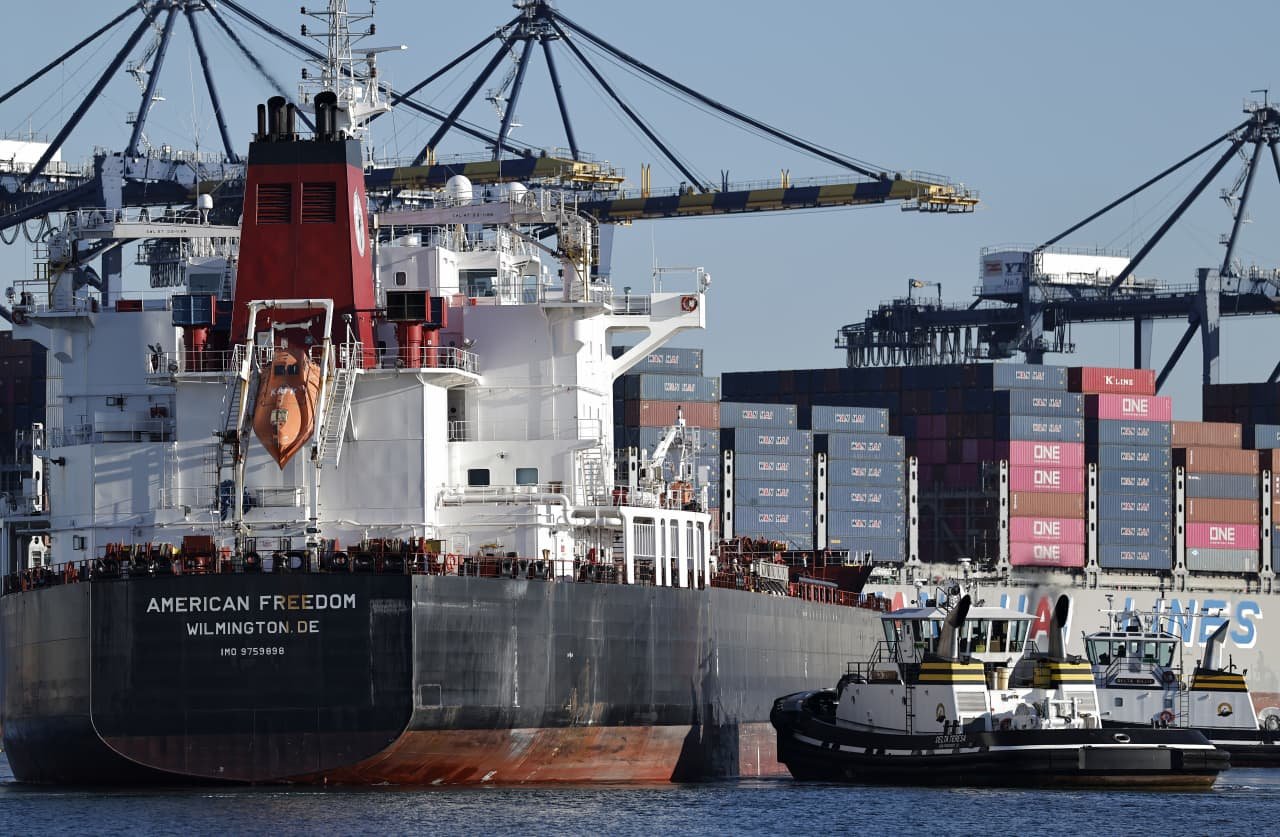
Four one-way attack drones skimmed the Strait of Hormuz on 26 June, one of them striking a cargo vessel before US forces intercepted the remaining three, according to President Trump's account relayed by Cointelegraph. Iran did not, as of the wire's last useful cycle, formally confirm the strike; Iran's Deputy Foreign Minister framed the dispute in sovereignty language, telling reporters that "safe passage through the Strait of Hormuz without consideration of Iran's sovereignty is 'not guaranteed'". By the time a UN evacuation restart was being negotiated, the chokepoint had been repriced in real time, and the world's most consequential oil artery was, once again, a contested corridor. Tehran's signalling is now consistent with a play: not a blockade, but a toll.
Tehran has spent the better part of a decade preparing the legal and rhetorical scaffolding for exactly this moment. The 1972 Montreux-style argument, that the Strait is not a free transit zone but a corridor whose terms a coastal state can condition on recognition, is now moving from seminar rooms into the operational layer. Iran's Deputy Foreign Minister made the formula explicit on 26 June: passage, yes, but only under a framework that treats Iranian sovereignty as the rate card. The wire is light on the arithmetic, but the political-economy direction is unmistakable. A $40bn annualised toll regime, the figure circulating in Gulf and Tehran-adjacent channels, is large enough to be coercive and small enough to be defensible as "user pays".
The ceasefire that didn't
Trump publicly accused Iran of "foolish violations" within hours of the drone incident, characterising the attack on four ships as a breach of an interim deal that the same wire, two days earlier, had described as freshly signed. Press TV, Iran's state broadcaster, reported in parallel that a US-Iran communication line in the Strait had been established, a procedural milestone that reads, in context, as a back-channel concession even as the public posture hardened. The contradiction is the story. A ceasefire is holding and not holding. Ships are being attacked and a hotline is being installed. Both things are happening because the agreement was, in effect, an armistice, not a settlement.
The UAE, a Gulf state whose exports depend on Hormuz the way a heart depends on a ventricle, broke its usual public reserve to call Tehran. Polymarket's distribution of the readout was short: the UAE urged Iran to protect freedom of navigation, a phrase that, from Abu Dhabi's diplomatic lexicon, functions as an alarm bell. The UAE does not make such calls lightly. When it does, it is because the shipping lanes themselves are being repriced, and the regional consensus is that the cost of a closed Strait would outstrip the cost of an open one under almost any Iranian-administered framework.
Chokepoint, repriced
Roughly a fifth of the world's seaborne oil and a third of its LNG move through Hormuz on any given day. A persistent Iranian "toll" regime does not need to close the waterway; it merely needs to make the insurance mathematics uncomfortable. War-risk premiums, which had already begun to climb through the spring as the proxy front widened, would harden. Greek and Asian tanker operators, the bulk of the long-haul fleet, would route around the Cape of Good Hope, adding ten to fourteen days and roughly 30 per cent in fuel cost per voyage. Spot freight rates through the Bab el-Mandeb, the only realistic southern bypass, would converge upward, with African and Yemeni transit states picking up rents they have not enjoyed since the early 2020s. None of this is hypothetical. Each line item is a function already running in the market, waiting for a trigger.
The trigger is now in place, and the trigger is not a single dramatic closure. It is the slow accretion of conditional passage: a hotline, a sovereignty caveat, a toll, a drone, a UN evacuation pause, a restart. The cumulative effect is to convert a recognised international waterway into a sovereign service, and the world adjusts not by contesting the principle, which it cannot, but by rerouting, repricing, and waiting for a framework that doesn't yet exist.
What Tehran is buying
A $40bn annualised figure, even if the eventual settlement is half that, is not a trivial number. It is roughly equivalent to Iran's annual non-oil merchandise exports, and it would arrive in hard currency, routed through channels the sanctions architecture does not currently touch. Iran's actual goal is to replace the JCPOA-era sanctions relief, which was hostage to political weather in Washington, with something more durable: a transit fee that flows whether the White House changes parties or not. The Strait, in this reading, is not a weapon Tehran is wielding. It is a balance sheet Tehran is building.
The other side of that ledger is risk. Hormuz toll regimes are not stable equilibria; they are bargaining chips that decay under use. The longer the regime operates, the more the global energy market, increasingly supplied by Atlantic and West African barrels, prices the bypass in. Iranian rents are maximum at the moment of threatened closure and minimum once the world has re-engineered. Tehran knows the clock is running, which is why the press cycle is dense and the diplomatic traffic is heavy: a toll regime that takes too long to lock is a toll regime that is locked out by routing, not by treaty.
The structural reading
The framing the wire naturally produces, that of an Iran-US crisis around a ceasefire, obscures the more durable shift underneath. The real story is the erosion of the post-1945 maritime-transit norm, the principle that a handful of straits and canals must remain open to global commerce on predictable terms, regardless of who controls the coastline. Hormuz is the third such chokepoint to be contested in the last five years, after Bab el-Mandeb, where Huthi pressure forced the same kind of insurance repricing, and the Black Sea, where wartime routing under the grain corridor's collapse redrew commercial flows. Each incident has weakened the assumption, embedded in how energy traders, underwriters, and naval planners price risk, that the sea lanes are a given.
The 25 June wire does not yet prove that a $40bn regime will crystallise; the figure is not on the record in any of the cited posts. What the record does support is the broader dynamic: a toll regime is being talked about, the Iranian state is laying the legal-political groundwork, the regional consensus is tolerating rather than confronting, and the world's energy infrastructure is already in the early stages of routing around the assumption that Hormuz is open. The toll is not yet a fact. The repricing is.
What to watch next
Two indicators will tell the story over the coming weeks. The first is the level of Iran's state-media engagement with the "user pays" framing; Deputy Foreign Minister statements are a leading indicator, and Press TV's tone will harden or soften as the diplomatic cycle turns. The second is the war-risk premium for VLCCs transiting Hormuz, which the Lloyd's market publishes weekly and which will move on incremental news before the headline diplomacy resolves. A regime that costs the world $20-30bn in annualised insurance and routing is a regime that the world will eventually pay to dismantle. A regime that costs $5bn is one the world learns to live with. The next 30 days will tell Tehran which kind of toll it is building.
Sources
- Cointelegraph on X, President Trump says Iran launched four one-way attack drones at ships in the Strait of Hormuz, with one hitting a cargo vessel while U.S. forces intercepted the other three, calling it a ceasefire violation. 26 June 2026, 16:20 UTC.
- Unusual Whales on X, BREAKING: Trump says Iran violated the ceasefire agreement by attacking a ship in the Strait of Hormuz. 26 June 2026, 16:58 UTC.
- Unusual Whales on X, Iran's Deputy Foreign Minister: Safe passage through the Strait of Hormuz without consideration of Iran's sovereignty is 'not guaranteed'. 26 June 2026, 16:37 UTC.
- Polymarket on X, JUST IN: UAE holds rare call with Iran stressing the need to protect freedom of navigation through the Strait of Hormuz. 27 June 2026, 01:42 UTC.
- Polymarket on X, JUST IN: U.N. says it is working to restart Hormuz evacuations after Iranian attacks halted the effort. 26 June 2026, 19:01 UTC.
- Polymarket on X, BREAKING: Trump accuses Iran of "foolish violations" of the ceasefire agreement after they attacked 4 ships in Hormuz. 26 June 2026, 16:08 UTC.
- LiveMint on Telegram, Fresh tensions have erupted between the United States and Iran, days after they signed an interim deal to end their war. Iran targeted US positions in the Middle East after Washington struck Iranian targets. 27 June 2026, 04:04 UTC.
- Unusual Whales on X, Iran's Press TV: A communication line between the US and Iran in the Strait of Hormuz has been established. 26 June 2026, 14:57 UTC.
Desk note: Monexus treated this as a structural story about the slow erosion of the maritime-transit norm, not as a crisis ticker. The wire's natural shape is event-by-event; we lifted out the throughline of a toll regime being built, named it, and flagged what the 30-day indicators will be.