Nairobi's sealed roads and the cost of pre-emptive policing
On the eve of a fresh Gen Z mobilisation, Inspector-General Kanja has defended sealing Nairobi's arteries as intelligence-led prevention. The justification deserves harder questions than it has so far received.
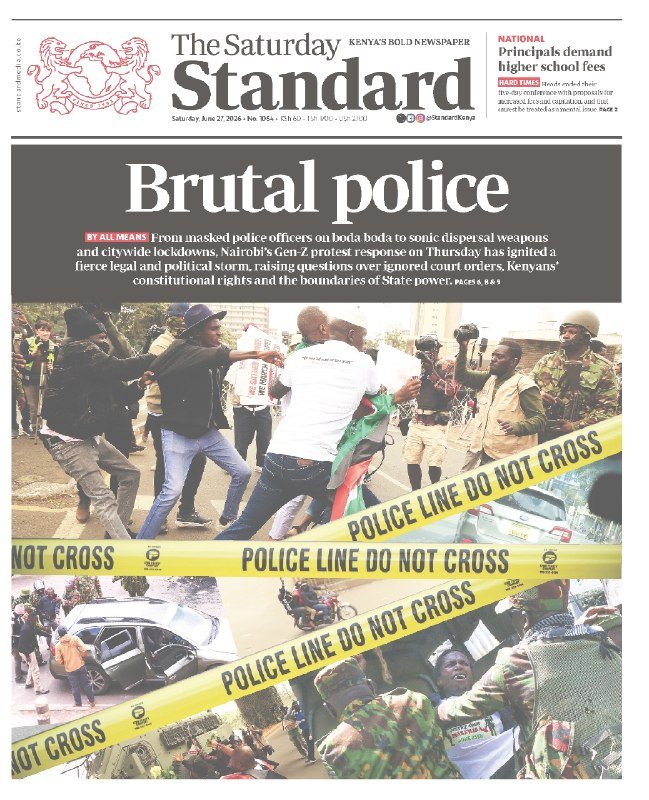
On the morning of 25 June 2026, Nairobi did not look like a capital preparing for a protest so much as a city preparing for a siege. Police roadblocks and razor-wire barricades ringed the central business district, choking off the arteries that normally carry commuters in from places like Kitengela, Kawangware and Kangemi. Inspector-General of Police Douglas Kanja, the country's top officer, defended the closures as intelligence-led: a calibrated effort, he said, to keep "goons" out of the CBD rather than a sweeping assault on the right to demonstrate. By late morning, the Standard reported, Kitengela — historically one of the most combustible flashpoints in Kenya's Gen Z protest cycle — was "relatively calm" compared with previous mobilisations.
The choice the government has made is not whether to permit protest, but where to draw the line between policing and pre-emption. That distinction matters because the line, once shifted, rarely returns to its original position.
A predictable script, played again
The June 25th mobilisation marks the third anniversary in spirit of the youth-led movement that erupted in June 2024 against the now-withdrawn Finance Bill, and which Kenya's political class has spent two years trying to out-manoeuvre rather than out-argue. The grievances are unchanged: corruption, the cost of living, and a police service that has, in the words of multiple domestic and international rights monitors, killed with impunity. The BBC reported on 25 June that protesters are demanding justice for more than 80 people killed during the 2024 demonstrations and the 2025 anniversary protests — a figure that has become a kind of liturgy for a generation that came of age believing it could shame its government into behaving better.
Kenya's response has converged on a recognisable template. Seal the city, declare the protests unlawful on procedural grounds, mass officers in riot gear at known flashpoints, and wait for the day to pass. The Kanja doctrine — as set out in his 25 June briefings to the press — adds a new rhetorical flourish: intelligence-driven pre-emption, with named villains ("goons") and a defensive posture. The framing is clever because it concedes, in passing, that the security state was prepared for violence; it simply declines to say whose violence it expected.
Whose intelligence, and what threat?
The Inspector-General's claim that the roadblocks were "informed by intelligence reports" is the kind of sentence that is impossible to falsify and therefore impossible to interrogate. Kenyan security agencies do not routinely publish the intelligence assessments behind crowd-control decisions, and opposition politicians have no standing in court to demand them. That opacity is not new; what is new is the scale. Sealing an entire central business district on the basis of an unnamed threat assessment is a high-wire act: it casts a presumptive shadow over tens of thousands of workers, traders and patients who had no intention of marching, and it hands the security forces a permanent veto over where Kenyans may assemble.
The plausible alternative reading is also available. There is credible reporting — not least from the National Police Service's own internal reviews of the 2024 killings — that Kenyan crowds turn violent when the police do, and that heavy-handed containment is itself the accelerant the state claims to be guarding against. Under that reading, the CBD is not being protected from protesters; the protesters are being kept out of a police cordon that, history suggests, will not hold its fire if provoked. Both readings can be true simultaneously, and the official line does not require the government to choose between them.
The structural pattern
What is unfolding in Nairobi sits inside a wider pattern across the region, and further afield. Governments that came to power on youth-driven mandates have struggled to govern the same youth once it turns its organising energy on the state. The default response is a mix of co-optation — cabinet positions for former protest leaders, youth funds, the ceremonial extension of a bursary here and a digital-jobs promise there — and containment. The containment phase is where Kenya now finds itself, two years in. It is the phase at which protest movements are most likely to radicalise, most likely to fracture into less manageable factions, and most likely to provide the security apparatus with the very pretexts it cites when justifying its barricades.
The Kanja doctrine also has a quiet class dimension that the wire reporting has not pressed on. Sealing the CBD does not inconvenience the residents of Runda and Karen; it inconveniences the matatu operators, the street vendors, the clerks and the patients who depend on the city's central institutions. It is, in effect, a tax on the working city in the name of order. Whether the working city consents is the question that the roadblock arrangement has been designed, deliberately, to make harder to ask.
What remains uncertain
Three things the sources do not yet resolve. First, the precise casualty tally from the 2024 and 2025 protest cycles — the "more than 80" figure cited by the BBC is consistent with earlier civil-society tallies but has not been officially corroborated, and the government's own count is lower. Second, the content and provenance of the intelligence Kanja invoked on 25 June. The Inspector-General has not, in any of the briefings reviewed by this publication, named the agency that produced the assessment, the methodology behind it, or the specific plots it claims to have disrupted. Third, the political ceiling of the Gen Z movement. The script that reads "protest → killings → commission of inquiry → no prosecutions" has played out twice in Kenya already, and the younger cadres who would have to relitigate it again are not the same cohort as those who took to the streets in 2024.
The Stakes are concrete. If the Kanja doctrine is allowed to harden — sealed cities, intelligence cited without disclosure, the word "goons" doing the rhetorical work that evidence should — Kenya will arrive at the 2027 electoral cycle with a security apparatus that has effectively rewritten the rules of public assembly in its own favour. If it is challenged in time, the more difficult question of who is actually accountable for the 80-plus dead becomes harder to defer. Nairobi on the morning of 25 June was a city that had, in effect, answered the first half of that question for itself.
Monexus covered this story primarily through Kenyan domestic press and BBC reporting rather than Western wire aggregation; the editorial interest is less the protest itself than the constitutional architecture being assembled around it.
Wire provenance
This editorial synthesis draws on the following public wire/social posts:
- https://t.me/s/StandardKenya
- https://t.me/s/StandardKenya