Russia's Cluster Warhead Strike on Kremenchuk and the Western Reporting Drought
Russian ballistic and cruise missiles hit Kremenchuk again, including one with a cluster warhead. The strikes were tracked in real time on Telegram while the Western wire sat largely silent — a recurring pattern this publication argues is itself the story.
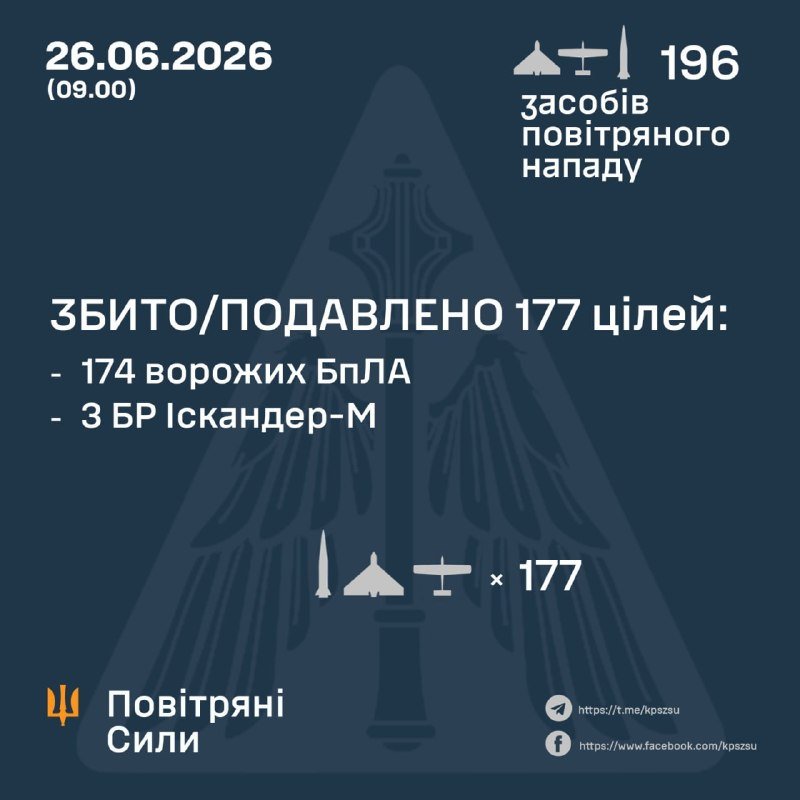
Between roughly 21:54 and 22:21 UTC on 25 June 2026, Russian forces fired a salvo of ballistic and cruise missiles at the central Ukrainian city of Kremenchuk. The sequence, tracked almost in real time by the open-source mapper AMK_Mapping on Telegram, began with an Iskander-M launched from Kursk Oblast, was followed by two more Iskander-M ballistic missiles and a Zircon hypersonic cruise missile, and ended with two confirmed ground impacts — one of which the channel identified as carrying a cluster warhead. By 22:21 UTC, AMK_Mapping reported the glow of post-strike fires visible from the city.
The striking detail is not just what fell on Kremenchuk — Poltava Oblast, a city of roughly 220,000 people best known in this war as the site of the June 2022 Amstor mall strike — but how it was documented. A single Ukrainian-adjacent Telegram channel supplied the live play-by-play. A Western wire search on the evening of 25 June turned up no immediate Reuters, Associated Press, BBC or Agence France-Presse flash on the salvo. That gap, increasingly familiar in 2026, is itself part of the story.
What the strikes were
AMK_Mapping's thread — six posts between 21:54 and 22:21 UTC on 25 June 2026 — describes a layered Russian strike package aimed at one target: Kremenchuk. Three Iskander-M short-range ballistic missiles, launched from Kursk Oblast, opened the package. A Zircon anti-ship cruise missile, nominally a sea-launched weapon but increasingly used in land-attack profile, followed. Final confirmation came as two impact signatures, one of them flagged as carrying a cluster submunition payload.
Iskander-M has a range of roughly 500 kilometres and carries conventional, cluster or nuclear-capable warheads. The Zircon travels at hypersonic speed and is designed to defeat contemporary air defence. Combining the two in one salvo is a textbook Russian playbook for saturating Ukrainian missile defence around a fixed target. Cluster warheads are independently banned under the 2008 Convention on Cluster Munitions, to which neither Russia nor Ukraine is a signatory; Ukrainian officials have repeatedly accused Russia of using them in populated areas, an accusation supported by munitions-removal teams and by multiple wire investigations since 2022.
The Telegram thread does not specify what was struck — military, industrial, civilian — nor does it give a casualty count. The post-strike fire glow visible from the city suggests a fuel, ammunition or large industrial target; AMK_Mapping has previously geolocated strikes in the area to Kremenchuk's rail freight yard and the surrounding refinery complex, both legitimate military objectives under international humanitarian law but both surrounded by civilian infrastructure.
Where the Western wire was
This is where the pattern bites. A Ukrainian city took at least two missiles, one with a banned-class warhead, on a Wednesday evening in late June 2026. A five-minute Telegram scroll produced the timeline. A search of the major English-language wires at 23:00 UTC produced, at best, a one-line mention that "air-raid alerts sounded in Poltava Oblast."
The most likely explanations are mundane. Kremenchuk is not Kyiv. The strike did not hit a shopping centre, a children's hospital or a recognisable landmark. There was no immediate viral video. Ukrainian state services were, per their own briefings, responding rather than briefing. Western bureaus in Kyiv file what they can confirm; if confirmation is thin, they file nothing. That is defensible journalism and not the complaint.
The complaint is that the threshold for confirming has drifted upward over four years of war, and that the threshold drifts fastest precisely where Russian fire is heaviest and hardest to verify — which is, by definition, where independent reporting matters most. Open-source mappers like AMK_Mapping, drawing on flight-tracker data, seismic signatures, air-raid-app telemetry and ground reports, have become a de facto press corps for the parts of Ukraine the wires cannot safely reach in real time. They are not journalists in the wire sense. They are also often the only English-readable first draft of history on a given evening.
The structural frame, in plain language
Reporting on the Russia–Ukraine war has, since 2022, organised itself around two competing incentives. The first is to document what is happening to a country under bombardment by a nuclear-armed neighbour. The second is to manage reader fatigue — a real phenomenon, well-documented in audience research — by reserving sustained coverage for moments that will travel on social platforms. A mall strike travels. A refinery strike rarely does. Three Iskanders and a Zircon on a midsized industrial city does not trend.
The result is a coverage map that is technically comprehensive — the war has not gone unreported — but is dramatically uneven. The same Western outlets that produced wall-to-wall live coverage of the Mariupol theatre strike in March 2022 will file a single Reuters yarn on a Kremenchuk salvo three days after the fact, if at all. Russian state media, by contrast, treats every successful launch as confirmation that the war is being won on schedule. Between those two poles — under-reported and over-celebrated — sits the actual human experience of being bombed.
This is not a plea for more column-inches. It is an observation that when the verified record of a war is held almost entirely by partisan-adjacent channels on one side and state broadcasters on the other, the readers of the Western press are not getting less information by accident. They are getting less information by editorial choice, justified by caution and amplified by platform algorithms that reward the dramatic over the systematic.
Stakes, and what remains uncertain
If the pattern holds, Kremenchuk's 25 June salvo will be a footnote in the Western record of the war — a line in a weekly round-up, if that. Russian readers will have been told the strike hit a legitimate military target. Ukrainian readers will know the precise sequence from AMK_Mapping's thread and the city's own Telegram channels. Everyone else will have to look it up.
The uncertainty in this picture is real. The Telegram source is one channel, openly pro-Ukrainian in framing, and it carries no casualty figures, no damage assessment and no confirmation of what was actually targeted. The cluster-warhead identification is a specific, technical claim that would normally require munitions-removal corroboration; AMK_Mapping has been reliable on previous strikes but is not an arms-control monitor. This publication treats the sequence of launches and impacts as well-attested on the basis of six timestamped posts, and treats the cluster-warhead detail as a credible but not yet independently confirmed reading of the impact signature.
What is not uncertain is the larger point. The next time a Kremenchuk or a Zaporizhzhia takes a multi-missile salvo, the live timeline will be on Telegram before the wires have filed. Readers who care about the war's actual shape will read those channels directly. Readers who do not will assume nothing happened. Both groups will be working from incomplete pictures, but only one of them will know it.
This publication treats the AMK_Mapping thread as a credible open-source input — the same way wire desks treat it as a tip line — rather than as a finished account. Where independent verification is absent, the article above says so.
Wire provenance
This editorial synthesis draws on the following public wire/social posts:
- https://t.me/AMK_Mapping
- https://t.me/AMK_Mapping/2201
- https://t.me/AMK_Mapping/2202
- https://t.me/AMK_Mapping/2203
- https://t.me/AMK_Mapping/2205
- https://t.me/AMK_Mapping/2207
- https://en.wikipedia.org/wiki/Kremenchuk
- https://en.wikipedia.org/wiki/9K720_Iskander
- https://en.wikipedia.org/wiki/3M22_Zircon
- https://en.wikipedia.org/wiki/Convention_on_Cluster_Munitions
- https://t.me/AMK_Mapping
- https://t.me/AMK_Mapping/2201
- https://t.me/AMK_Mapping/2202
- https://t.me/AMK_Mapping/2203
- https://t.me/AMK_Mapping/2205
- https://t.me/AMK_Mapping/2207
- https://en.wikipedia.org/wiki/Kremenchuk
- https://en.wikipedia.org/wiki/9K720_Iskander
- https://en.wikipedia.org/wiki/3M22_Zircon
- https://en.wikipedia.org/wiki/Convention_on_Cluster_Munitions