A motorcycle, a drone, and the geometry of a slow-burn front
An Israeli UAV strike on a motorcycle in the Nabatieh district killed at least five people on 25 June. The reporting gap, not the strike itself, is now the story.
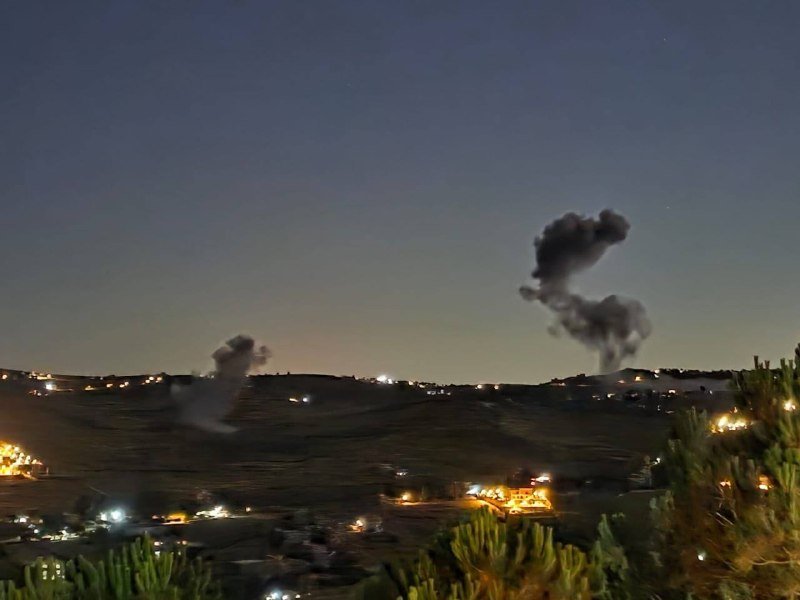
At roughly 11:20 UTC on 25 June 2026, an Israeli drone struck a motorcycle travelling between the villages of Mifdon and Zoter al-Sharqiya in Lebanon's Nabatieh district, killing at least five people, according to unofficial Lebanese channels monitored by regional outlets. The initial reports, carried by Telegram-based correspondents at 11:50 UTC and 12:16 UTC, were followed by a 12:50 UTC update citing "additional sources" suggesting a higher toll and further casualties in a separate incident. Israeli authorities had not, as of writing, issued a public statement on the strike through the channels this publication monitors.
The event is small in the arithmetic of a border that has been burning for months. Its larger significance is methodological. Every cross-border strike in southern Lebanon now arrives in the Anglophone news cycle through a chain of Telegram channels, anonymous "additional sources" and translated Arabic fragments, before any institutional voice — Israeli, Lebanese, or international — confirms or contextualises it. The strike on a motorcycle between two named villages is, in other words, less a piece of news than a stress test of the wiring through which news about this front now travels.
The reporting chain, end to end
The first signal of the strike appeared at 11:50 UTC on the Abuali Express Telegram channel, describing an Israeli drone attack on a motorcycle between Mifdon and Zoter al-Sharqiya in the Nabatieh district. A near-identical item, timestamped 12:16 UTC, repeated the core claim. By 12:50 UTC, the English-language channel English Abuali had aggregated the Lebanese-language reporting and added two new elements: a casualty figure of five, and a reference to "additional sources" suggesting the toll could rise. None of the three items names the target, identifies the riders, or quotes an official Lebanese or Israeli source. The drone strike is, for the moment, a Telegram-native fact.
This is not unique to 25 June. South Lebanon has become a reporting environment in which the wire services operate on a lag, in which Lebanese state media is partial at best, and in which field correspondents push voice notes and short-form video into channels whose editorial standards are opaque to outsiders. The Anglophone reader is therefore receiving a strike report that has been filtered through a translation step, a partisan-sourcing step, and a delay of hours — without the corroborating layer that, in other conflicts, an IDF spokesperson briefing, a UNIFIL statement, or a Reuters datelined dispatch would provide.
What the Western wire will and will not tell you
Mainstream wire reporting on the Israel–Lebanon front has converged on a particular texture: strike events are reported with geometric precision, casualty figures carry attribution to "Lebanese health officials" or "the Lebanese health ministry," and Israeli operations are described in the passive voice. The Nabatieh district has been a recurring dateline through 2025 and 2026. The vocabulary is established. What is not established, in the public record this publication can verify, is the doctrine of engagement on this specific motorcycle, on this specific road, on this specific morning.
The plausible alternative read of the same data is straightforward: the IDF does not, as a rule, comment on individual strikes in real time, and the absence of a statement is therefore uninformative. Lebanese casualty reporting, particularly when it moves through unofficial channels, is also subject to upward drift in the hours after an event, as the "additional sources" framing of the 12:50 UTC item implicitly concedes. A reader who weights both possibilities will hold the five-figure with appropriate humility. A reader who weights only one will produce a starker story than the evidence supports.
The structural frame, plainly stated
South Lebanon is a textbook case of a front in which the kinetic event and the information event have decoupled. The strike itself is one of a string of similar operations along the same axis through 2026, against a backdrop of an unresolved ceasefire architecture and a Hezbollah presence whose public posture has shifted but whose military infrastructure, by most external accounts, has not. The reporting chain is the second-order story: news about this front reaches international readers via a stack of Telegram channels that function as both field reporting and editorial filter, with no clear institutional accountability at any layer.
That is not, on its own, an argument for dismissing the reporting. Telegram-based correspondents in southern Lebanon are, in many cases, closer to the kinetic event than any institutional press operation. The argument is for reading the chain. A strike that exists only in three Telegram items, with no IDF comment, no UNIFIL mention, no Lebanese military statement, and no Western-wire dateline, is a real event with thin confirmation — and treating it as more confirmed than that, in either direction, is a category error.
Stakes and what remains unresolved
If the trajectory of the past several months continues, the Mifdon-Zoter al-Sharqiya strike will be one of several on the same axis this week, and the international press cycle will continue to receive each one through a similar Telegram-first pipeline. The casualty figures will be revised upward in increments; the institutional voices will arrive, if at all, hours after the operative fact; and the Anglophone reader will, by default, learn what happened in Nabatieh from channels whose editorial chain is invisible to them.
What remains genuinely uncertain as of 14:00 UTC on 25 June is straightforward and worth naming. The identities of the killed have not been published in the materials this publication can verify. The target's affiliation, if any, has not been stated by any party. The Israeli military's account of the strike is not in the public record this publication can verify. The Lebanese health ministry, where it has spoken on comparable events in 2026, has not yet spoken on this one. The "additional sources" referenced at 12:50 UTC have not been named. Each of those gaps is, individually, ordinary wartime reporting friction. Collectively, they are the geometry of a front on which the institutional layer of confirmation has thinned to translucence, and on which the next strike will arrive through the same channel, in the same shape, with the same caveats.
Monexus framed this strike as a reporting-chain story as much as a kinetic event; the wire cycle is likely to file the casualty figure as confirmed and move on.
Wire provenance
This editorial synthesis draws on the following public wire/social posts:
- https://t.me/englishabuali/12093
- https://t.me/abualiexpress/43118
- https://t.me/abualiexpress/43119