The $500 million question: How Trump's Iran relief gambit became an American domestic crisis
A $500 million American-goods package and a fund-release framework were supposed to mark a breakthrough with Tehran. Inside the United States, the same announcement is hardening into a domestic political liability.
On 24 June 2026, as a 16-day celebration of the United States' 250th anniversary opened in Iowa with a political rally, the Trump administration was simultaneously putting the finishing touches on a financial relief package for Iran — an arrangement that, in its earliest public form, would route roughly $500 million in American goods through a framework releasing some Iranian funds currently held in restricted accounts. The juxtaposition is the story. What the White House is selling abroad as a calibrated de-escalation is, by 25 June 2026, increasingly being read at home as a politically costly gesture toward a government that much of the American public no longer views as a strategic counterweight worth the price. The two readings are not reconcilable in the messaging, and the gap between them is now the operative political fact.
This publication's read is that the deal has entered its most dangerous phase — not because the substance is unworkable, but because the domestic coalition required to absorb it has fractured faster than the diplomatic one. The administration's argument is that financial relief, narrowly scoped to humanitarian goods and accompanied by monitored fund releases, is the only realistic way to prevent a wider war that the American public, by every available indicator, does not want. The counter-argument, taking shape rapidly across the political spectrum, is that the same relief is functionally indistinguishable from a payment to an adversary whose regional behaviour has not changed. Both arguments are coherent. What is not coherent is the assumption that the package can be sold as one thing abroad and another thing at home without the contradiction becoming the story.
What the package actually is
The publicly available shape of the arrangement, as described in reporting on 24 June 2026, has three moving parts. First, an initial tranche of approximately $500 million in American goods — agricultural commodities and medical supplies have been the categories named in preliminary coverage — would move to Iran under terms yet to be specified in full. Second, the United States would release a portion of Iranian funds currently held in restricted accounts, with the size of that release and the timing not yet disclosed. Third, the entire package is conditioned on continued diplomatic engagement, with the implicit threat of snapback if Iran's behaviour, as judged by Washington, deteriorates.
This is not the Joint Comprehensive Plan of Action. It is narrower, more transactional, and more politically fragile. It does not attempt to resolve the nuclear file, the missile file, or the proxy file. It attempts to convert a moment of acute military tension into a managed economic relationship, on the theory that economic entanglement is a more reliable restraint than sanctions pressure alone. That theory has empirical support from the 2013-15 period, when the interim Joint Plan of Action did produce a measurable, if temporary, reduction in enrichment activity. It also has empirical pushback: the same period demonstrated that reversible economic relief can be reversed by either side with little warning, and that the diplomatic architecture around it is only as durable as the political coalitions on each end.
The $500 million figure should be understood as a starting offer, not a ceiling. The arrangement's long-run cost, in either goods or released funds, is the variable that will determine whether the deal is treated as a footnote or as a precedent. American negotiators have, in recent rounds, signalled flexibility on the goods composition and rigidity on the fund-release timeline — a posture consistent with an administration that wants the political credit for humanitarian relief but is wary of appearing to write cheques to a government under sanctions.
The domestic crisis Mehr flagged
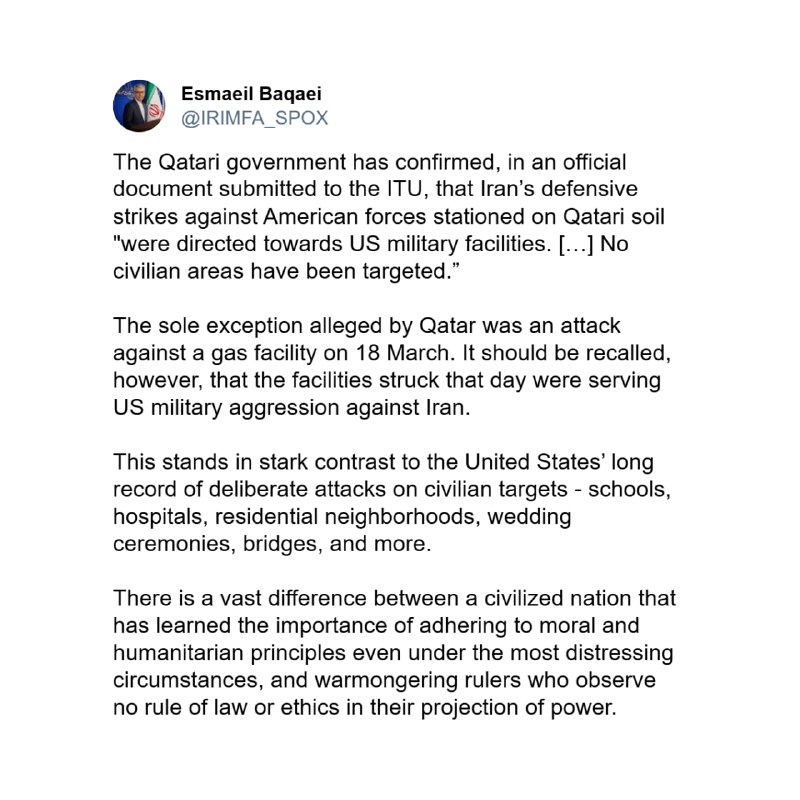
Iranian state-aligned reporting on 25 June 2026 framed the question with unusual sharpness: how did the adventure against Iran become a domestic crisis for the United States? The framing is not neutral — it is the read of a state outlet that wants the deal to hold — but the underlying observation is supported by the same American polling and commentary the outlet is reacting to. Across the political spectrum, three distinct objections have crystallised within roughly 72 hours of the framework's emergence.
The first objection is from the administration's right flank, where the argument is that any relief, regardless of goods composition, functionally rewards a regime whose regional posture has not changed. The second is from the administration's left flank, where the argument is that a transactional relief package without a broader diplomatic architecture is precisely the kind of arrangement that produces the next crisis rather than preventing it. The third objection, more diffuse but increasingly audible, is a general war-weariness frame: the American public, by the available indicators, does not want another military campaign in the Middle East, and the relief package is being read, fairly or not, as the price of avoiding one.
The political difficulty is that the administration needs at least two of these three constituencies to hold. It cannot have the relief framed simultaneously as appeasement of an adversary and as the only alternative to war; those are different sales, to different audiences, and the evidence on the ground suggests the message is bleeding between them. By 25 June 2026, the dominant domestic frame is no longer the diplomatic substance of the deal. It is the political cost of having made it.
The structural pattern underneath
What is unfolding is a familiar American pattern, and naming it plainly is more useful than reaching for theoretical scaffolding. The United States has, across multiple administrations, repeatedly arrived at a fork: continue a maximalist posture toward Iran and accept the rising risk of a kinetic event, or accept a transactional arrangement that concedes something the domestic politics will punish. Each time the fork has appeared, the choice has been deferred until a crisis forces it, and each time the resulting arrangement has been narrower and more politically fragile than the one a steadier diplomatic cadence would have produced.
The relief package sits inside that pattern. It is, structurally, the kind of arrangement that emerges when the maximalist coalition has exhausted its domestic purchase but the transactional coalition has not yet built one. The goods component is designed to give the administration a defensible humanitarian frame. The fund-release component is designed to give Iran enough economic oxygen to stay at the table. Neither component is large enough to satisfy either side's maximalist critics, and that is the point: the arrangement is calibrated to be just sufficient to prevent the immediate crisis, not to resolve the underlying dispute.
The risk of this calibration is not that it fails outright. It is that it succeeds narrowly enough to be reversible by either side, and that the next crisis — and there will be a next crisis, given the unresolved files — arrives with the same coalition problem unsolved and a smaller reservoir of political capital on both ends. American negotiators have, historically, accepted that trade. Iranian negotiators have, historically, accepted it too. What is different in 2026 is the speed at which the American domestic coalition is fragmenting around the package, which shortens the time horizon on which the arrangement can be expected to hold.
What the wires are and are not telling us
The available reporting on 24-25 June 2026 gives a clear picture of the package's architecture and of the political reaction inside the United States. It gives a thinner picture of three things that matter. First, the operational mechanics of the goods transfer — who procures, who inspects, who certifies end-use — are not in the public record, and the credibility of the humanitarian frame depends on those mechanics being both robust and legible. Second, the size of the fund-release component, and the conditions under which it can be paused, are not specified in the publicly available reporting, and the political durability of the arrangement on the Iranian side depends on those numbers being both real and reliable. Third, the Iranian regime's internal politics around the package — who is for it, who is against it, what the Revolutionary Guard's posture is — is, as always, opaque in ways that matter for whether the arrangement survives its first test.
A separate epistemic caution is in order. The Iranian framing of the package as an American domestic crisis is a state-outlet framing, and it is offered in the service of an Iranian interest: keeping the package alive by reading American domestic opposition as soft rather than structural. That interest does not make the observation wrong — the observation that the package is politically costly inside the United States is supported by independent American reporting — but it should be noted that the framing has a direction.
The stakes if the trajectory holds
If the package holds, the most likely outcome is a managed de-escalation that lasts between six and eighteen months, during which the humanitarian goods move, a modest amount of Iranian funds is released, and the diplomatic channel stays open at a working level. That outcome is the one the administration is selling. It is also the outcome that produces the next fork: at the end of that window, the same coalition problem will reappear, and the same narrow arrangement will need to be renegotiated or allowed to lapse.
If the package collapses, the most likely outcome is a return to escalation, with the administration under domestic pressure to demonstrate that the diplomatic effort was not in vain. That outcome would produce, at minimum, a renewed sanctions push and, at maximum, the kinetic event the package was designed to prevent. The Iranian counter-reading, offered by outlets aligned with Tehran, is that American domestic politics will produce the collapse regardless of substance; that reading is too neat, but it is not baseless.
The honest assessment, as of 25 June 2026, is that the package is more politically fragile than it is diplomatically fragile, and that the next two to four weeks will determine which fragility dominates. The domestic crisis Mehr flagged is real, but it is a crisis of framing rather than of substance — and framing, in American politics, is a problem that can be solved with money, time, or a sufficiently dramatic external event. The administration has indicated a preference for the first two. The question is whether Iran's behaviour, and the world's attention, allow it.
Monexus framed this story around the gap between the diplomatic package and the American domestic coalition it requires, rather than around the bilateral mechanics. The Iranian read of the same facts is sharper but directionally aligned.
Key sources for this article are listed below. The desk note above describes how this publication framed the material; the sources describe what was actually read.
Wire provenance
This editorial synthesis draws on the following public wire/social posts:
- https://t.me/mehrnews