Venezuela's Doublet Quake Is a Test the Wire Can Barely Cover
A 7.1-magnitude seismic doublet struck Venezuela on Wednesday, killing an unconfirmed number in and around Caracas. The geography of the disaster is clearer than the geography of the press coverage.
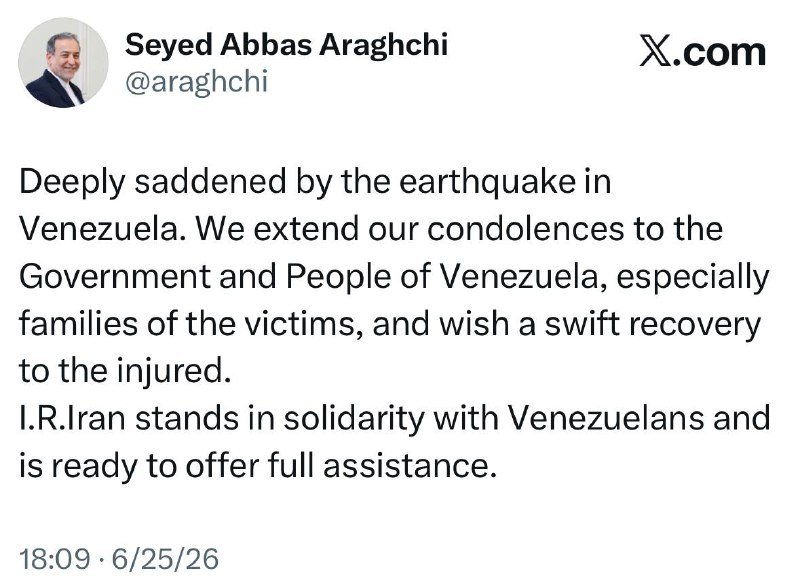
A 7.1-magnitude earthquake struck Venezuela on the evening of 24 June 2026, with Caracas among the hardest-hit areas, according to teleSUR English reporting on 25 June 2026 at 01:52 UTC. Seismologists have described the event as a rare "doublet" — two powerful earthquakes that hit within a minute of each other — compounding the destruction across the capital and outlying regions. Authorities have confirmed the first fatalities, though precise casualty counts remain preliminary.
The pattern matters as much as the physics. A seismic doublet funnels a country's emergency response into the same narrow window twice, double-booking hospitals, search teams, and evacuation routes. It is the kind of event that tests a state and the international press corps that covers it in equal measure — and in Caracas, only one of those tests has produced anything resembling sustained reporting.
What the wire has, and what it doesn't
The early signal is thin. teleSUR English, the Caracas-based multi-state outlet, has been the dominant English-language source on the disaster as of the early UTC hours of 25 June 2026, filing on fatalities (01:52 UTC), the doublet seismology (01:36 UTC), the stadium gathering in Caracas (01:30 UTC), the wider destruction (01:23 UTC), and the preliminary USGS human-toll assessment (01:10 UTC). The United States Geological Survey has produced an early assessment suggesting a potentially high human toll, per teleSUR's reporting.
What is conspicuously absent from the visible record is granular, named-on-the-ground reporting from the major Western wires — Reuters, AP, AFP, the BBC, the Guardian. None of their URLs appear in the current thread. That is not a comment on whether the reporting exists; it is a comment on what has surfaced into the public feed so far. In a disaster of this scale and proximity to a capital city, the time zone is unkind: Caracas is roughly four to five hours behind UTC, putting the quake's mainshock in the early evening local time on a Wednesday. Western newsrooms in New York and London are still arriving at their desks.
The information asymmetry this creates is structural. When teleSUR English is the primary source, the framing lands in places the Caracas government would prefer it to land: a state-affiliated multi-lateral network telling a story about Venezuelan resilience and emergency response. That is not the same as a state media organ, but neither is it the BBC. The honest read is that the early cycle belongs to whoever is awake and filing, and on Wednesday night into Thursday morning UTC, that is teleSUR.
The counter-frame, and what it would take
The plausible alternative read is straightforward: a 7.1-magnitude doublet is a major disaster in a country with constrained emergency-response capacity, and the casualty count is likely to climb sharply as dawn breaks over Caracas. The infrastructure vulnerabilities are well documented — chronic underinvestment in public works, a healthcare system hollowed by years of economic crisis, and seismic building-code enforcement that varies block by block. A doublet near a capital of roughly three million people is, on its face, exactly the event that produces body counts an order of magnitude higher than the first confirmed fatalities would suggest.
If the major Western wires confirm a high toll in the next 24 to 48 hours, the early teleSUR framing will look, in retrospect, both useful and inadequate — useful as a real-time wire when the alternatives were silent, inadequate in the way any first-pass reporting on a multi-fatality disaster is inadequate. If the toll remains modest, the early framing will be remembered mostly as a case study in information scarcity: a major event that the global press corps arrived at late.
What sits underneath the coverage gap
The deeper question is why Caracas is treated, in practice, as a peripheral bureau. Venezuela has been a difficult accreditation environment for years; several major outlets reduced their permanent presence as the political crisis deepened after 2017, and a number of correspondents now file from Bogotá or Miami. The economics of foreign correspondence have been deteriorating across the board, but the contraction has been sharper in places where visa access, security, and political friction compound each other. A 7.1-magnitude earthquake does not reset those constraints overnight. It simply forces the wire to fly someone in, or to lean on local stringers and partner feeds — the latter being what the early cycle has done.
There is also a quieter pattern: disasters in countries subject to US sanctions, or under active US policy pressure, often receive shallower early coverage than comparable events in countries with closer institutional ties to Western governments. The mechanism is not editorial bias in any conscious sense; it is structural. Fewer permanent staff, fewer local hires, more dependence on a narrow band of partner feeds, and a default toward confirmation of official casualty figures that may themselves be politically shaped. None of this is unique to Venezuela. It is the general operating environment of the global news wire in 2026.
The stakes over the next 72 hours
The next three days will set the frame. If the USGS preliminary assessment of a potentially high human toll holds, and the Western wires confirm it with named on-the-ground reporting, Venezuela will move from a teleSUR-led story to a wire-led story, and the casualty count — not the response — will become the headline. If the toll turns out to be lower than the early assessment suggested, the story will drift back toward infrastructure and seismic science, and the doublet's rarity will dominate the copy.
For Venezuelans, the stakes are not editorial. They are structural: the same building-code and healthcare-capacity deficits that shape the casualty count also shape how many of the injured survive the next 48 hours. The press cycle will move on by Monday. The hospital wards in Caracas will not.
Monexus framed this story as a coverage-gap test, not a casualty-race dispatch. The wire provenance is teleSUR English on X, with USGS preliminary assessment as the only directly attributed scientific input; the major Western wires had not yet filed into the public thread at the time of writing.
Wire provenance
This editorial synthesis draws on the following public wire/social posts:
- https://x.com/telesurenglish/status/2069956094621790208
- https://x.com/telesurenglish/status/2069956094621790208
- https://x.com/telesurenglish/status/2069956094621790208
- https://x.com/telesurenglish/status/2069956094621790208
- https://x.com/telesurenglish/status/2069956094621790208