Venezuela's Earthquake and the Test of a Distracted Hemisphere
A magnitude-7.1 earthquake has Caracas on edge and preliminary US assessments projecting a toll in the thousands. The response will be measured as much by what is absent as by what arrives.
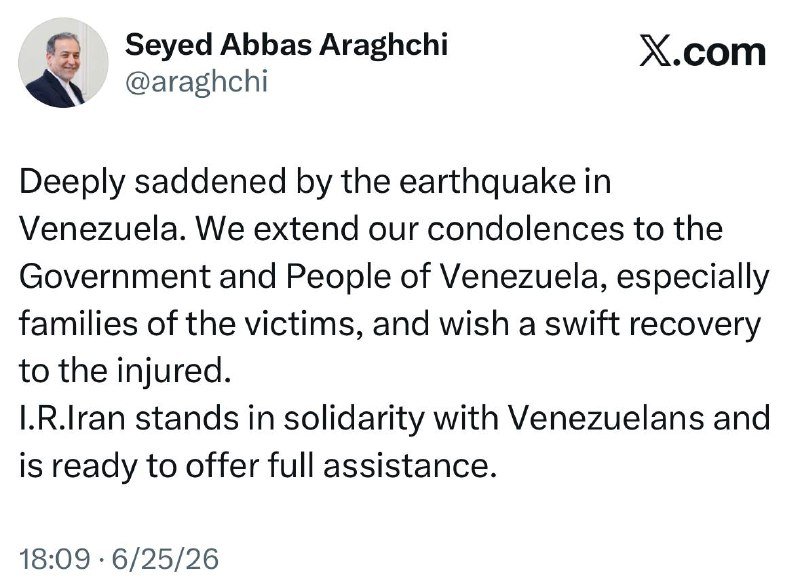
A 7.1-magnitude earthquake struck Venezuela on the evening of 24 June 2026, sending residents of Caracas pouring into streets, stadiums and public squares. By the early hours of 25 June, the United States Geological Survey had warned that the eventual death toll could exceed 10,000, even as Caracas had not yet released a nationwide casualty figure (teleSUR, 25 June 2026, 02:30 UTC). The initial picture is one of a capital jolted out of routine, an underdetermined casualty count, and a humanitarian response that will be read as a test of hemispheric attention spans.
The disaster lands on a country whose crisis of governance and sanctions-era isolation is well documented and whose infrastructure has been visibly degraded for years. A serious reading of what happens next requires holding two facts at once: the legitimate scale of human need, and the political economy in which relief will or will not arrive.
The first 24 hours
TeleSUR correspondents reported from the Altamira neighbourhood of Caracas, where emergency crews were deployed and residents gathered in open spaces immediately after the shock (teleSUR, 25 June 2026, 01:05 UTC). Video from a Caracas stadium showed crowds clustering on the field, a familiar image across the Caribbean and Latin America in the seconds after a long tremor, when the open ground is the safest place available (teleSUR, 25 June 2026, 01:30 UTC). Scenes of destruction and active rescue operations followed across the capital and other affected regions, with emergency teams still deployed as the night wore on (teleSUR, 25 June 2026, 01:23 UTC). Residents later converged on Youth Square in central Caracas as authorities continued their monitoring posture (teleSUR, 25 June 2026, 02:42 UTC).
The USGS warning that the toll could exceed 10,000 is preliminary and based on modelling, not a confirmed count. The Venezuelan government has not yet published a national figure. The gap between the two numbers is the story until the second one lands.
Solidarity and silence
Mexico publicly expressed solidarity with the Venezuelan people following the quakes, joining the small initial circle of regional governments that have put a name to the moment (teleSUR, 25 June 2026, 02:17 UTC). For a country whose relations with much of the hemisphere have been frayed by sanctions, contested elections and the long campaign to isolate Caracas, even perfunctory gestures are notable. The more revealing question is who does not call, and how quickly.
The pattern after past Latin American disasters is consistent: regional neighbours move first, followed by the European Union and the United Nations system, with the United States arriving later and more conditionally, particularly when the affected government is one Washington does not recognise. The 2010 Haiti earthquake, the 2016 Ecuador quake and the 2023 Türkiye-Syria response are the relevant reference points. In each case, the speed and openness of US logistical support depended less on the magnitude of the event than on the diplomatic posture of the recipient government.
What the framing decides
Coverage of disasters in sanctioned or pariah-state-adjacent countries tends to bifurcate along pre-existing editorial lines. State-aligned outlets in the region emphasise solidarity and reconstruction; Western wire copy tends to fold the event into the longer story of state failure, with casualty figures cited in the same breath as pre-existing political dysfunction. Both registers are selective. The honest read sits between them: a government with strained institutional capacity cannot mount a 10,000-casualty response on its own, regardless of who is in the Miraflores Palace. The politics of relief matter as much as the geology.
The structural pattern here is not new. Disasters expose which states the international system treats as legible recipients of aid and which it treats as permanent litigants. The earthquake does not change that geometry; it makes it visible.
Stakes and what to watch
Three indicators will determine how this is read in a week. First, the official Venezuelan casualty and damage assessment — its scale, and whether it is published on the government's own timeline or under external pressure. Second, the list of governments that offer material assistance rather than statements of solidarity, and the speed at which that assistance is cleared. Third, the movement, or absence, of US Treasury licences that have historically been the gating factor on humanitarian imports reaching Venezuelan ports. On past form, those licences are slow when they arrive at all.
The framing that will settle over this event is not yet written. The 10,000-toll projection, the Caracas stadium footage and the still-unreleased official count are the inputs. What gets added — the political adjective, the obligatory reference to contested institutions, the column-inch given to reconstruction versus to diagnosis — is the editorial choice. This publication will return to the verified casualty figure when Caracas publishes one. Until then, the honest position is that a country is shaking, the early numbers are grim, and the response is being measured in hours that the hemisphere cannot afford to waste on posturing.
Desk note: Monexus treats the USGS modelling figure as preliminary, the Caracas casualty count as pending, and Mexican solidarity as the only confirmed regional government response in the source set. We will update on the official count.
Wire provenance
This editorial synthesis draws on the following public wire/social posts:
- https://x.com/telesurenglish/status/2069974255974887424
- https://x.com/telesurenglish/status/2069956094621790208
- https://x.com/telesurenglish/status/2069960000000000000
- https://x.com/telesurenglish/status/2069940000000000000
- https://x.com/telesurenglish/status/2069935000000000000
- https://x.com/telesurenglish/status/2069932000000000000
- https://x.com/telesurenglish/status/2069930000000000000
- https://x.com/telesurenglish/status/2069974255974887424
- https://x.com/telesurenglish/status/2069956094621790208
- https://x.com/telesurenglish/status/2069960000000000000
- https://x.com/telesurenglish/status/2069940000000000000
- https://x.com/telesurenglish/status/2069935000000000000
- https://x.com/telesurenglish/status/2069932000000000000
- https://x.com/telesurenglish/status/2069930000000000000